 VIPSolutions
Summarize briefly about : give me answer in humanised only without using bullet pointsThe simultaneous internal diffusion and chemical reaction within a spherical catalyst pellet of radius Rinvolves a localized temperature gradient that modifies the effective diffusivity Diy. The reaction is a non-isothermal, reversible first-order decomposition where the equiibrium constant JK, is a sensitive function of the local radial temperature T(r). Establish the effectiveness factor 1 by solving the coupled differential equations for mass and energy balance: & [12 D, 7; 94] = k(T)C and 2 (120, 4Z] = (— AH)k(T) Ca. The Thiele modulus bis provided in the following data array, representing the transition from kinetic control to strong pore-cliffusion resistance. Dimensionless Radius € [ 0.0 [0.2 70.4 [0.6 [ 0.8 [0.0 [1.0 | Local Thiele ¢(r) | 0.15 | 0.52 | 0.88 | 1.54 2.10 | 2.85 | 3.50 Calculate the global reaction rate if the surface concentration C5, = 2.0mol/m® and the Prater number 8 = 0.05 at the pellet exterior.
Question:
Summarize briefly about :
give me answer in humanised only without using bullet points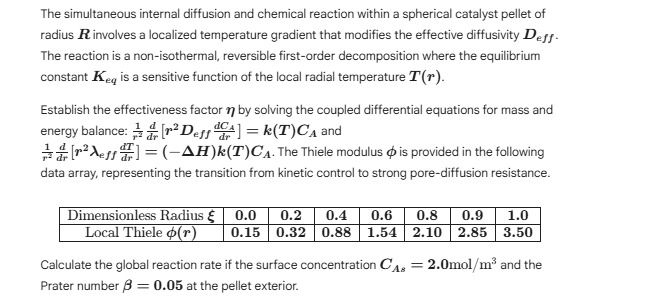 The simultaneous internal diffusion and chemical reaction within a spherical catalyst pellet of
radius Rinvolves a localized temperature gradient that modifies the effective diffusivity Diy.
The reaction is a non-isothermal, reversible first-order decomposition where the equiibrium
constant JK, is a sensitive function of the local radial temperature T(r).
Establish the effectiveness factor 1 by solving the coupled differential equations for mass and
energy balance: & [12 D, 7; 94] = k(T)C and
2 (120, 4Z] = (— AH)k(T) Ca. The Thiele modulus bis provided in the following
data array, representing the transition from kinetic control to strong pore-cliffusion resistance.
Dimensionless Radius € [ 0.0 [0.2 70.4 [0.6 [ 0.8 [0.0 [1.0 |
Local Thiele ¢(r) | 0.15 | 0.52 | 0.88 | 1.54 2.10 | 2.85 | 3.50
Calculate the global reaction rate if the surface concentration C5, = 2.0mol/m® and the
Prater number 8 = 0.05 at the pellet exterior.
Asked by: Francis
Created at: 2026-01-13 13:23:02
Final Answer:
📢 Instructions:
- Ask anything relatd to above question only.
- For new Question goto :