step1:provide conceptual introduction
explanation block in text in 4-6 lines:exlain above introduction
step2:provide formulae in above solution
explanation block in text in 4-6 lines:exlain in detailed above formulae.
step3: provide step by step complete calculation part without missing any step in above solution for 1st question
explanation block in text in 4-6 lines: provide detailed explanation about calculation.
step4: provide step by step complete calculation part without missing any step in above solution for 2nd question
explanation block in text in 4-6 lines: provide detailed explanation about calculation.
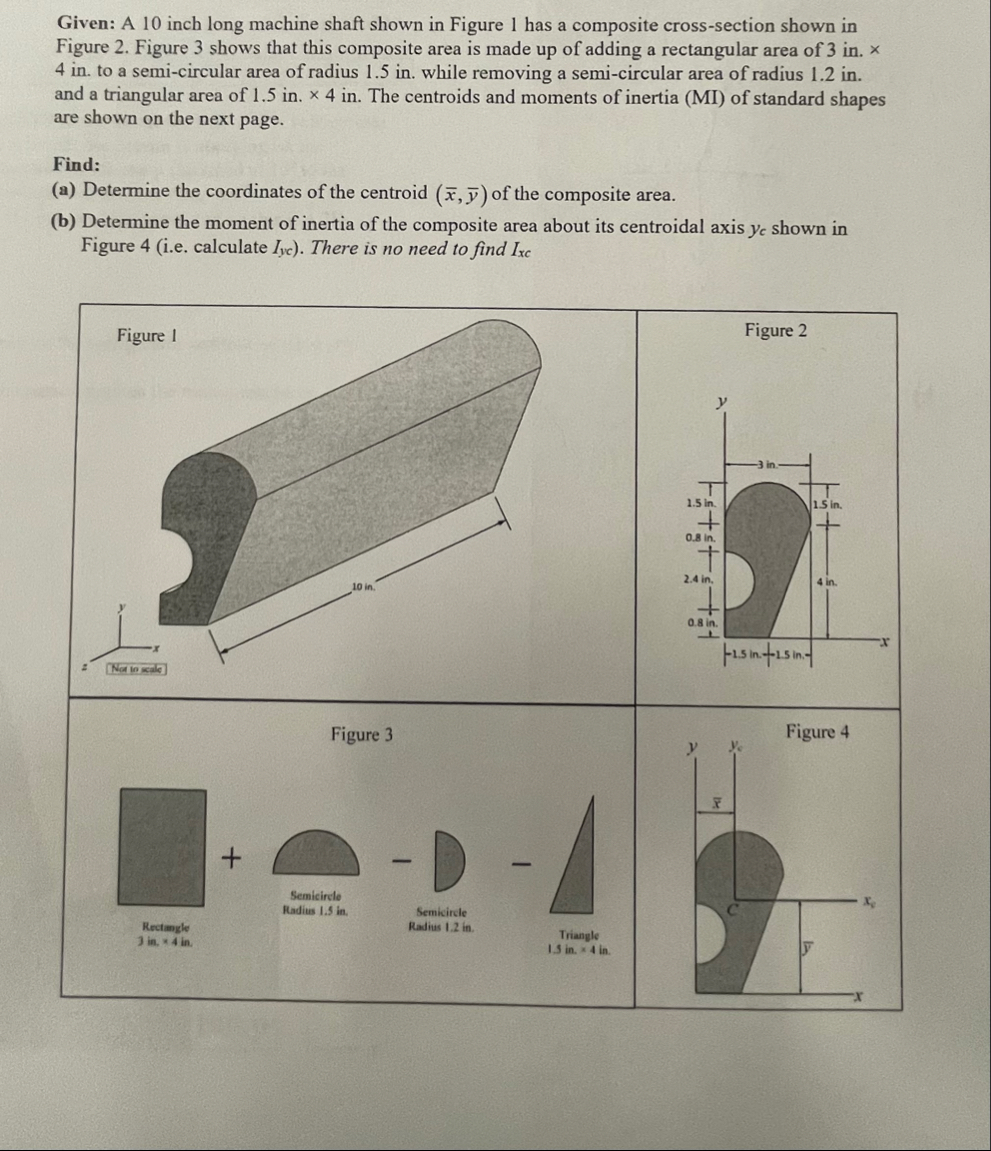
final answer: provide simple final answerGiven: A 10 inch long machine shaft shown in Figure 1 has a composite cross-section shown in
Figure 2. Figure 3 shows that this composite area is made up of adding a rectangular area of 3 in. x
4 in. to a semi-circular area of radius 1.5 in. while removing a semi-circular area of radius 1.2 in.
and a triangular area of 1.5 in. x 4 in. The centroids and moments of inertia (MI) of standard shapes
are shown on the next page.
Find:
(a) Determine the coordinates of the centroid (X,¥) of the composite area.
(b) Determine the moment of inertia of the composite area about its centroidal axis Ye shown in
Figure 4 (i.e. calculate Ji). There is no need to find Ix
Figure | it 2 Figure 2
FN Rete
Rema
ERS TAT >
Te EE
AA
Ea 7%
me A n-
Ne Po St
Peapod FETS 15m Se.
2 5h
di [CIE oe
a sl hens Sa
; FE Eo aa
: Fi fowss
Cle Le a Ea
AR a eo ’
SE] oy EEE sym
fe ape : So —_
SS 2 0
Cn ES eam
Sa a Heaton
CE plo va
Ea at EEA =
I Rien
Question:
step1:provide conceptual introduction
explanation block in text in 4-6 lines:exlain above introduction
step2:provide formulae in above solution
explanation block in text in 4-6 lines:exlain in detailed above formulae.
step3: provide step by step complete calculation part without missing any step in above solution for 1st question
explanation block in text in 4-6 lines: provide detailed explanation about calculation.
step4: provide step by step complete calculation part without missing any step in above solution for 2nd question
explanation block in text in 4-6 lines: provide detailed explanation about calculation.
final answer: provide simple final answerGiven: A 10 inch long machine shaft shown in Figure 1 has a composite cross-section shown in
Figure 2. Figure 3 shows that this composite area is made up of adding a rectangular area of 3 in. x
4 in. to a semi-circular area of radius 1.5 in. while removing a semi-circular area of radius 1.2 in.
and a triangular area of 1.5 in. x 4 in. The centroids and moments of inertia (MI) of standard shapes
are shown on the next page.
Find:
(a) Determine the coordinates of the centroid (X,¥) of the composite area.
(b) Determine the moment of inertia of the composite area about its centroidal axis Ye shown in
Figure 4 (i.e. calculate Ji). There is no need to find Ix
Figure | it 2 Figure 2
FN Rete
Rema
ERS TAT >
Te EE
AA
Ea 7%
me A n-
Ne Po St
Peapod FETS 15m Se.
2 5h
di [CIE oe
a sl hens Sa
; FE Eo aa
: Fi fowss
Cle Le a Ea
AR a eo ’
SE] oy EEE sym
fe ape : So —_
SS 2 0
Cn ES eam
Sa a Heaton
CE plo va
Ea at EEA =
I Rien
This is AI generated Response.
Asked by: Kumar
Created at: 2025-07-31 22:37:48
Final Answer:
RenderedRaw Text
Did you like this answer?
Let’s solve the problem step by step as per your structure:
---
## **Step 1: Conceptual Introduction**
In engineering, determining the centroid and moment of inertia of composite areas is essential for analyzing the strength and stability of machine components. Composite areas are formed by combining basic geometric shapes, and their properties can be found by summing the contributions of each shape, considering both addition and subtraction (for removed areas). The centroid is the "center of mass" of the area, while the moment of inertia measures the area's resistance to bending or rotation about an axis.
**Explanation Block:**
The centroid helps locate the center point through which the entire area can be balanced, while the moment of inertia is crucial for understanding how the shape will resist bending. These properties are calculated by breaking down the composite area into simpler shapes, finding their individual centroids and moments of inertia, and then combining them algebraically, taking into account positive (added) and negative (subtracted) areas.
---
## **Step 2: Formulae Used**
### **Centroid of Composite Area:**
\[
\bar{x} = \frac{\sum A_i x_i}{\sum A_i}
\]
\[
\bar{y} = \frac{\sum A_i y_i}{\sum A_i}
\]
where \( A_i \) is the area of each shape, and \( (x_i, y_i) \) is the centroid of each shape.
### **Moment of Inertia (about centroidal axis \( y_c \)):**
\[
I_{yc} = \sum (I_{yi} + A_i d_i^2)
\]
where \( I_{yi} \) is the moment of inertia of each shape about its own centroidal axis parallel to \( y_c \), and \( d_i \) is the distance from the shape's centroid to the composite centroid \( y_c \) (parallel axis theorem).
**Explanation Block:**
The centroid is found as the weighted average of the centroids of the constituent shapes, using their areas as weights. The moment of inertia is found by adding each shape's own moment of inertia (about its centroid) plus a correction for its offset from the composite centroid, as per the parallel axis theorem.
---
## **Step 3: Step-by-Step Calculation — Centroid Coordinates**
### **Areas and Centroids:**
Let’s label:
- **Area 1 (Rectangle)**: \(3 \text{ in.} \times 4 \text{ in.}\)
- **Area 2 (Semicircle, add)**: \(r = 1.5 \text{ in.}\)
- **Area 3 (Semicircle, subtract)**: \(r = 1.2 \text{ in.}\)
- **Area 4 (Triangle, subtract)**: \(1.5 \text{ in.} \times 4 \text{ in.}\)
#### **1. Area Calculations**
- \(A_1 = 3 \times 4 = 12\) in²
- \(A_2 = \frac{1}{2} \pi (1.5)^2 = \frac{1}{2} \pi (2.25) \approx 3.534\) in²
- \(A_3 = -\frac{1}{2} \pi (1.2)^2 = -\frac{1}{2} \pi (1.44) \approx -2.262\) in²
- \(A_4 = -\frac{1}{2} \times 1.5 \times 4 = -3\) in²
#### **2. Centroid Locations (from bottom-left corner as origin)**
- Rectangle: \(x_1 = 1.5\), \(y_1 = 2\)
- Semicircle (1.5 in): \(x_2 = 1.5\), \(y_2 = 1.5 + \frac{4r}{3\pi} = 1.5 + \frac{6}{3\pi} \approx 1.5 + 0.637 = 2.137\)
- Semicircle (1.2 in, subtracted): \(x_3 = 0.8\), \(y_3 = 1.2 + \frac{4r}{3\pi} = 1.2 + \frac{4 \times 1.2}{3\pi} = 1.2 + 0.509 = 1.709\)
- Triangle (subtracted): \(x_4 = 1.5/3 = 0.5\), \(y_4 = 4 - h/3 = 4 - 1.5/3 = 4 - 0.5 = 3.5\)
#### **3. Weighted Sums**
\[
\sum A_i x_i = (12)(1.5) + (3.534)(1.5) + (-2.262)(0.8) + (-3)(0.5)
\]
\[
= 18 + 5.301 - 1.81 - 1.5 = 20.0
\]
\[
\sum A_i y_i = (12)(2) + (3.534)(2.137) + (-2.262)(1.709) + (-3)(3.5)
\]
\[
= 24 + 7.553 - 3.87 - 10.5 = 17.18
\]
\[
\sum A_i = 12 + 3.534 - 2.262 - 3 = 10.272
\]
\[
\bar{x} = \frac{20.0}{10.272} \approx 1.947 \text{ in.}
\]
\[
\bar{y} = \frac{17.18}{10.272} \approx 1.673 \text{ in.}
\]
**Explanation Block:**
Each shape’s area and centroid is calculated, and then the contributions of each are summed, with subtracted areas included as negative. The overall centroid is found by dividing the sum of area-centroid products by the total area, giving the “center of mass” of the composite.
---
## **Step 4: Step-by-Step Calculation — Moment of Inertia About \( y_c \)**
### **1. Moments of Inertia about Own Centroid (standard formulas):**
- Rectangle: \(I_{y1} = \frac{1}{12} b h^3 = \frac{1}{12} \times 3 \times 4^3 = \frac{1}{12} \times 3 \times 64 = 16\) in⁴
- Semicircle (1.5 in): \(I_{y2} = 0.1098 r^4 = 0.1098 \times (1.5)^4 \approx 0.555\) in⁴
- Semicircle (1.2 in, subtracted): \(I_{y3} = -0.1098 r^4 = -0.1098 \times (1.2)^4 \approx -0.228\) in⁴
- Triangle: \(I_{y4} = -\frac{1}{36} b h^3 = -\frac{1}{36} \times 1.5 \times 4^3 = -\frac{1}{36} \times 1.5 \times 64 = -2.667\) in⁴
### **2. Parallel Axis Theorem (add \(A_i d_i^2\)):**
\[
d_i = y_i - \bar{y}
\]
- Rectangle: \(d_1 = 2 - 1.673 = 0.327\)
- Semicircle (1.5 in): \(d_2 = 2.137 - 1.673 = 0.464\)
- Semicircle (1.2 in): \(d_3 = 1.709 - 1.673 = 0.036\)
- Triangle: \(d_4 = 3.5 - 1.673 = 1.827\)
\[
I_{yc} = I_{y1} + A_1 d_1^2 + I_{y2} + A_2 d_2^2 + I_{y3} + A_3 d_3^2 + I_{y4} + A_4 d_4^2
\]
\[
= 16 + 12(0.327^2) + 0.555 + 3.534(0.464^2) -0.228 + (-2.262)(0.036^2) -2.667 + (-3)(1.827^2)
\]
\[
= 16 + 1.283 + 0.555 + 0.761 - 0.228 - 0.003 - 2.667 - 10.012
\]
\[
= (16 + 1.283 + 0.555 + 0.761) - (0.228 + 0.003 + 2.667 + 10.012)
\]
\[
= 18.599 - 12.91 = 5.689 \text{ in}^4
\]
**Explanation Block:**
Each shape’s moment of inertia about its own centroid is shifted to the composite centroid using the parallel axis theorem, and then all contributions are summed (again, subtracted areas are negative). This gives the total moment of inertia about the centroidal axis \(y_c\).
---
## **Final Answer**
**Centroid coordinates:**
\[
(\bar{x}, \bar{y}) \approx (1.95 \text{ in.}, 1.67 \text{ in.})
\]
**Moment of Inertia about \( y_c \):**
\[
I_{yc} \approx 5.69 \text{ in}^4
\]
VIPSolutions focuses on clear, step‑by‑step explanations so you can learn quickly. Whether you need an AI‑generated walkthrough or a short hint to get unstuck, each solution is organized for fast reading and easy review later.
Search similar questions, compare approaches, and bookmark the best answers for revision. Our goal is simple: quick, reliable study help that feels natural—not noisy.
 VIPSolutions
 Given: A 10 inch long machine shaft shown in Figure 1 has a composite cross-section shown in
Figure 2. Figure 3 shows that this composite area is made up of adding a rectangular area of 3 in. x
4 in. to a semi-circular area of radius 1.5 in. while removing a semi-circular area of radius 1.2 in.
and a triangular area of 1.5 in. x 4 in. The centroids and moments of inertia (MI) of standard shapes
are shown on the next page.
Find:
(a) Determine the coordinates of the centroid (X,¥) of the composite area.
(b) Determine the moment of inertia of the composite area about its centroidal axis Ye shown in
Figure 4 (i.e. calculate Ji). There is no need to find Ix
Figure | it 2 Figure 2
FN Rete
Rema
ERS TAT >
Te EE
AA
Ea 7%
me A n-
Ne Po St
Peapod FETS 15m Se.
2 5h
di [CIE oe
a sl hens Sa
; FE Eo aa
: Fi fowss
Cle Le a Ea
AR a eo ’
SE] oy EEE sym
fe ape : So —_
SS 2 0
Cn ES eam
Sa a Heaton
CE plo va
Ea at EEA =
I Rien