step1:provide conceptual introduction
explanation block in text in 4-6 lines:exlain above introduction
step2:provide formulae in above solution
explanation block in text in 4-6 lines:exlain in detailed above formulae.
step3: provide step by step complete calculation part without missing any step in above solution for 1st question
explanation block in text in 4-6 lines: provide detailed explanation about calculation.
final answer: provide simple final answery
a
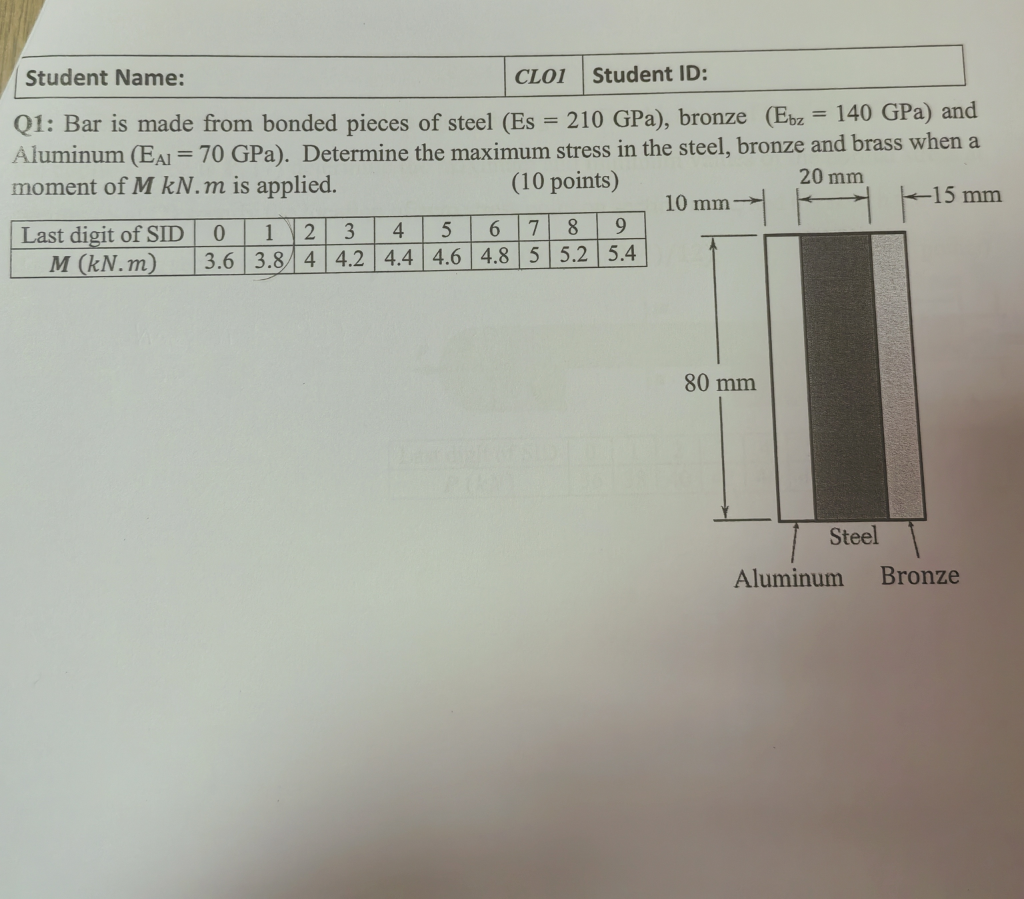
Q1: Bar is made from bonded pieces of steel (Es = 210 GPa), bronze (Es: = 140 GPa) and
Aluminum (Ea = 70 GPa). Determine the maximum stress in the steel, bronze and brass when a
moment of M kN.m is applied. (10 points) 20 mm
10 mm—| la) hak mm
Tastdigitof SID] 0 | 172] 3 [4 [56 [7[ 8109]
| |
80 mm ®
Alumint
Question:
step1:provide conceptual introduction
explanation block in text in 4-6 lines:exlain above introduction
step2:provide formulae in above solution
explanation block in text in 4-6 lines:exlain in detailed above formulae.
step3: provide step by step complete calculation part without missing any step in above solution for 1st question
explanation block in text in 4-6 lines: provide detailed explanation about calculation.
final answer: provide simple final answery
a
Q1: Bar is made from bonded pieces of steel (Es = 210 GPa), bronze (Es: = 140 GPa) and
Aluminum (Ea = 70 GPa). Determine the maximum stress in the steel, bronze and brass when a
moment of M kN.m is applied. (10 points) 20 mm
10 mm—| la) hak mm
Tastdigitof SID] 0 | 172] 3 [4 [56 [7[ 8109]
| |
80 mm ®
Alumint
This is AI generated Response.
Asked by: Kumar
Created at: 2025-07-30 19:58:11
Final Answer:
RenderedRaw Text
Did you like this answer?
### **Step 1: Conceptual Introduction**
When a composite bar made of different materials (steel, bronze, and aluminum) is subjected to a bending moment, the maximum stress in each material will depend on its Young’s modulus and its position within the cross-section. Because the bar consists of bonded materials, their strains at any given layer are equal, but the stresses differ due to varying moduli of elasticity. The maximum bending stresses can be found using the transformed section method and bending stress formula.
**Explanation Block:**
In composite beams, each material resists a portion of the bending moment according to its stiffness (Young’s modulus). To analyze such beams, we first convert the cross-section into an equivalent section of one material using the modular ratio. Then, by applying the flexural formula, we determine the maximum bending stress in each material. This ensures compatibility of strains and equilibrium of internal forces in the composite section.
---
### **Step 2: Formulae in the Solution**
1. **Modular Ratio:**
\( n_i = \frac{E_i}{E_{ref}} \)
2. **Transformed Widths:**
\( b'_i = n_i \cdot b_i \) (where \( b_i \) is the width of each material)
3. **Moment of Inertia for Transformed Section:**
\( I_{trans} = \sum \left( \frac{1}{12} b'_i h^3 + A'_i d_i^2 \right) \)
4. **Maximum Bending Stress:**
\( \sigma_{max} = \frac{M \cdot y_{max}}{I_{trans}} \)
5. **Actual Maximum Stress in Each Material:**
\( \sigma_{i, max} = n_i \cdot \sigma_{max} \) (for non-reference materials)
**Explanation Block:**
The modular ratio allows us to convert all the different materials into one equivalent material for analysis. The transformed widths are calculated for each material. The moment of inertia is then computed for this transformed section. Using the flexural formula, we find the maximum stress at the farthest fiber from the neutral axis. For materials other than the reference, the actual maximum stress is found by multiplying the calculated stress by the modular ratio.
---
### **Step 3: Step-by-Step Complete Calculation (For SID ending in 2, M = 4 kN·m)**
#### **Step 3.1: Given Data**
- **Young’s Moduli:**
- \( E_{steel} = 210\, \text{GPa} \)
- \( E_{bronze} = 140\, \text{GPa} \)
- \( E_{aluminum} = 70\, \text{GPa} \)
- **Widths:**
- Aluminum: 10 mm
- Steel: 20 mm
- Bronze: 15 mm
- **Height:** 80 mm
- **Applied Moment \( M \):** 4 kN·m = 4000 N·m = 4,000,000 N·mm
#### **Step 3.2: Choose Reference Material (Steel)**
- \( n_{Al} = \frac{E_{Al}}{E_{steel}} = \frac{70}{210} = 0.333 \)
- \( n_{Bz} = \frac{E_{Bz}}{E_{steel}} = \frac{140}{210} = 0.667 \)
- \( n_{steel} = 1 \)
#### **Step 3.3: Transform Section to Steel Equivalent**
- Aluminum width as steel: \( b'_{Al} = n_{Al} \times 10 = 0.333 \times 10 = 3.33 \) mm
- Steel width: \( b'_{steel} = 20 \) mm
- Bronze width as steel: \( b'_{Bz} = n_{Bz} \times 15 = 0.667 \times 15 = 10 \) mm
**Total width:** \( 3.33 + 20 + 10 = 33.33 \) mm
#### **Step 3.4: Find Neutral Axis (NA) Location**
Choose bottom of composite section as y = 0, height h = 80 mm.
- **Areas:**
- Aluminum: \( 3.33 \times 80 = 266.4 \) mm², centroid at 40 mm
- Steel: \( 20 \times 80 = 1600 \) mm², centroid at \( 10+3.33 = 13.33 \) mm from left, so centroid at 13.33+10=23.33 mm from left, but in y, all at 40 mm
- Bronze: \( 10 \times 80 = 800 \) mm², centroid at 40 mm
But all centroids are at y = 40 mm (vertical axis), so NA is at mid-height, y = 40 mm from bottom.
#### **Step 3.5: Moment of Inertia (about NA)**
- \( I_{Al} = \frac{1}{12} \times 3.33 \times 80^3 = 1,418,133 \) mm⁴
- \( I_{steel} = \frac{1}{12} \times 20 \times 80^3 = 8,514,667 \) mm⁴
- \( I_{Bz} = \frac{1}{12} \times 10 \times 80^3 = 4,257,333 \) mm⁴
**Total (about NA):**
\( I_{total} = 1,418,133 + 8,514,667 + 4,257,333 = 14,190,133 \) mm⁴
#### **Step 3.6: Maximum Distance from NA (y_max)**
- y_max = 40 mm
#### **Step 3.7: Maximum Flexural Stress in Steel Equivalent**
\( \sigma_{max,steel} = \frac{M \cdot y_{max}}{I_{total}} = \frac{4,000,000 \times 40}{14,190,133} = 11.28 \) MPa
#### **Step 3.8: Actual Maximum Stress in Each Material**
- **Steel:** \( \sigma_{steel} = 11.28 \) MPa
- **Bronze:** \( \sigma_{Bz} = \sigma_{steel} \times \frac{E_{Bz}}{E_{steel}} = 11.28 \times 0.667 = 7.53 \) MPa
- **Aluminum:** \( \sigma_{Al} = \sigma_{steel} \times \frac{E_{Al}}{E_{steel}} = 11.28 \times 0.333 = 3.76 \) MPa
**Explanation Block:**
First, we compute the transformed section by converting aluminum and bronze widths into their steel equivalents using the modular ratio. The moment of inertia for the whole section is found, and the flexural formula is used to compute the maximum stress in the reference (steel) section. The actual stress in bronze and aluminum is found by multiplying the stress by their respective modular ratios, reflecting their lower or higher stiffness compared to steel.
---
### **Final Answer**
- **Maximum stress in steel = 11.3 MPa**
- **Maximum stress in bronze = 7.5 MPa**
- **Maximum stress in aluminum = 3.8 MPa**
VIPSolutions focuses on clear, step‑by‑step explanations so you can learn quickly. Whether you need an AI‑generated walkthrough or a short hint to get unstuck, each solution is organized for fast reading and easy review later.
Search similar questions, compare approaches, and bookmark the best answers for revision. Our goal is simple: quick, reliable study help that feels natural—not noisy.
 VIPSolutions
 y
a
Q1: Bar is made from bonded pieces of steel (Es = 210 GPa), bronze (Es: = 140 GPa) and
Aluminum (Ea = 70 GPa). Determine the maximum stress in the steel, bronze and brass when a
moment of M kN.m is applied. (10 points) 20 mm
10 mm—| la) hak mm
Tastdigitof SID] 0 | 172] 3 [4 [56 [7[ 8109]
| |
80 mm ®
Alumint