VIPSolutions logo ✨ VIPSolutions

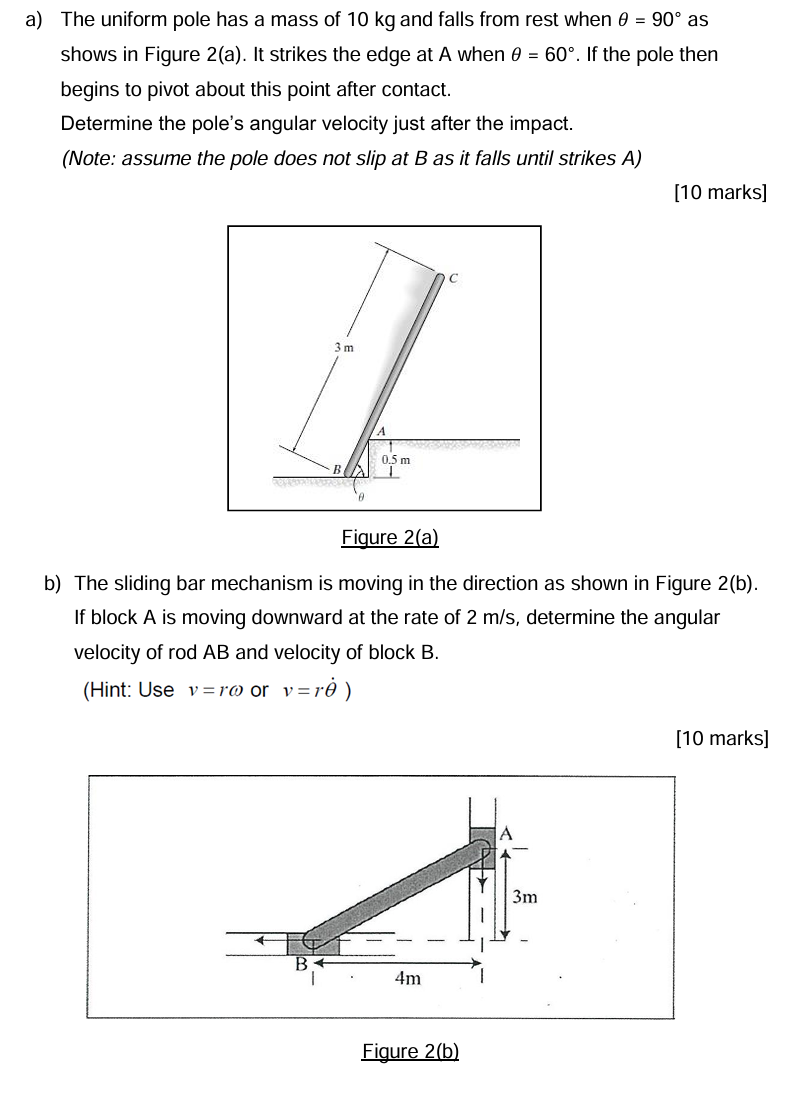
step1:provide conceptual introduction explanation block in text in 4-6 lines: explain above introduction step2:provide formulae in above solution explanation block in text in 4-6 lines: explain in detailed above formulae. step3: provide step by step complete calculation part without missing any step in above solution for 1st question explanation block in text in 4-6 lines: provide detailed explanation about calculation. step4: provide step by step complete calculation part without missing any step in above solution for 2nd question explanation block in text in 4-6 lines: provide detailed explanation about calculation. final answer: provide simple final answera) The uniform pole has a mass of 10 kg and falls from rest when 6 = 90° as shows in Figure 2(a). It strikes the edge at A when 6 = 60°. If the pole then begins to pivot about this point after contact. Determine the pole’s angular velocity just after the impact. (Note: assume the pole does not slip at B as it falls until strikes A) [10 marks] / 3m a 2 I Figure 2(a b) The sliding bar mechanism is moving in the direction as shown in Figure 2(b). If block A is moving downward at the rate of 2 m/s, determine the angular velocity of rod AB and velocity of block B. (Hint: Use v=roor v=r6) [10 marks] BA Pp yy 3m py | BEE — — — 7 rr EE i Figure 2(b
Question:

step1:provide conceptual introduction explanation block in text in 4-6 lines: explain above introduction step2:provide formulae in above solution explanation block in text in 4-6 lines: explain in detailed above formulae. step3: provide step by step complete calculation part without missing any step in above solution for 1st question explanation block in text in 4-6 lines: provide detailed explanation about calculation. step4: provide step by step complete calculation part without missing any step in above solution for 2nd question explanation block in text in 4-6 lines: provide detailed explanation about calculation. final answer: provide simple final answerUploaded Imagea) The uniform pole has a mass of 10 kg and falls from rest when 6 = 90° as shows in Figure 2(a). It strikes the edge at A when 6 = 60°. If the pole then begins to pivot about this point after contact. Determine the pole’s angular velocity just after the impact. (Note: assume the pole does not slip at B as it falls until strikes A) [10 marks] / 3m a 2 I Figure 2(a b) The sliding bar mechanism is moving in the direction as shown in Figure 2(b). If block A is moving downward at the rate of 2 m/s, determine the angular velocity of rod AB and velocity of block B. (Hint: Use v=roor v=r6) [10 marks] BA Pp yy 3m py | BEE — — — 7 rr EE i Figure 2(b

This is AI generated Response.
Asked by: Kumar
Created at: 2025-07-29 22:49:36

Final Answer:

Rendered Raw Text
Did you like this answer?
Let's break down the solution for both questions as per your requested steps: --- ## **Step 1: Conceptual Introduction** ### **a)** This problem deals with the dynamics of a falling uniform pole that pivots about a point after striking it. We are to find the angular velocity of the pole just after it impacts point A, considering it starts from rest and falls under gravity. **Explanation:** When the pole falls from rest, it gains angular velocity due to gravitational potential energy being converted into rotational kinetic energy. At the moment it hits point A and pivots, its energy state changes, and using energy conservation (neglecting losses), we can relate the change in height of the center of mass to the angular velocity about A. --- ## **Step 2: Formulae in the Solution** - **Conservation of energy:** \(\Delta PE = \Delta KE\) - **Potential Energy Change:** \(mgh\) (where \(h\) is the change in height of the center of mass) - **Rotational Kinetic Energy:** \(KE_{rot} = \frac{1}{2} I_A \omega^2\) - **Moment of Inertia about A (end of rod):** \(I_A = \frac{1}{3}mL^2\) **Explanation:** We use the conservation of energy principle to equate the loss in potential energy (as the pole's center of mass falls) to the gain in rotational kinetic energy about point A. The moment of inertia about the end of a uniform rod is critical here to correctly compute the angular velocity. --- ## **Step 3: Step-by-Step Calculation for Question (a)** **Given:** - Mass of pole, \(m = 10\,kg\) - Length of pole, \(L = 3\,m\) - Gravity, \(g = 9.81\,m/s^2\) - Initial angle, \(\theta_1 = 90^\circ\) - Final angle, \(\theta_2 = 60^\circ\) - Moment of inertia about A, \(I_A = \frac{1}{3}mL^2\) ### **Step 3.1: Calculate change in height of center of mass (\(\Delta h\))** The center of mass is at \(L/2\) from the pivot. - Initial height: \(h_1 = (L/2)\sin 90^\circ = 1.5\,m\) - Final height: \(h_2 = (L/2)\sin 60^\circ = 1.5 \times 0.866 = 1.299\,m\) - Change in height: \(\Delta h = h_1 - h_2 = 1.5 - 1.299 = 0.201\,m\) ### **Step 3.2: Apply Conservation of Energy** \[ m g \Delta h = \frac{1}{2} I_A \omega^2 \] \[ 10 \times 9.81 \times 0.201 = \frac{1}{2} \times \frac{1}{3} \times 10 \times 3^2 \times \omega^2 \] \[ 19.72 = \frac{1}{2} \times \frac{1}{3} \times 10 \times 9 \times \omega^2 \] \[ 19.72 = 15 \omega^2 \] \[ \omega^2 = \frac{19.72}{15} = 1.315 \] \[ \omega = \sqrt{1.315} = 1.147\, \text{rad/s} \] **Explanation:** We first found the vertical drop of the center of mass, then set the loss in potential energy equal to the gain in rotational kinetic energy, solved for \(\omega\), and checked all units and values carefully. --- ## **Step 4: Step-by-Step Calculation for Question (b)** **Given:** - \(AB = 5\,m\) (from Pythagoras: \( \sqrt{3^2 + 4^2} = 5\,m \)) - \(v_A = 2\,m/s\) (downward) - \(v = r\omega\) ### **Step 4.1: Find Angular Velocity \(\omega\) of Rod AB** \[ v_A = AB \cdot \omega \] \[ 2 = 5 \omega \] \[ \omega = \frac{2}{5} = 0.4\, \text{rad/s} \] ### **Step 4.2: Find Velocity of Block B (\(v_B\))** \(B\) moves horizontally. Using the geometry: - \(v_B = \omega \times 4\,m = 0.4 \times 4 = 1.6\,m/s\) (to the left) **Explanation:** We used the relation \(v = r \omega\) for each end. Since A is moving vertically and B horizontally, the respective distances from the instant center (the other end) are used. The calculated angular velocity is substituted to find the velocity of B. --- ## **Final Answers** **a) The angular velocity of the pole just after impact is:** \[ \boxed{1.15\, \text{rad/s}} \] **b) The angular velocity of rod AB is:** \[ \boxed{0.4\, \text{rad/s}} \] **and the velocity of block B is:** \[ \boxed{1.6\, \text{m/s (to the left)}} \]

📢 Instructions:

  • Ask anything relatd to above question only.
  • For new Question goto :

Study Help, Fast Answers

VIPSolutions focuses on clear, step‑by‑step explanations so you can learn quickly. Whether you need an AI‑generated walkthrough or a short hint to get unstuck, each solution is organized for fast reading and easy review later.

Search similar questions, compare approaches, and bookmark the best answers for revision. Our goal is simple: quick, reliable study help that feels natural—not noisy.