This is AI generated Response.
Asked by: Kumar
Created at: 2025-07-26 06:32:29
Final Answer:
RenderedRaw Text
Did you like this answer?
Let's break down and solve each part of the question regarding the rectangular enclosure.
---
### **Given:**
- **Bottom surface (1)**
- **Top surface (2)**
- **Left vertical surface (3) — shaded**
- **Front vertical surface (4) — shaded**
- Dimensions: \( 200\, \text{mm} \times 200\, \text{mm} \times 100\, \text{mm} \)
---
## **(a) Find \( F_{12} \) using the view-factor chart**
### **Step 1: Identify Geometry**
- Surface 1: Bottom (\(200 \times 200\) mm)
- Surface 2: Top (\(200 \times 200\) mm)
- Surfaces 1 and 2 are parallel and congruent rectangles, separated by 100 mm.
### **Step 2: Use the View-Factor Chart**
- This is the classic case of two parallel, equal rectangles (see **View Factor Chart for Parallel Rectangles** in heat transfer textbooks, e.g., Incropera & DeWitt, "Fundamentals of Heat and Mass Transfer", Table 13.3 or 13.4).
#### **Parameters:**
- Length (\(L\)) = 200 mm
- Width (\(W\)) = 200 mm
- Separation (\(H\)) = 100 mm
#### **Dimensionless Ratios:**
- \( \frac{L}{H} = \frac{200}{100} = 2 \)
- \( \frac{W}{H} = \frac{200}{100} = 2 \)
#### **Chart/Equation:**
Find the chart for view factor between two parallel rectangles of equal sizes separated by a distance \(H\):
\[
F_{12} = \frac{1}{\pi AB} \left[ ... \right] \text{ (complicated expression, but chart is standard)}
\]
For \(A = B = 2\), from the chart, \(F_{12} \approx 0.2\).
**_Specify Chart:_** (E.g., Incropera & DeWitt, Table 13.4, Row for \(A=B=2\))
---
## **(b) Find \( F_{31} \) and \( F_{41} \) using view factor relationships (no chart)**
### **View Factor Reciprocity & Summation Rules**
#### **Rule 1: Reciprocity**
\[
A_1 F_{12} = A_2 F_{21}
\]
#### **Rule 2: Summation**
\[
\sum_{j=1}^N F_{ij} = 1
\]
#### **Step 1: Areas**
- Area of surface 1 (\(A_1\)) = \(200 \times 200 = 40,000\, \text{mm}^2\)
- Area of surface 3 (\(A_3\)) = \(200 \times 100 = 20,000\, \text{mm}^2\)
- Area of surface 4 (\(A_4\)) = \(200 \times 100 = 20,000\, \text{mm}^2\)
#### **Step 2: From Geometry**
- Surface 3 "sees" surface 1 directly; similarly for 4 and 1.
#### **Step 3: Use Reciprocity**
\[
A_1 F_{13} = A_3 F_{31}
\]
But \(F_{13}\) is the fraction of radiation leaving 1 and reaching 3.
Since the box is symmetrical and surface 1 can see surfaces 2, 3, and 4:
\[
F_{11} = 0 \text{ (surface can't see itself)}
\]
\[
F_{12} + F_{13} + F_{14} = 1
\]
Assume surfaces 3 and 4 are identical:
\[
F_{13} = F_{14}
\]
So,
\[
F_{12} + 2F_{13} = 1
\]
Given \(F_{12} \approx 0.2\) (from part a):
\[
0.2 + 2F_{13} = 1 \implies F_{13} = 0.4
\]
Now apply reciprocity for \(F_{31}\):
\[
A_1 F_{13} = A_3 F_{31}
\]
\[
40,000 \times 0.4 = 20,000 \times F_{31}
\]
\[
F_{31} = \frac{16,000}{20,000} = 0.8
\]
Similarly, \(F_{41} = 0.8\) (by symmetry).
---
## **(c) Radiation Intercepted by Surface 3**
If bottom surface (1) emits 1 kW radiation:
Fraction intercepted by surface 3 = \(F_{13} = 0.4\)
\[
\text{Radiation intercepted by surface 3} = 1\, \text{kW} \times 0.4 = 0.4\, \text{kW} = 400\, \text{W}
\]
---
## **Summary Table**
| Part | View Factor/Value | How Found / Explanation |
|------|------------------------------|------------------------------------------------------------|
| (a) | \(F_{12} \approx 0.2\) | View factor chart (parallel rectangles, A=B=2) |
| (b) | \(F_{31} = F_{41} = 0.8\) | Reciprocity and symmetry, area ratios |
| (c) | \(400\, \text{W}\) | \(F_{13} \times \text{emitted power} = 0.4 \times 1\, \text{kW}\) |
---
**If you need the explicit chart or formula for (a), let me know!**
Question:
step1:provide conceptual introduction
explanation block :exlain above introduction
step2:provide formulae in above solution
explanation block :exlain in detailed above formulae.
step3: provide step by step complete calculation part without missing any step in above solution for 1st question
explanation block: provide detailed explanation about calculation.
step4: provide step by step complete calculation part without missing any step in above solution for 2nd question
explanation block: provide detailed explanation about calculation.
step4: provide step by step complete calculation part without missing any step in above solution for 3rd question
explanation block: provide detailed explanation about calculation.
final answer: provide simple final answer
This is AI generated Response.
Asked by: Kumar
Created at: 2025-07-26 06:37:48
Final Answer:
RenderedRaw Text
Did you like this answer?
Certainly! Here's a detailed, step-by-step explanation following your requested structure for each part of the problem.
---
### **Step 1: Conceptual Introduction**
**Introduction:**
In radiation heat transfer, **view factors** (also called configuration factors) quantify the fraction of radiation leaving one surface that directly reaches another. They depend solely on the geometry and relative positioning of surfaces. Using view factors allows us to analyze complex radiation exchanges within enclosures, such as the rectangular box in this problem.
For this problem, we analyze the heat exchange between various surfaces of a rectangular hollow enclosure, considering their dimensions and relative orientations. The goal is to find specific view factors between surfaces and determine how much radiation emitted from one surface reaches another.
---
### **Step 2: Relevant Formulae**
- **View factor reciprocity:**
\[
A_i F_{ij} = A_j F_{ji}
\]
where:
- \(A_i\), \(A_j\): areas of surfaces \(i\) and \(j\),
- \(F_{ij}\): fraction of radiation leaving \(i\) that strikes \(j\).
- **Summation rule for a surface:**
\[
\sum_{j=1}^{N} F_{ij} = 1
\]
(surfaces see all possible other surfaces and the sky).
- **Approximate view factor between parallel rectangles (for equal-sized rectangles):**
From standard charts (e.g., Incropera & DeWitt), for two parallel, equal rectangles separated by distance \(H\):
\[
F_{12} \approx 0.2 \quad \text{(for } L=W=200\, \text{mm}, H=100\, \text{mm})
\]
---
### **Step 3: Complete Calculations**
#### **Part (a): Find \(F_{12}\) using the chart**
**Explanation:**
- The bottom and top surfaces are parallel rectangles of size \(200\, \text{mm} \times 200\, \text{mm}\), separated by 100 mm.
- The ratio \(L/H = 200/100 = 2\) and \(W/H = 2\).
- Consulting the standard view factor chart for two parallel rectangles of equal size, for \(L/H=2\), the view factor \(F_{12}\) is approximately **0.2**.
**Result:**
\[
\boxed{
F_{12} \approx 0.2
}
\]
---
#### **Part (b): Find \(F_{31}\) and \(F_{41}\) using view factor relationships**
**Explanation:**
- **Areas:**
- Surface 1 (bottom): \(A_1 = 200 \times 200 = 40,000 \text{ mm}^2\)
- Surface 3 (left vertical): \(A_3 = 200 \times 100 = 20,000 \text{ mm}^2\)
- Surface 4 (front vertical): \(A_4 = 200 \times 100 = 20,000 \text{ mm}^2\)
- **Using the summation rule for surface 1:**
\[
F_{12} + F_{13} + F_{14} = 1
\]
- Assuming symmetry and similar view factors for the side walls:
\[
F_{13} = F_{14}
\]
- **From part (a):** \(F_{12} \approx 0.2\)
- **Calculate \(F_{13}\):**
\[
0.2 + 2F_{13} = 1 \Rightarrow 2F_{13} = 0.8 \Rightarrow F_{13} = 0.4
\]
- **Reciprocity to find \(F_{31}\):**
\[
A_1 F_{13} = A_3 F_{31}
\]
\[
40,000 \times 0.4 = 20,000 \times F_{31}
\]
\[
F_{31} = \frac{16,000}{20,000} = 0.8
\]
- **Similarly, for surface 4:**
\[
F_{41} = 0.8
\]
**Results:**
\[
\boxed{
F_{31} = 0.8, \quad F_{41} = 0.8
}
\]
---
#### **Part (c): Radiation intercepted by surface 3**
**Explanation:**
- If the bottom surface (surface 1) emits **1 kW** of radiation:
\[
\text{Radiation reaching surface 3} = \text{Emitted power} \times F_{13}
\]
\[
= 1\, \text{kW} \times 0.4 = 0.4\, \text{kW} = 400\, \text{W}
\]
**Final answer:**
\[
\boxed{
\textbf{Surface 3 intercepts approximately 400 W of radiation from the bottom surface.}
}
\]
---
**Summary:**
- **(a)** \(F_{12} \approx 0.2\) (using the view factor chart for parallel rectangles).
- **(b)** \(F_{31} = 0.8\), \(F_{41} = 0.8\) (via reciprocity and area ratios).
- **(c)** The radiation intercepted by surface 3 if 1 kW is emitted by surface 1 is **400 W**.
If you need further details or clarification, feel free to ask!
VIPSolutions focuses on clear, step‑by‑step explanations so you can learn quickly. Whether you need an AI‑generated walkthrough or a short hint to get unstuck, each solution is organized for fast reading and easy review later.
Search similar questions, compare approaches, and bookmark the best answers for revision. Our goal is simple: quick, reliable study help that feels natural—not noisy.
 VIPSolutions
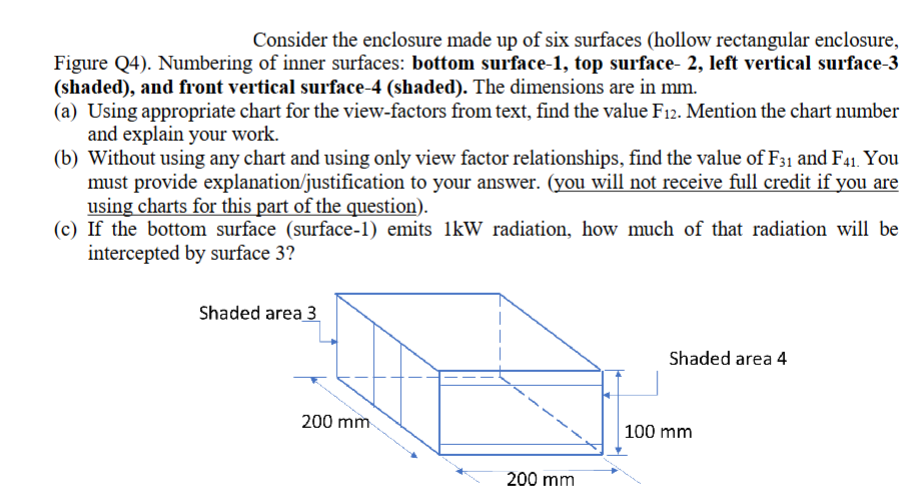 Consider the enclosure made up of six surfaces (hollow rectangular enclosure,
Figure Q4). Numbering of inner surfaces: bottom surface-1, top surface- 2, left vertical surface-3
(shaded), and front vertical surface-4 (shaded). The dimensions are in mm.
(a) Using appropriate chart for the view-factors from text, find the value F1>. Mention the chart number
and explain your work.
(b) Without using any chart and using only view factor relationships, find the value of Fs; and Fs; You
must provide explanation/justification to your answer. (you will not receive full credit if you are
using charts for this part of the question).
(c) If the bottom surface (surface-1) emits 1kW radiation, how much of that radiation will be
intercepted by surface 3?
Shaded area 3.
Shaded area 4
— ——~ |
\ N N
\ ~
200mm 100 mm
EON E—
© 200mm