 VIPSolutions
Step by step solution tutor mode2.19° Let G be a connected graph with & (> 0) vertices of odd degree. (i) Show that the minimum number of trails, that together include every edge of G and that have no edges in common, is '/2k. (i) How many continuous pen-strokes are needed to draw the diagram in Fig. 2.20 without repeating any line? Figure 2.20
Question:
Step by step solution
tutor mode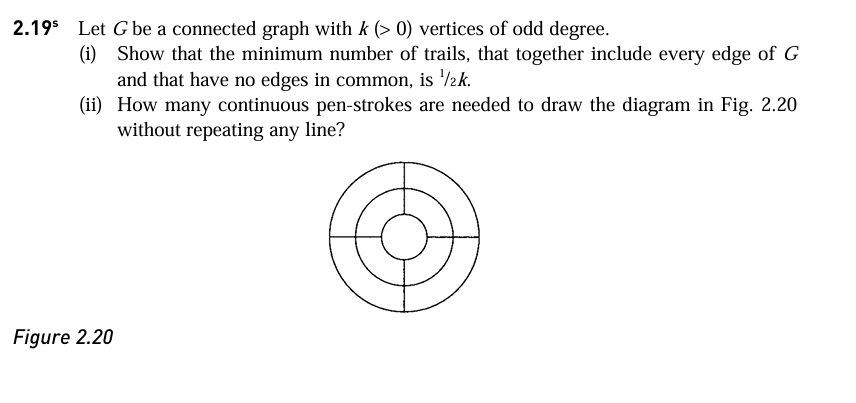 2.19° Let G be a connected graph with & (> 0) vertices of odd degree.
(i) Show that the minimum number of trails, that together include every edge of G
and that have no edges in common, is '/2k.
(i) How many continuous pen-strokes are needed to draw the diagram in Fig. 2.20
without repeating any line?
Figure 2.20
This is AI generated Response.
Asked by: Pradeep Rajora
Created at: 2025-09-29 00:51:25
Asked by: Pradeep Rajora
Created at: 2025-09-29 00:51:25
Final Answer:
Rendered
Raw Text
Did you like this answer?
Let's work through each part step by step.
---
## Part (i): Minimum Number of Trails in a Graph with \( k \) Odd Degree Vertices
### **Step 1: Understanding the Problem**
- We have a connected graph \( G \) with \( k \) vertices of odd degree (\( k > \)).
- We want to cover edges with edge-disjoint trails (no edge repeats in a trail, and trails don't share edges).
- **Claim:** The minimum number of such trails is \( \frac{k}{2} \).
---
### **Step 2: Recall Key Graph Theory Concepts**
- **Trail:** A walk in which all edges are distinct.
- **Euler Trail:** A trail that visits every edge exactly once.
- **Euler’s Theorem:** A connected graph has an Euler trail iff it has exactly or 2 vertices of odd degree.
---
### **Step 3: Pairing Odd Degree Vertices**
- Every trail that starts and ends at vertices of odd degree "uses up" two odd degree vertices (because entering and leaving a vertex uses up two edges).
- Thus, to cover all edges, each trail can start and end at two odd degree vertices.
- With \( k \) odd degree vertices, we can pair them up into \( \frac{k}{2} \) pairs.
- Each pair can be connected by a trail that covers some edges without repeating.
---
### **Step 4: Why Can't We Do Fewer?**
- Each trail can only "use up" two odd degree vertices (at its ends).
- Therefore, the absolute minimum number of such trails is \( \frac{k}{2} \).
- This is a classic result in graph theory.
---
### **Conclusion for (i):**
\[
\boxed{\text{The minimum number of edge-disjoint trails covering all edges of } G \text{ is } \frac{k}{2}.}
\]
---
## Part (ii): Pen-Strokes Needed for Figure 2.20
Let's analyze the diagram.
### **Step 1: Model the Graph**
- There are three concentric circles, each divided into four segments by four straight lines.
- The straight lines connect at the center and radiate outward, intersecting the circles.
#### **Vertices and Degrees**
- **Vertices:** Intersection points (center, and intersections at each circle).
- The degree at each intersection = number of lines meeting at that point.
Let's count the **odd degree vertices**.
#### **At the Center:**
- 4 straight lines meet at the center. **Degree = 4** (even).
#### **At Each Circle:**
- Each straight line crosses all 3 circles, making 4 intersection points per circle.
- At each such intersection, the line (1 edge) and the circular arc (2 arcs meeting at each point) meet, so degree = 3 (odd).
- **Number of such vertices:**
4 (lines) × 3 (circles) = **12 vertices of degree 3** (odd).
#### **At the Outer Edge:**
- Each straight line ends at the outermost circle. Let's assume the outermost intersections are just like other circle intersections, so total odd-degree vertices is still 12.
---
### **Step 2: Apply the Result from (i)**
- The minimum number of trails = \( \frac{k}{2} \), where \( k \) is the number of odd-degree vertices.
- Here, \( k = 12 \).
\[
\text{Number of pen-strokes needed} = \frac{12}{2} = \boxed{6}
\]
---
## **Summary of Answers**
### (i) **Minimum number of trails:**
\[
\boxed{\frac{k}{2}}
\]
### (ii) **Pen-strokes needed to draw Fig. 2.20:**
\[
\boxed{6}
\]
---
If you want a more detailed breakdown of the degrees for each node in the diagram, let me know!
📢 Instructions:
- Ask anything relatd to above question only.
- For new Question goto :