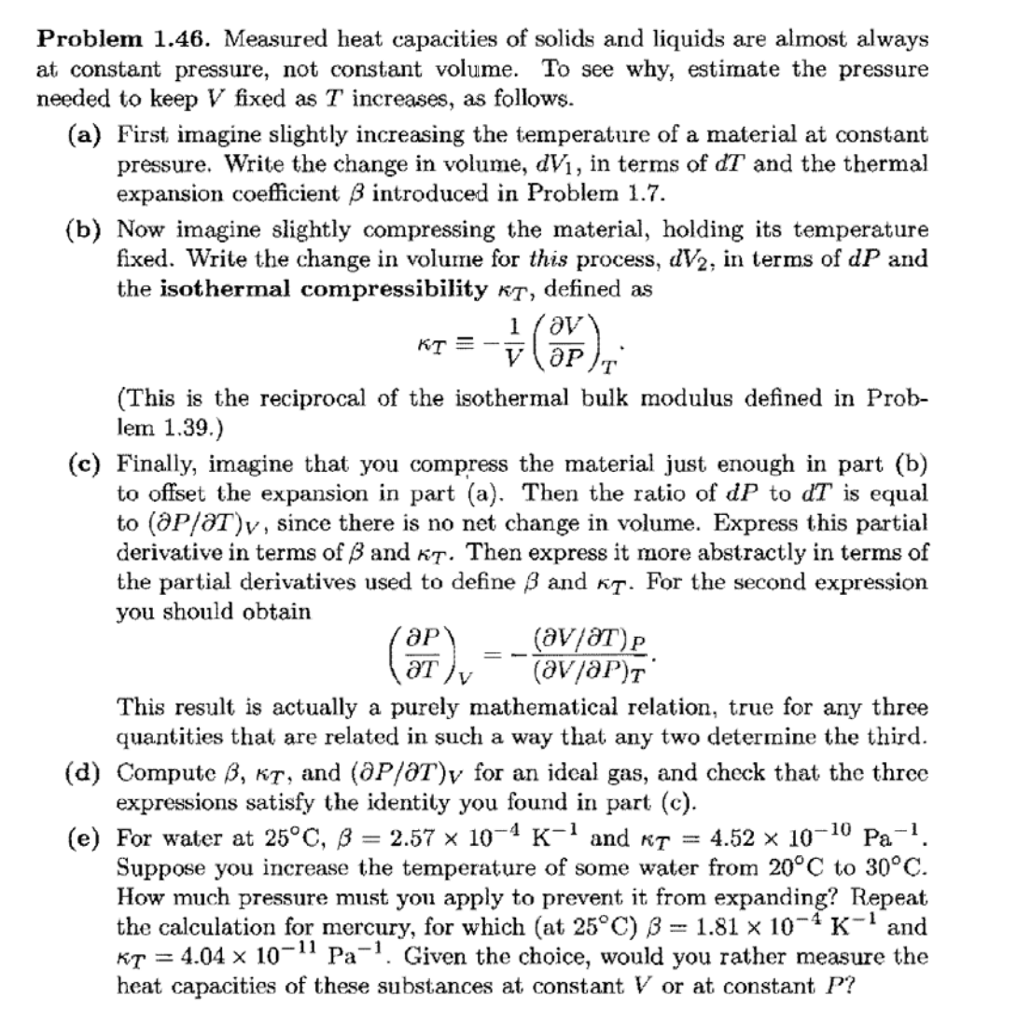
solvwe allProblem 1.46. Measured heat capacities of solids and liquids are almost always
at constant pressure, not constant volume. To see why, estimate the pressure
needed to keep V fixed as 7" increases, as follows.
(a) First imagine slightly increasing the temperature of a material at constant
pressure. Write the change in volume, dV, in terms of d7" and the thermal
expansion coefficient 3 introduced in Problem 1.7.
(b) Now imagine slightly compressing the material, holding its temperature
fixed. Write the change in volume for this process, dV3, in terms of dP and
the isothermal compressibility x7, defined as
—_—
RAC
(This is the reciprocal of the isothermal bulk modulus defined in Prob-
lem 1.39.)
(c) Finally, imagine that you compress the material just enough in part (b)
to offset the expansion in part (a). Then the ratio of dP to dT is equal
to (OP/8T)y, since there is no net change in volume. Express this partial
derivative in terms of 3 and x7. Then express it more abstractly in terms of
the partial derivatives used to define 3 and xp. For the second expression
you should obtain
aP\ _ _(av/aT)p
(3), ~ vier)’
This result is actually a purely mathematical relation, true for any three
quantities that are related in such a way that any two determine the third.
(@) Compute 3, xr, and (3P/8T)y for an ideal gas, and check that the three
expressions satisfy the identity you found in part (c).
(e) For water at 25°C, 8 = 2.57 x 10⁷? K~! and np = 4.52 x 1071" Pa~!.
Suppose you increase the temperature of some water from 20°C to 30°C.
How much pressure must you apply to prevent it from expanding? Repeat
the calculation for mercury, for which (at 25°C) 8 = 1.81 x 10™* K~! and
x7 =4.04 x 107"! Pa~'. Given the choice, would you rather measure the
heat capacities of these substances at constant V or at constant I’?
Question:
solvwe allProblem 1.46. Measured heat capacities of solids and liquids are almost always
at constant pressure, not constant volume. To see why, estimate the pressure
needed to keep V fixed as 7" increases, as follows.
(a) First imagine slightly increasing the temperature of a material at constant
pressure. Write the change in volume, dV, in terms of d7" and the thermal
expansion coefficient 3 introduced in Problem 1.7.
(b) Now imagine slightly compressing the material, holding its temperature
fixed. Write the change in volume for this process, dV3, in terms of dP and
the isothermal compressibility x7, defined as
—_—
RAC
(This is the reciprocal of the isothermal bulk modulus defined in Prob-
lem 1.39.)
(c) Finally, imagine that you compress the material just enough in part (b)
to offset the expansion in part (a). Then the ratio of dP to dT is equal
to (OP/8T)y, since there is no net change in volume. Express this partial
derivative in terms of 3 and x7. Then express it more abstractly in terms of
the partial derivatives used to define 3 and xp. For the second expression
you should obtain
aP\ _ _(av/aT)p
(3), ~ vier)’
This result is actually a purely mathematical relation, true for any three
quantities that are related in such a way that any two determine the third.
(@) Compute 3, xr, and (3P/8T)y for an ideal gas, and check that the three
expressions satisfy the identity you found in part (c).
(e) For water at 25°C, 8 = 2.57 x 10⁷? K~! and np = 4.52 x 1071" Pa~!.
Suppose you increase the temperature of some water from 20°C to 30°C.
How much pressure must you apply to prevent it from expanding? Repeat
the calculation for mercury, for which (at 25°C) 8 = 1.81 x 10™* K~! and
x7 =4.04 x 107"! Pa~'. Given the choice, would you rather measure the
heat capacities of these substances at constant V or at constant I’?
This is AI generated Response.
Asked by: Adapaka Jagadeesh
Created at: 2025-07-30 17:04:32
Final Answer:
RenderedRaw Text
Did you like this answer?
Let’s solve each part step by step:
---
### (a) **Change in Volume at Constant Pressure**
At constant pressure, if you increase the temperature by \( dT \), the change in volume is given by the **thermal expansion coefficient** \( \beta \):
\[
\beta = \frac{1}{V}\left(\frac{\partial V}{\partial T}\right)_P
\]
So, the change in volume:
\[
dV_1 = \left(\frac{\partial V}{\partial T}\right)_P dT = \beta V dT
\]
---
### (b) **Change in Volume at Constant Temperature**
At constant temperature, if you change the pressure by \( dP \), the change in volume is given by the **isothermal compressibility** \( \kappa_T \):
\[
\kappa_T = -\frac{1}{V}\left(\frac{\partial V}{\partial P}\right)_T
\]
So, the change in volume:
\[
dV_2 = \left(\frac{\partial V}{\partial P}\right)_T dP = -\kappa_T V dP
\]
---
### (c) **Finding \(\left(\frac{\partial P}{\partial T}\right)_V\) in Terms of \(\beta\) and \(\kappa_T\)**
To keep volume constant, the total change in volume must be zero:
\[
dV_1 + dV_2 = 0
\]
\[
\beta V dT - \kappa_T V dP = 0
\]
\[
\beta dT = \kappa_T dP
\]
\[
\frac{dP}{dT} = \frac{\beta}{\kappa_T}
\]
So,
\[
\left(\frac{\partial P}{\partial T}\right)_V = \frac{\beta}{\kappa_T}
\]
For the abstract expression involving partial derivatives (from the problem):
\[
\left(\frac{\partial P}{\partial T}\right)_V = -\frac{(\partial V / \partial T)_P}{(\partial V / \partial P)_T}
\]
Recall:
- \( (\partial V / \partial T)_P = \beta V \)
- \( (\partial V / \partial P)_T = -\kappa_T V \)
So,
\[
-\frac{\beta V}{-\kappa_T V} = \frac{\beta}{\kappa_T}
\]
---
### (d) **For an Ideal Gas**
For an ideal gas:
- \( V = \frac{nRT}{P} \)
Find each term:
#### \( \beta \):
\[
\beta = \frac{1}{V}\left(\frac{\partial V}{\partial T}\right)_P
= \frac{1}{V} \cdot \frac{nR}{P} = \frac{1}{T}
\]
#### \( \kappa_T \):
\[
\kappa_T = -\frac{1}{V}\left(\frac{\partial V}{\partial P}\right)_T = -\frac{1}{V} \cdot \left(-\frac{nRT}{P^2}\right) = \frac{V}{P} = \frac{1}{P}
\]
#### \( \left(\frac{\partial P}{\partial T}\right)_V \):
From the ideal gas law, \( P = \frac{nRT}{V} \), so:
\[
\left(\frac{\partial P}{\partial T}\right)_V = \frac{nR}{V} = \frac{P}{T}
\]
Check that:
\[
\frac{\beta}{\kappa_T} = \frac{1/T}{1/P} = \frac{P}{T}
\]
Which matches.
---
### (e) **Numerical Calculation for Water and Mercury**
Given:
- For water at 25°C:
- \( \beta = 2.57 \times 10^{-4} \) K\(^{-1}\)
- \( \kappa_T = 4.52 \times 10^{-10} \) Pa\(^{-1}\)
Temperature increase: \( \Delta T = 10 \) K.
The pressure required to offset the expansion:
\[
\frac{dP}{dT} = \frac{\beta}{\kappa_T}
\]
\[
\Delta P = \frac{\beta}{\kappa_T} \Delta T
\]
Plug in the values:
\[
\Delta P = \frac{2.57 \times 10^{-4}}{4.52 \times 10^{-10}} \times 10
= (5.685 \times 10^{5}) \times 10
= 5.69 \times 10^{6} \text{ Pa}
\]
#### For Mercury:
- \( \beta = 1.81 \times 10^{-4} \) K\(^{-1}\)
- \( \kappa_T = 4.04 \times 10^{-11} \) Pa\(^{-1}\)
\[
\Delta P = \frac{1.81 \times 10^{-4}}{4.04 \times 10^{-11}} \times 10
= (4.48 \times 10^{6}) \times 10
= 4.48 \times 10^{7} \text{ Pa}
\]
---
### (f) **Would You Rather Measure Heat Capacity at Constant V or P?**
It is much easier to keep pressure constant than to keep volume constant because the pressure required to keep the volume fixed changes drastically with small temperature changes (as calculated above). Thus, it is much more practical to measure heat capacities at constant pressure.
---
## **Summary Table**
| Substance | \(\beta\) (K\(^{-1}\)) | \(\kappa_T\) (Pa\(^{-1}\)) | \(\Delta P\) for \( \Delta T = 10\,K \) (Pa) |
|-----------|------------------------|----------------------------|----------------------------------------------|
| Water | \(2.57 \times 10^{-4}\) | \(4.52 \times 10^{-10}\) | \(5.69 \times 10^6\) |
| Mercury | \(1.81 \times 10^{-4}\) | \(4.04 \times 10^{-11}\) | \(4.48 \times 10^7\) |
---
Let me know if you want a more detailed algebraic step for any part!
VIPSolutions focuses on clear, step‑by‑step explanations so you can learn quickly. Whether you need an AI‑generated walkthrough or a short hint to get unstuck, each solution is organized for fast reading and easy review later.
Search similar questions, compare approaches, and bookmark the best answers for revision. Our goal is simple: quick, reliable study help that feels natural—not noisy.
 VIPSolutions
 Problem 1.46. Measured heat capacities of solids and liquids are almost always
at constant pressure, not constant volume. To see why, estimate the pressure
needed to keep V fixed as 7" increases, as follows.
(a) First imagine slightly increasing the temperature of a material at constant
pressure. Write the change in volume, dV, in terms of d7" and the thermal
expansion coefficient 3 introduced in Problem 1.7.
(b) Now imagine slightly compressing the material, holding its temperature
fixed. Write the change in volume for this process, dV3, in terms of dP and
the isothermal compressibility x7, defined as
—_—
RAC
(This is the reciprocal of the isothermal bulk modulus defined in Prob-
lem 1.39.)
(c) Finally, imagine that you compress the material just enough in part (b)
to offset the expansion in part (a). Then the ratio of dP to dT is equal
to (OP/8T)y, since there is no net change in volume. Express this partial
derivative in terms of 3 and x7. Then express it more abstractly in terms of
the partial derivatives used to define 3 and xp. For the second expression
you should obtain
aP\ _ _(av/aT)p
(3), ~ vier)’
This result is actually a purely mathematical relation, true for any three
quantities that are related in such a way that any two determine the third.
(@) Compute 3, xr, and (3P/8T)y for an ideal gas, and check that the three
expressions satisfy the identity you found in part (c).
(e) For water at 25°C, 8 = 2.57 x 10⁷? K~! and np = 4.52 x 1071" Pa~!.
Suppose you increase the temperature of some water from 20°C to 30°C.
How much pressure must you apply to prevent it from expanding? Repeat
the calculation for mercury, for which (at 25°C) 8 = 1.81 x 10™* K~! and
x7 =4.04 x 107"! Pa~'. Given the choice, would you rather measure the
heat capacities of these substances at constant V or at constant I’?