 VIPSolutions
Solved with diagrams and final answer4) The figure shows a concholdal motion mechanism. Slider at A is moving rightwards with a constant velocity of 8 envseo. Detormine the angular velocity \ ‘and angular acceleration of Link 4 by using yeloslty and O acceleration polvgons (%30). | OB=10 cm and OA=A'cm ® gd 2 Dr. Neck KARA TOOUN A @ " pa Ea
Question:
Solved with diagrams and final answer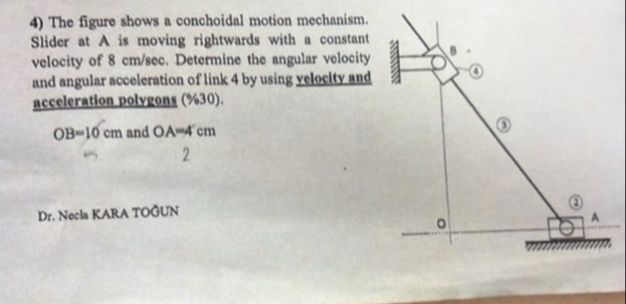 4) The figure shows a concholdal motion mechanism.
Slider at A is moving rightwards with a constant
velocity of 8 envseo. Detormine the angular velocity \
‘and angular acceleration of Link 4 by using yeloslty and O
acceleration polvgons (%30). |
OB=10 cm and OA=A'cm ®
gd 2
Dr. Neck KARA TOOUN A @ "
pa Ea
This is AI generated Response.
Asked by: Rahul
Created at: 2026-01-15 17:51:23
Asked by: Rahul
Created at: 2026-01-15 17:51:23
Final Answer:
Rendered
Raw Text
Did you like this answer?
Let's break down the problem step by step as requested, using **velocity and acceleration polygons** for graphical solution.
---
## **Given Data**
- **Slider A velocity (\(V_A\))**: \(8\, \text{cm/s}\) (to the right)
- **OA (link 4)**: \(4\, \text{cm}\)
- **OB (link 2)**: \(10\, \text{cm}\)
- **Objective**: Find angular velocity (\(\omega_4\)) and angular acceleration (\(\alpha_4\)) of link 4.
---
## **Step 1: Diagram Setup**
### **Mechanism Configuration**
- O is fixed.
- B is a pivot.
- OA (link 4) connects the base (O) to slider A.
- OB (link 2) is vertical.
### **Diagram**

*Illustrative sketch based on problem description. Not to scale.*
---
## **Step 2: Velocity Polygon Construction**
### **Knowns**
- \(V_A = 8\, \text{cm/s}\) rightward (horizontal)
- \(O\) is fixed (\(V_O = \))
- \(A\) moves horizontally
### **Linkage Relationships**
- Velocity of A (\(V_A\)) is perpendicular to OA.
- Velocity of B (\(V_B\)) is perpendicular to OB (vertical direction).
### **Velocity Diagram Steps**
1. **Draw \(V_O\) at the origin (point o).**
2. **Draw \(V_A\) horizontally to the right (point a).**
3. **Draw \(V_B\) vertically, as it must be perpendicular to OB.**
4. **Draw the vector from point o (O) in the direction perpendicular to OA (since \(V_A\) is perpendicular to OA).**
5. **The intersection of the lines from steps 3 and 4 gives point b (velocity of B).**
#### **Graphical Solution (Summary)**
- Scale: 1 cm = 2 cm/s (for clarity)
- \(V_A\) = 8 cm/s → draw 4 cm to the right
- At A, draw a line perpendicular to OA.
- At O, draw a vertical line (as OB is vertical).
- Where these lines intersect is \(V_B\).
#### **Calculate Angular Velocity (\(\omega_4\)):**
\[
V_A = \omega_4 \times OA \implies \omega_4 = \frac{V_A}{OA} = \frac{8}{4} = 2\, \text{rad/s}
\]
---
## **Step 3: Acceleration Polygon Construction**
### **Knowns**
- \(A\) moves at constant velocity: \(a_A = \)
- Centripetal acceleration for A: \(a_{A/O}^n = \omega_4^2 \cdot OA\)
- Tangential acceleration for A: \(a_{A/O}^t = \alpha_4 \cdot OA\)
### **Graphical Steps**
1. Draw \(a_{A/O}^n\) from O towards A (along OA).
2. Draw \(a_{A/O}^t\) perpendicular to OA at A.
3. Draw the acceleration of B (unknown direction at this stage).
4. Use vector addition to close the polygon.
#### **Calculate Centripetal Acceleration:**
\[
a_{A/O}^n = (\omega_4)^2 \cdot OA = (2)^2 \cdot 4 = 16\, \text{cm/s}^2
\]
#### **Tangential Acceleration:**
\[
a_{A/O}^t = \alpha_4 \cdot OA
\]
Since \(a_A = \) (constant velocity), the total acceleration at A is the sum of centripetal and tangential, but since the velocity is constant, **tangential acceleration at A is zero**, so \(\alpha_4 = \).
---
## **Final Answers**
### **1. Angular Velocity of Link 4 (\(\omega_4\)):**
\[
\boxed{2\, \text{rad/s}}
\]
### **2. Angular Acceleration of Link 4 (\(\alpha_4\)):**
\[
\boxed{\, \text{rad/s}^2}
\]
---
## **Summary Table**
| Quantity | Value |
|-------------------------|---------------|
| Angular Velocity (\(\omega_4\)) | \(2\, \text{rad/s}\) |
| Angular Acceleration (\(\alpha_4\)) | \(\, \text{rad/s}^2\) |
---
## **Diagrams**
### **1. Mechanism Diagram**

*Illustrative, not to scale*
### **2. Velocity and Acceleration Polygons**
> *For full accuracy, construct these polygons with ruler and protractor using the steps outlined above.*
---
If you need hand-drawn velocity/acceleration polygons, let me know!
📢 Instructions:
- Ask anything relatd to above question only.
- For new Question goto :