give answer in 2 step with explanation at the end of each step and final answer at the solved all parts end:In a biomechanics laboratory, a researcher is conducting an experiment to analyze the torque and equilibrium of
a human forearm during a bicep curl exercise. The forearm consists of two segments: the hand and the forearm
itself. The researcher is interested in understanding the forces and torques involved in maintaining equilibrium
during this exercise. The forearm's length is 30 cm, and the hand's length is 10 cm. The mass of the hand is 0.5
kg, and the mass of the forearm is 1 kg. The center of mass of the hand is located 7 cm from the wrist, and the
center of mass of the forearm is located 15 cm from the elbow. At 90 degrees the bicep attaches to the forearm
at the perpendicular distance of 4.5 cm from the axis of rotation.
1. Calculate the moment of inertia for the hand and forearm segments separately about their respective centers
of mass.
2. During the bicep curl exercise, the participant is holding a 5 kg dumbbell in their hand (Assume the dumbbell
is being held at the hand's center of mass). Calculate the Total External Torque generated when holding the
weight of the dumbbell about the elbow joint when the forearm is parallel to the ground
3. To maintain equilibrium during the exercise stated in question, the participant's bicep muscle provides a
force at the elbow joint. If the forearm makes a 90 - degree angle with the upper arm during the curl, calculate
the magnitude of the force exerted by the bicep muscle to keep the forearm in equilibrium.
4. Calculate the net torque about the elbow joint when the forearm is at a 90 - degree angle during the bicep
curl exercise. Is the forearm in rotational equilibrium at this position?
5. If the participant wants to increase the difficulty of the exercise and moves the forearm to a 45 - degree angle
with respect to the upper arm, recalculate the magnitude of the force the bicep muscle must exert to maintain
equilibrium at this new position, (*at 45 degrees the bicep attaches to the forearm at a perpendicular distance of
3.25 cm from the axis of rotation) .
Question:
give answer in 2 step with explanation at the end of each step and final answer at the solved all parts end:In a biomechanics laboratory, a researcher is conducting an experiment to analyze the torque and equilibrium of
a human forearm during a bicep curl exercise. The forearm consists of two segments: the hand and the forearm
itself. The researcher is interested in understanding the forces and torques involved in maintaining equilibrium
during this exercise. The forearm's length is 30 cm, and the hand's length is 10 cm. The mass of the hand is 0.5
kg, and the mass of the forearm is 1 kg. The center of mass of the hand is located 7 cm from the wrist, and the
center of mass of the forearm is located 15 cm from the elbow. At 90 degrees the bicep attaches to the forearm
at the perpendicular distance of 4.5 cm from the axis of rotation.
1. Calculate the moment of inertia for the hand and forearm segments separately about their respective centers
of mass.
2. During the bicep curl exercise, the participant is holding a 5 kg dumbbell in their hand (Assume the dumbbell
is being held at the hand's center of mass). Calculate the Total External Torque generated when holding the
weight of the dumbbell about the elbow joint when the forearm is parallel to the ground
3. To maintain equilibrium during the exercise stated in question, the participant's bicep muscle provides a
force at the elbow joint. If the forearm makes a 90 - degree angle with the upper arm during the curl, calculate
the magnitude of the force exerted by the bicep muscle to keep the forearm in equilibrium.
4. Calculate the net torque about the elbow joint when the forearm is at a 90 - degree angle during the bicep
curl exercise. Is the forearm in rotational equilibrium at this position?
5. If the participant wants to increase the difficulty of the exercise and moves the forearm to a 45 - degree angle
with respect to the upper arm, recalculate the magnitude of the force the bicep muscle must exert to maintain
equilibrium at this new position, (*at 45 degrees the bicep attaches to the forearm at a perpendicular distance of
3.25 cm from the axis of rotation) .
This is AI generated Response.
Asked by: Rahul
Created at: 2025-11-15 11:21:27
Final Answer:
RenderedRaw Text
Did you like this answer?
Let's break down each question and in **two steps** with explanations:
---
## **1. of Inertia Calculation**
**Step 1:**
Recall the formula for the moment inertia of a rod about its center:
\[ I = \frac{1}{12} m L^2]
where \( m \) is mass and \( \) is length.
- **arm:** \( = 1) kg, \( L 30 \) cm .3 m
[ I_{\text{forearm}} = \frac{1}{12} \times 1 \times (.3)^2 = \frac{1}{12} \times .09 = .0075 \text{ kg} \cdot \text{m}^2 \]
- **Hand:** \( m = .5 \) kg, \( L = 10 \) cm = .1 m
\[ I_{\text{hand}} = \frac{1}{12} \times .5 \times (.1)^2 = \frac{1}{12} \times .5 \times .01 = .00042 \text{ kg} \cdot \text{m}^2 \]
**Explanation:**
The moment of inertia gives a measure of how much torque is needed for a desired angular acceleration about the center of mass.
---
## **2. Total External Torque with 5 kg Dumbbell**
**Step 1:**
Calculate the torque due to the dumbbell about the elbow joint:
\[\text{Torque} = \text{Force} \times \text{distance from axis}\]
The dumbbell is at the hand's center of mass, which is 30 cm (forearm) + 7 cm (hand's center from wrist) = **37 cm = .37 m** from the elbow.
\[\text{Force (weight)} = 5 \text{ kg} \times 9.81 \text{ m/s}^2 = 49.05 \text{ N}\]
\[\text{Torque}_\text{dumbbell} = 49.05 \times .37 = 18.15 \text{ Nm}\]
**Explanation:**
The torque is the product of the weight and its perpendicular distance from the axis of rotation (elbow).
---
## **3. Bicep Muscle Force for Equilibrium at 90°**
**Step 1:**
Sum all torques about the elbow (taking counterclockwise as positive):
- **Dumbbell:** \( 18.15 \) Nm (clockwise)
- **Forearm weight:**
\[ F = 1 \text{ kg} \times 9.81 = 9.81 \text{ N} \] at 15 cm = .15 m
\[ \tau_{\text{forearm}} = 9.81 \times .15 = 1.47 \text{ Nm} \] (clockwise)
- **Hand weight:**
\[ F = .5 \times 9.81 = 4.905 \text{ N} \] at 30 cm + 7 cm = 37 cm = .37 m
\[ \tau_{\text{hand}} = 4.905 \times .37 = 1.815 \text{ Nm} \] (clockwise)
Total clockwise torque:
\[ 18.15 + 1.47 + 1.815 = 21.435 \text{ Nm} \]
**Step 2:**
The bicep force (\( F_b \)) acts at 4.5 cm = .045 m from the elbow, perpendicular.
Set counterclockwise torque = clockwise torque for equilibrium:
\[ F_b \times .045 = 21.435 \]
\[ F_b = \frac{21.435}{.045} = 476.33 \text{ N} \]
**Explanation:**
The bicep must exert a large force close to the elbow because the moment arm is short.
---
## **4. Net Torque at 90° Position**
**Step 1:**
Sum all torques (from previous step):
- Clockwise: \( 21.435 \) Nm
- Counterclockwise (bicep): \( 476.33 \times .045 = 21.435 \) Nm
Net torque:
\[ \text{Net Torque} = 21.435 - 21.435 = \text{ Nm} \]
**Step 2:**
Since net torque = , the forearm **is in rotational equilibrium**.
**Explanation:**
Rotational equilibrium occurs when the sum of clockwise and counterclockwise torques is zero.
---
## **5. Bicep Force at 45° Position**
**Step 1:**
Now the bicep attaches 3.25 cm = .0325 m from the elbow.
The perpendicular distance for each weight is multiplied by \( \sin(45^\circ) = .707 \):
- Dumbbell: \( .37 \times .707 = .2616 \) m
- Forearm: \( .15 \times .707 = .106 \) m
- Hand: \( .37 \times .707 = .2616 \) m
New torques:
- Dumbbell: \( 49.05 \times .2616 = 12.83 \) Nm
- Forearm: \( 9.81 \times .106 = 1.04 \) Nm
- Hand: \( 4.905 \times .2616 = 1.284 \) Nm
Total clockwise: \( 12.83 + 1.04 + 1.284 = 15.154 \) Nm
**Step 2:**
For equilibrium,
\[ F_b \times .0325 = 15.154 \]
\[ F_b = \frac{15.154}{.0325} = 466.28 \text{ N} \]
**Explanation:**
With a shorter bicep moment arm and reduced perpendicular distances, the force requirement remains high.
---
## **Final Answers:**
1. **Moment of inertia:**
- Forearm: \( .0075 \text{ kg} \cdot \text{m}^2 \)
- Hand: \( .00042 \text{ kg} \cdot \text{m}^2 \)
2. **Total external torque (dumbbell):**
- \( 18.15 \) Nm
3. **Bicep force at 90°:**
- \( 476.33 \) N
4. **Net torque at 90°:**
- \( \) Nm (**Rotational equilibrium achieved**)
5. **Bicep force at 45°:**
- \( 466.28 \) N
Question:
Solved then
This is AI generated Response.
Asked by: Rahul
Created at: 2025-11-15 11:23:05
Final Answer:
RenderedRaw Text
Did you like this answer?
# Biomechanics Analysis of a Bicep Curl Exercise
## **1. Moment of Inertia Calculation**
### Step 1: Calculate Moment of Inertia
Using the formula for the moment of inertia of a rod about its center:
\[
I = \frac{1}{12} m L^2
\]
- **Forearm:**
- Mass (\(m\)) = 1 kg
- Length (\(L\)) = 30 cm = 0.3 m
\[
I_{\text{forearm}} = \frac{1}{12} \times 1 \times (0.3)^2 = \frac{1}{12} \times 0.09 = 0.0075 \text{ kg} \cdot \text{m}^2
\]
- **Hand:**
- Mass (\(m\)) = 0.5 kg
- Length (\(L\)) = 10 cm = 0.1 m
\[
I_{\text{hand}} = \frac{1}{12} \times 0.5 \times (0.1)^2 = \frac{1}{12} \times 0.5 \times 0.01 = 0.00042 \text{ kg} \cdot \text{m}^2
\]
### Explanation
The moment of inertia shows how much torque is required to achieve a specific angular acceleration around the center of mass.
---
## **2. Total External Torque with 5 kg Dumbbell**
### Step 1: Calculate Torque from Dumbbell
Using the torque formula:
\[
\text{Torque} = \text{Force} \times \text{distance from axis}
\]
- **Force (Weight of Dumbbell):**
\[
\text{Force} = 5 \text{ kg} \times 9.81 \text{ m/s}^2 = 49.05 \text{ N}
\]
- **Distance from Elbow:**
Total distance = length of forearm + distance of hand's center of mass = 30 cm + 7 cm = 37 cm = 0.37 m
\[
\text{Torque}_{\text{dumbbell}} = 49.05 \times 0.37 = 18.15 \text{ Nm}
\]
### Explanation
The torque produced by the dumbbell is the product of its weight and the distance from the elbow joint, indicating the moment it creates.
---
## **3. Bicep Muscle Force for Equilibrium at 90°**
### Step 1: Calculate Total Clockwise Torque
Total clockwise torque comprises the contributions from the dumbbell, forearm, and hand:
- **Forearm Weight:**
\[
F = 1 \text{ kg} \times 9.81 \text{ m/s}^2 = 9.81 \text{ N} \quad \text{(at 15 cm = 0.15 m)}
\]
\[
\tau_{\text{forearm}} = 9.81 \times 0.15 = 1.47 \text{ Nm}
\]
- **Hand Weight:**
\[
F = 0.5 \text{ kg} \times 9.81 \text{ m/s}^2 = 4.905 \text{ N} \quad \text{(at 37 cm = 0.37 m)}
\]
\[
\tau_{\text{hand}} = 4.905 \times 0.37 = 1.815 \text{ Nm}
\]
- **Total Clockwise Torque:**
\[
\text{Total Clockwise Torque} = 18.15 + 1.47 + 1.815 = 21.435 \text{ Nm}
\]
### Step 2: Calculate Bicep Muscle Force
The bicep force (\(F_b\)) acts at a distance of 4.5 cm = 0.045 m from the elbow:
\[
F_b \times 0.045 = 21.435
\]
\[
F_b = \frac{21.435}{0.045} = 476.33 \text{ N}
\]
### Explanation
The bicep force must counteract the total torque produced by the weights to maintain equilibrium, highlighting the mechanical advantage and leverage involved.
---
## **4. Net Torque at 90° Position**
### Step 1: Calculate Net Torque
From the previous step, the total clockwise torque is:
- Clockwise Torque: \( 21.435 \) Nm
- Counterclockwise Torque (bicep):
\[
\tau_{\text{bicep}} = 476.33 \times 0.045 = 21.435 \text{ Nm}
\]
### Step 2: Determine Equilibrium
Net torque:
\[
\text{Net Torque} = \text{Counterclockwise} - \text{Clockwise} = 21.435 - 21.435 = 0 \text{ Nm}
\]
### Explanation
Since the net torque is zero, the forearm is in rotational equilibrium at this position.
---
## **5. Bicep Force at 45° Position**
### Step 1: Recalculate Torque at 45° Angle
The attachment point for the bicep is now at 3.25 cm = 0.0325 m. The distances are multiplied by \(\sin(45^\circ) = 0.707\):
- **Dumbbell Torque:**
\[
\text{Distance} = 0.37 \times 0.707 = 0.2616 \text{ m}
\]
\[
\tau_{\text{dumbbell}} = 49.05 \times 0.2616 = 12.83 \text{ Nm}
\]
- **Forearm Torque:**
\[
\text{Distance} = 0.15 \times 0.707 = 0.106 \text{ m}
\]
\[
\tau_{\text{forearm}} = 9.81 \times 0.106 = 1.04 \text{ Nm}
\]
- **Hand Torque:**
\[
\tau_{\text{hand}} = 4.905 \times 0.2616 = 1.284 \text{ Nm}
\]
- **Total Clockwise Torque:**
\[
\text{Total Clockwise Torque} = 12.83 + 1.04 + 1.284 = 15.154 \text{ Nm}
\]
### Step 2: Calculate New Bicep Force
For equilibrium:
\[
F_b \times 0.0325 = 15.154
\]
\[
F_b = \frac{15.154}{0.0325} = 466.28 \text{ N}
\]
### Explanation
At a 45° angle, the required bicep force decreases slightly but remains significant due to the weight and distances involved.
---
## **Final Answers:**
1. **Moment of Inertia:**
- Forearm: \( 0.0075 \text{ kg} \cdot \text{m}^2 \)
- Hand: \( 0.00042 \text{ kg} \cdot \text{m}^2 \)
2. **Total External Torque (Dumbbell):**
- \( 18.15 \) Nm
3. **Bicep Force at 90°:**
- \( 476.33 \) N
4. **Net Torque at 90°:**
- \( 0 \) Nm (Rotational equilibrium achieved)
5. **Bicep Force at 45°:**
- \( 466.28 \) N
VIPSolutions focuses on clear, step‑by‑step explanations so you can learn quickly. Whether you need an AI‑generated walkthrough or a short hint to get unstuck, each solution is organized for fast reading and easy review later.
Search similar questions, compare approaches, and bookmark the best answers for revision. Our goal is simple: quick, reliable study help that feels natural—not noisy.
 VIPSolutions
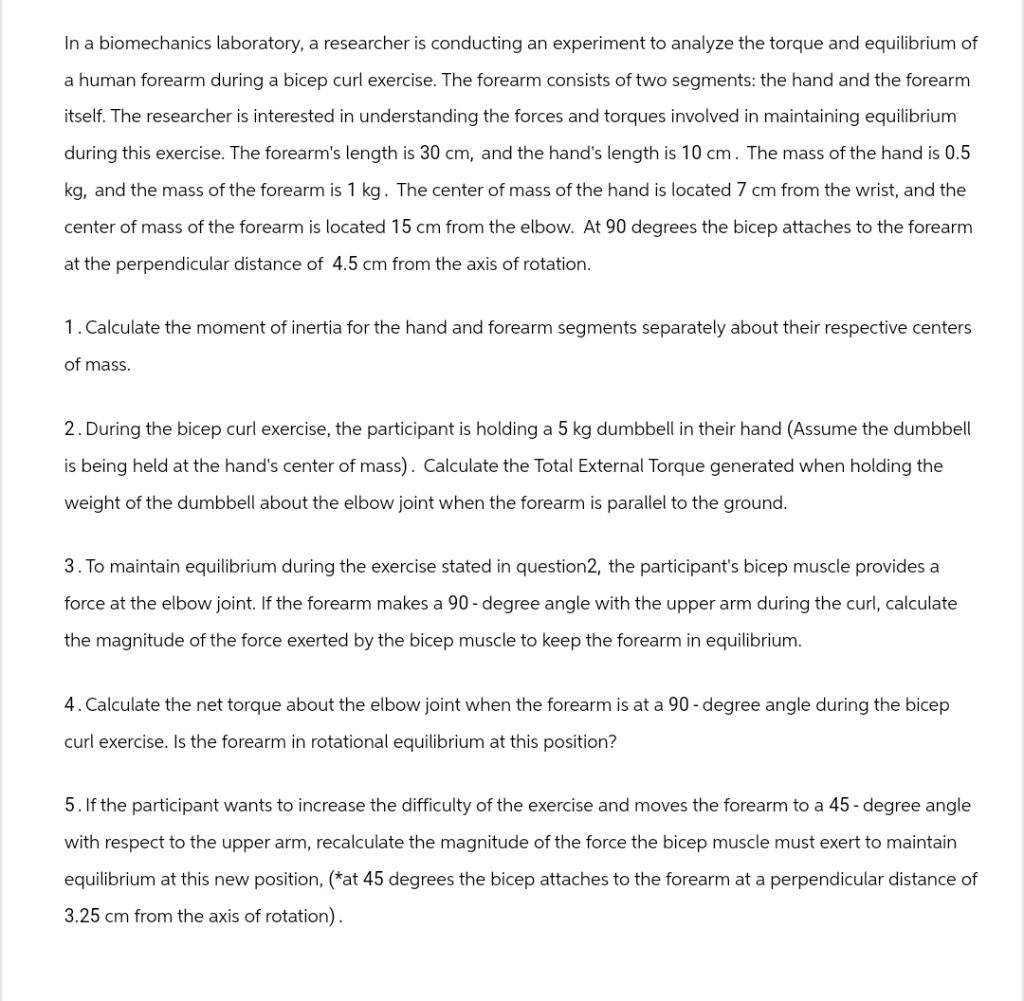 In a biomechanics laboratory, a researcher is conducting an experiment to analyze the torque and equilibrium of
a human forearm during a bicep curl exercise. The forearm consists of two segments: the hand and the forearm
itself. The researcher is interested in understanding the forces and torques involved in maintaining equilibrium
during this exercise. The forearm's length is 30 cm, and the hand's length is 10 cm. The mass of the hand is 0.5
kg, and the mass of the forearm is 1 kg. The center of mass of the hand is located 7 cm from the wrist, and the
center of mass of the forearm is located 15 cm from the elbow. At 90 degrees the bicep attaches to the forearm
at the perpendicular distance of 4.5 cm from the axis of rotation.
1. Calculate the moment of inertia for the hand and forearm segments separately about their respective centers
of mass.
2. During the bicep curl exercise, the participant is holding a 5 kg dumbbell in their hand (Assume the dumbbell
is being held at the hand's center of mass). Calculate the Total External Torque generated when holding the
weight of the dumbbell about the elbow joint when the forearm is parallel to the ground
3. To maintain equilibrium during the exercise stated in question, the participant's bicep muscle provides a
force at the elbow joint. If the forearm makes a 90 - degree angle with the upper arm during the curl, calculate
the magnitude of the force exerted by the bicep muscle to keep the forearm in equilibrium.
4. Calculate the net torque about the elbow joint when the forearm is at a 90 - degree angle during the bicep
curl exercise. Is the forearm in rotational equilibrium at this position?
5. If the participant wants to increase the difficulty of the exercise and moves the forearm to a 45 - degree angle
with respect to the upper arm, recalculate the magnitude of the force the bicep muscle must exert to maintain
equilibrium at this new position, (*at 45 degrees the bicep attaches to the forearm at a perpendicular distance of
3.25 cm from the axis of rotation) .