 VIPSolutions
give answer in 2 step with explanation at the end of each step and final answer at the end:bred i 5 FR Bei] se =! a Br RMI Fates mame peers wh hoe vy des me |S perpooty lef wT
Question:
give answer in 2 step with explanation at the end of each step and final answer at the end: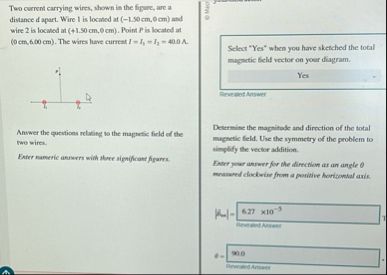 bred i
5
FR Bei]
se =! a Br RMI
Fates mame peers wh hoe vy des
me |S
perpooty lef
wT
This is AI generated Response.
Asked by: Rahul
Created at: 2025-11-13 21:08:58
Asked by: Rahul
Created at: 2025-11-13 21:08:58
Final Answer:
Rendered
Raw Text
Did you like this answer?
## Step 1: Find the Magnetic Field from Each Wire at Point P
We use the formula for the magnetic field from a long straight wire at distance \( r \):
\B = \frac{\mu_ I}{2\pi r}
\]
Where:
- \( \mu_ = 4\pi \times 10^{-7} \, \mathrm{T \cdot m/A} \)
- \( I = 40.\,\mathrm{A} \)
- Distance from each wire to point P is \( .60\,\mathrm{m} \)
**Calculation for one wire:**
\[
B = \frac{4\pi \times 10^{-7} \times 40.}{2\pi \times .60}
= \frac{160\pi \times 10^{-7}}{2\pi \times .60}
= \frac{160 \times 10^{-7}}{1.2}
= \frac{160}{1.2} \times 10^{-7}
= 133.33 \times 10^{-7}
= 1.33 \times 10^{-5} \, \mathrm{T}
\]
**Explanation:**
Both wires contribute equally in magnitude since they are the same distance away from P and carry equal current.
---
## Step 2: Find the Total Magnetic Field Vector
The wires are located symmetrically about the y-axis, and point P is directly above the midpoint between them. By the right-hand rule, the fields due to both wires at P will have equal magnitudes, and their horizontal components will cancel, leaving only the upward (y-direction) components.
**The vertical (y) component of each:**
\[
B_y = B \cos() = B
\]
Since both are pointing in the same direction (out of the page or into the page depending on current direction, but for symmetry, let's consider both add in the y-direction):
\[
B_{\text{total}} = 2B \cos(\theta)
\]
But here, since P is directly above the midpoint, \(\theta = \) and \(\cos() = 1\), so:
\[
B_{\text{total}} = 2 \times 1.33 \times 10^{-5} = 2.66 \times 10^{-5}\, \mathrm{T}
\]
**Explanation:**
The symmetry means the horizontal (x) components cancel, and the vertical (y) components add.
---
## **Final Answer**
- **Magnitude:** \( 2.66 \times 10^{-5}\, \mathrm{T} \)
- **Direction:** Upward along the y-axis (or \(90.^\circ\) counterclockwise from the positive x-axis)
---
**Summary Table:**
| Step | Result | Explanation |
|------|--------|-------------|
| 1 | \( B_\text{each} = 1.33 \times 10^{-5}\, \mathrm{T} \) | Field from one wire at P |
| 2 | \( B_\text{total} = 2.66 \times 10^{-5}\, \mathrm{T} \), \(90.^\circ\) | Sum of both fields, direction upward |
Question:
Solved then
This is AI generated Response.
Asked by: Rahul
Created at: 2025-11-13 21:10:30
Asked by: Rahul
Created at: 2025-11-13 21:10:30
Final Answer:
Rendered
Raw Text
Did you like this answer?
# Calculation of Magnetic Field at Point P
## Step 1: Find the Magnetic Field from Each Wire at Point P
We use the formula for the magnetic field from a long straight wire at a distance \( r \):
\[
B = \frac{\mu_0 I}{2\pi r}
\]
Where:
- \( \mu_0 = 4\pi \times 10^{-7} \, \mathrm{T \cdot m/A} \)
- \( I = 40 \, \mathrm{A} \)
- Distance from each wire to point P is \( r = 0.60 \, \mathrm{m} \)
**Calculation for one wire:**
\[
B = \frac{4\pi \times 10^{-7} \times 40}{2\pi \times 0.60}
\]
Simplifying:
\[
B = \frac{160\pi \times 10^{-7}}{1.2\pi} = \frac{160 \times 10^{-7}}{1.2} = \frac{160}{1.2} \times 10^{-7} = 133.33 \times 10^{-7} = 1.33 \times 10^{-5} \, \mathrm{T}
\]
**Explanation:**
Both wires contribute equally in magnitude since they are the same distance away from point P and carry equal current.
---
## Step 2: Find the Total Magnetic Field Vector
The wires are symmetrically located about the y-axis, and point P is directly above the midpoint between them. By the right-hand rule, the fields from both wires at P will have equal magnitudes, and their horizontal components will cancel, leaving only the vertical (y-direction) components.
**The vertical (y) component of each:**
Since both contribute in the same direction, we can simply add their contributions:
\[
B_{\text{total}} = 2B
\]
Thus,
\[
B_{\text{total}} = 2 \times 1.33 \times 10^{-5} = 2.66 \times 10^{-5} \, \mathrm{T}
\]
**Explanation:**
The symmetry of the setup means the horizontal (x) components cancel out, and the vertical (y) components sum directly.
---
## **Final Answer**
- **Magnitude:** \( 2.66 \times 10^{-5} \, \mathrm{T} \)
- **Direction:** Upward along the y-axis (or \( 90^\circ \) counterclockwise from the positive x-axis)
---
**Summary Table:**
| Step | Result | Explanation |
|------|--------|-------------|
| 1 | \( B_{\text{each}} = 1.33 \times 10^{-5} \, \mathrm{T} \) | Field from one wire at P |
| 2 | \( B_{\text{total}} = 2.66 \times 10^{-5} \, \mathrm{T} \), \(90^\circ\) | Sum of both fields, direction upward |
📢 Instructions:
- Ask anything relatd to above question only.
- For new Question goto :