 VIPSolutions
give answer in 2 step with explanation at the end of each step and final answer at the end:2.1 Autonomous 1% order equations 19. Consider the autonomous first-order differential equation dy/dx = y = y* and the initial condition (0) = yo. By hand, sketch the graph of a typical solution y(x) when y; has the given values. @ yo>1 (b) 0
Question:
give answer in 2 step with explanation at the end of each step and final answer at the end: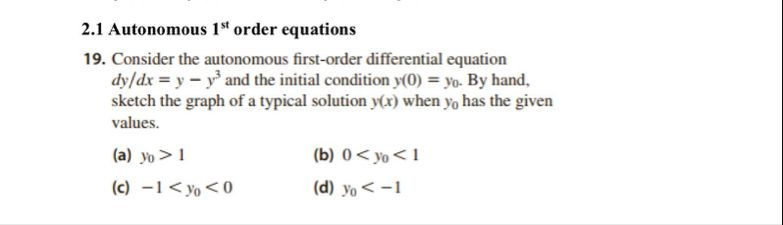 2.1 Autonomous 1% order equations
19. Consider the autonomous first-order differential equation
dy/dx = y = y* and the initial condition (0) = yo. By hand,
sketch the graph of a typical solution y(x) when y; has the given
values.
@ yo>1 (b) 0
This is AI generated Response.
Asked by: Roshan
Created at: 2025-11-07 03:04:49
Asked by: Roshan
Created at: 2025-11-07 03:04:49
Final Answer:
Rendered
Raw Text
Did you like this answer?
## Step 1: Analyze the Differential Equation
Given:
\[
\frac{dy}{dx} = y - y^3
\]
**Find the equilibrium points:**
Set \(\frac{dy}{dx} = \):
\[
y - y^3 = \implies y(1 - y^2) = \implies y = , \pm1
\]
- These are the equilibrium solutions.
**Stability Analysis:**
- For \(y > 1\): \(y - y^3 < \) (since \(y^3 > y\)), so \(y\) decreases.
- For \( < y < 1\): \(y - y^3 > \), so \(y\) increases.
- For \(-1 < y < \): \(y - y^3 < \), so \(y\) decreases.
- For \(y < -1\): \(y - y^3 > \), so \(y\) increases.
**Explanation:**
We determined the equilibrium points \(y = -1, , 1\), and the direction of the solution's movement depending on the value of \(y_\).
---
## Step 2: Sketch and Describe Typical Solution Behaviors
### (a) \(y_ > 1\)
- Solution **decreases toward** \(y=1\) but never crosses it.
### (b) \( < y_ < 1\)
- Solution **increases toward** \(y=1\).
### (c) \(-1 < y_ < \)
- Solution **decreases toward** \(y=-1\).
### (d) \(y_ < -1\)
- Solution **increases toward** \(y=-1\).
**Explanation:**
- \(y=1\) and \(y=-1\) are stable equilibrium points (attractors).
- \(y=\) is an unstable equilibrium (repellor).
---
## Final Answer
- **For \(y_ > 1\):** Solution decreases, approaching \(y=1\) from above.
- **For \( < y_ < 1\):** Solution increases, approaching \(y=1\) from below.
- **For \(-1 < y_ < \):** Solution decreases, approaching \(y=-1\) from above.
- **For \(y_ < -1\):** Solution increases, approaching \(y=-1\) from below.
**Graphically:**
All solutions tend toward \(y=1\) (if they start above ) or toward \(y=-1\) (if they start below ). The line \(y=\) is unstable.
Question:
Solved all parts step by step
This is AI generated Response.
Asked by: Roshan
Created at: 2025-11-07 03:05:19
Asked by: Roshan
Created at: 2025-11-07 03:05:19
Final Answer:
Rendered
Raw Text
Did you like this answer?
# Analysis of Autonomous First-Order Differential Equation
The given differential equation is:
\[
\frac{dy}{dx} = y - y^3
\]
## Step 1: Find Equilibrium Points and Stability
### Equilibrium Points
Set \(\frac{dy}{dx} = 0\):
\[
y - y^3 = 0 \implies y(1 - y^2) = 0
\]
The solutions are:
- \(y = 0\)
- \(y = 1\)
- \(y = -1\)
### Stability Analysis
- **For \(y > 1\)**: \(y - y^3 < 0\) (decreases).
- **For \(0 < y < 1\)**: \(y - y^3 > 0\) (increases).
- **For \(-1 < y < 0\)**: \(y - y^3 < 0\) (decreases).
- **For \(y < -1\)**: \(y - y^3 > 0\) (increases).
### Explanation
- The equilibrium points are classified as:
- **Stable:** \(y = 1\) and \(y = -1\) (solutions approach these points).
- **Unstable:** \(y = 0\) (solutions move away from this point).
---
## Step 2: Sketch Typical Solution Behaviors Based on Initial Conditions
### (a) \(y_0 > 1\)
- The solution **decreases** toward \(y = 1\).
### (b) \(0 < y_0 < 1\)
- The solution **increases** toward \(y = 1\).
### (c) \(-1 < y_0 < 0\)
- The solution **decreases** toward \(y = -1\).
### (d) \(y_0 < -1\)
- The solution **increases** toward \(y = -1\).
### Explanation
- Solutions starting above \(y = 1\) will decrease, while those starting between \(0\) and \(1\) will increase toward \(y = 1\). Solutions starting between \(-1\) and \(0\) will decrease toward \(y = -1\), and those starting below \(-1\) will increase toward \(y = -1\).
---
## Final Answer Summary
- **For \(y_0 > 1\)**: Decreases toward \(y = 1\).
- **For \(0 < y_0 < 1\)**: Increases toward \(y = 1\).
- **For \(-1 < y_0 < 0\)**: Decreases toward \(y = -1\).
- **For \(y_0 < -1\)**: Increases toward \(y = -1\).
This behavior highlights the stability of the equilibrium points \(y = 1\) and \(y = -1\) and the instability at \(y = 0\).
📢 Instructions:
- Ask anything relatd to above question only.
- For new Question goto :