 VIPSolutions
Give step-by-step solution with explanation and final answer:*2 7 ad LS / 3) a 12: 7 mw [TNT] my [«—S- / 7 QU OO xX The equation of motion for the my mass above can be written as —- —k: c k: F, i= Ey By — dt — ay — my me ma m2 me (a) Create a free body diagram of the system and verify that the above equation is true for mass ma. What's your reasoning? (b) Write the state vector X for the above equation. (c) Is it possible to find a state space solution from the given equation? Why or why not? (hint: Do we have enough info that we can solve the system?)
Question:
Give step-by-step solution with explanation and final answer: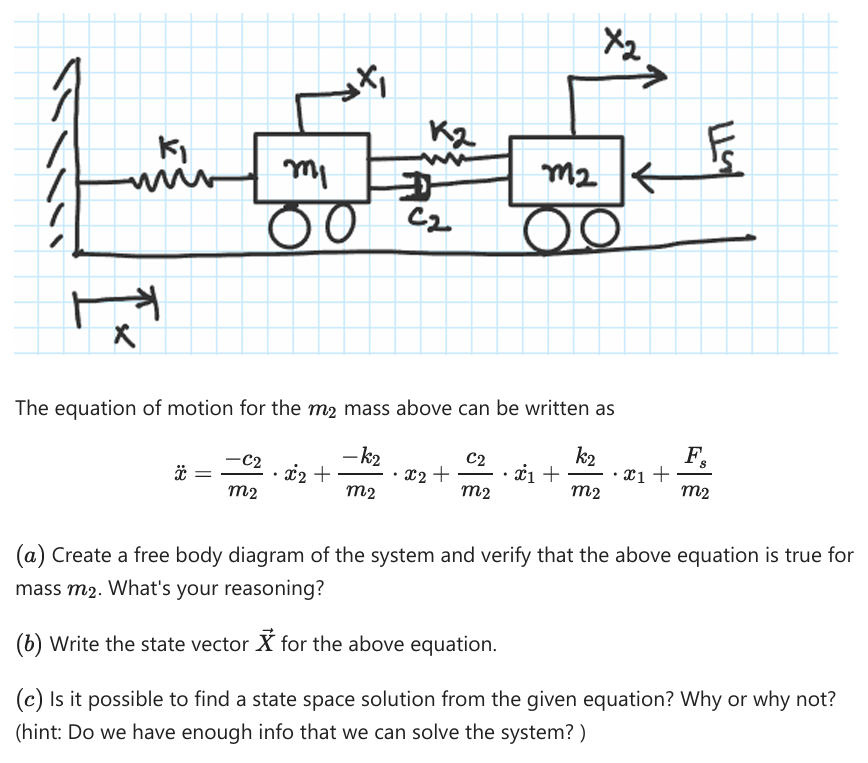 *2
7 ad
LS
/ 3) a 12:
7 mw [TNT] my [«—S-
/
7 QU OO
xX
The equation of motion for the my mass above can be written as
—- —k: c k: F,
i= Ey By — dt — ay —
my me ma m2 me
(a) Create a free body diagram of the system and verify that the above equation is true for
mass ma. What's your reasoning?
(b) Write the state vector X for the above equation.
(c) Is it possible to find a state space solution from the given equation? Why or why not?
(hint: Do we have enough info that we can solve the system?)
This is AI generated Response.
Asked by: Rahul
Created at: 2026-01-26 04:56:59
Asked by: Rahul
Created at: 2026-01-26 04:56:59
Final Answer:
Rendered
Raw Text
Did you like this answer?
Let's break down the steps as requested:
---
## (a) Free Body Diagram and Equation Verification for \( m_2 \)
### **Free Body Diagram for \( m_2 \):**
**Forces acting on \( m_2 \):**
- **Spring \( k_2 \) and Damper \( c_2 \) (between \( m_1 \) and \( m_2 \)):**
- Spring force: \( F_{k2} = k_2(x_1 - x_2) \)
- Damper force: \( F_{c2} = c_2(\dot{x}_1 - \dot{x}_2) \)
- **External Force:** \( F_s \) (applied to \( m_2 \))
**Total force on \( m_2 \):**
\[
F_{m_2} = k_2(x_1 - x_2) + c_2(\dot{x}_1 - \dot{x}_2) + F_s
\]
**Newton's Second Law:**
\[
m_2 \ddot{x}_2 = k_2(x_1 - x_2) + c_2(\dot{x}_1 - \dot{x}_2) + F_s
\]
**Expanding:**
\[
m_2 \ddot{x}_2 = k_2 x_1 - k_2 x_2 + c_2 \dot{x}_1 - c_2 \dot{x}_2 + F_s
\]
**Divide by \( m_2 \):**
\[
\ddot{x}_2 = \frac{k_2}{m_2} x_1 - \frac{k_2}{m_2} x_2 + \frac{c_2}{m_2} \dot{x}_1 - \frac{c_2}{m_2} \dot{x}_2 + \frac{F_s}{m_2}
\]
**Rearrange:**
\[
\ddot{x}_2 = -\frac{c_2}{m_2} \dot{x}_2 - \frac{k_2}{m_2} x_2 + \frac{c_2}{m_2} \dot{x}_1 + \frac{k_2}{m_2} x_1 + \frac{F_s}{m_2}
\]
**This matches the given equation.**
---
## (b) State Vector \( \vec{X} \)
Let’s define the state vector:
\[
\vec{X} =
\begin{bmatrix}
x_2 \\
\dot{x}_2
\end{bmatrix}
\]
If we only consider the \( m_2 \) mass, the state-space form is:
\[
\frac{d}{dt}
\begin{bmatrix}
x_2 \\
\dot{x}_2
\end{bmatrix}
=
\begin{bmatrix}
\dot{x}_2 \\
-\frac{c_2}{m_2} \dot{x}_2 - \frac{k_2}{m_2} x_2 + \frac{c_2}{m_2} \dot{x}_1 + \frac{k_2}{m_2} x_1 + \frac{F_s}{m_2}
\end{bmatrix}
\]
But note: \( x_1, \dot{x}_1 \) are from the other mass and are not defined by this equation alone!
---
## (c) Is State Space Solution Possible?
**No, it is _not_ possible to fully solve the system using only the given equation.**
### **Reason:**
- The equation for \( m_2 \) depends on both \( x_1 \) and \( \dot{x}_1 \) (the position and velocity of \( m_1 \)).
- We do **not** have the equation of motion for \( m_1 \).
- Without the coupled equation for \( m_1 \), the system is **underdetermined**; we have two unknowns (\( x_1 \) and \( x_2 \)) and only one equation.
- To construct the **full state-space model**, we need both equations (for \( m_1 \) and \( m_2 \)).
---
## **Summary Table**
| Part | Solution |
|------|----------|
| (a) | The free body diagram for \( m_2 \) leads to the given equation. Verified. |
| (b) | State vector: \( \vec{X} = \begin{bmatrix} x_2 \\ \dot{x}_2 \end{bmatrix} \) but the equation is not self-contained. |
| (c) | **No,** we cannot find a state-space solution from this equation alone because the dynamics of \( x_1 \), \( \dot{x}_1 \) are missing. |
---
**If you need the state-space for the full two-mass system, you would need both equations (for \( m_1 \) and \( m_2 \)).**
Question:
Solved all parts
This is AI generated Response.
Asked by: Rahul
Created at: 2026-01-26 04:57:36
Asked by: Rahul
Created at: 2026-01-26 04:57:36
Final Answer:
Rendered
Raw Text
Did you like this answer?
# Step-by-Step Solution to the Problem
## (a) Free Body Diagram and Equation Verification for \( m_2 \)
### **Free Body Diagram for \( m_2 \)**
**Forces acting on \( m_2 \):**
- **Spring \( k_2 \)**:
- Force due to spring: \( F_{k2} = k_2(x_1 - x_2) \)
- **Damper \( c_2 \)**:
- Force due to damper: \( F_{c2} = c_2(\dot{x}_1 - \dot{x}_2) \)
- **External Force**:
- Applied force: \( F_s \)
### **Total Force on \( m_2 \)**
Using Newton's Second Law:
\[
F_{m_2} = m_2 \ddot{x}_2
\]
The total force equation becomes:
\[
m_2 \ddot{x}_2 = k_2(x_1 - x_2) + c_2(\dot{x}_1 - \dot{x}_2) + F_s
\]
### **Expanding and Rearranging**
Rearranging gives:
\[
m_2 \ddot{x}_2 = k_2 x_1 - k_2 x_2 + c_2 \dot{x}_1 - c_2 \dot{x}_2 + F_s
\]
Dividing by \( m_2 \):
\[
\ddot{x}_2 = \frac{k_2}{m_2} x_1 - \frac{k_2}{m_2} x_2 + \frac{c_2}{m_2} \dot{x}_1 - \frac{c_2}{m_2} \dot{x}_2 + \frac{F_s}{m_2}
\]
This matches the given equation, confirming its validity for mass \( m_2 \).
---
## (b) State Vector \( \vec{X} \)
### **Defining the State Vector**
We define the state vector as:
\[
\vec{X} =
\begin{bmatrix}
x_2 \\
\dot{x}_2
\end{bmatrix}
\]
### **State-Space Formulation**
The state-space representation can be expressed as:
\[
\frac{d}{dt}
\begin{bmatrix}
x_2 \\
\dot{x}_2
\end{bmatrix}
=
\begin{bmatrix}
\dot{x}_2 \\
-\frac{c_2}{m_2} \dot{x}_2 - \frac{k_2}{m_2} x_2 + \frac{c_2}{m_2} \dot{x}_1 + \frac{k_2}{m_2} x_1 + \frac{F_s}{m_2}
\end{bmatrix}
\]
### **Note on Dependencies**
The variables \( x_1 \) and \( \dot{x}_1 \) are from mass \( m_1 \), which are not defined by this equation alone.
---
## (c) Is a State Space Solution Possible?
### **Conclusion: No, it is not possible.**
### **Reasoning:**
- The motion equation for \( m_2 \) depends on \( x_1 \) and \( \dot{x}_1 \), which are not provided.
- The system is **underdetermined** because we have two unknowns (\( x_1 \) and \( x_2 \)) but only one equation.
- To fully derive a state-space model, we need the equations of motion for both \( m_1 \) and \( m_2 \).
---
## **Summary Table**
| Part | Solution |
|------|----------|
| (a) | Verified the equation for \( m_2 \) using a free body diagram. |
| (b) | State vector: \( \vec{X} = \begin{bmatrix} x_2 \\ \dot{x}_2 \end{bmatrix} \) with a dependent equation. |
| (c) | **No,** the solution cannot be found with the given information alone. |
---
This structured approach clarifies the verification process, state vector definition, and the limitations in deriving a complete state-space solution.
📢 Instructions:
- Ask anything relatd to above question only.
- For new Question goto :