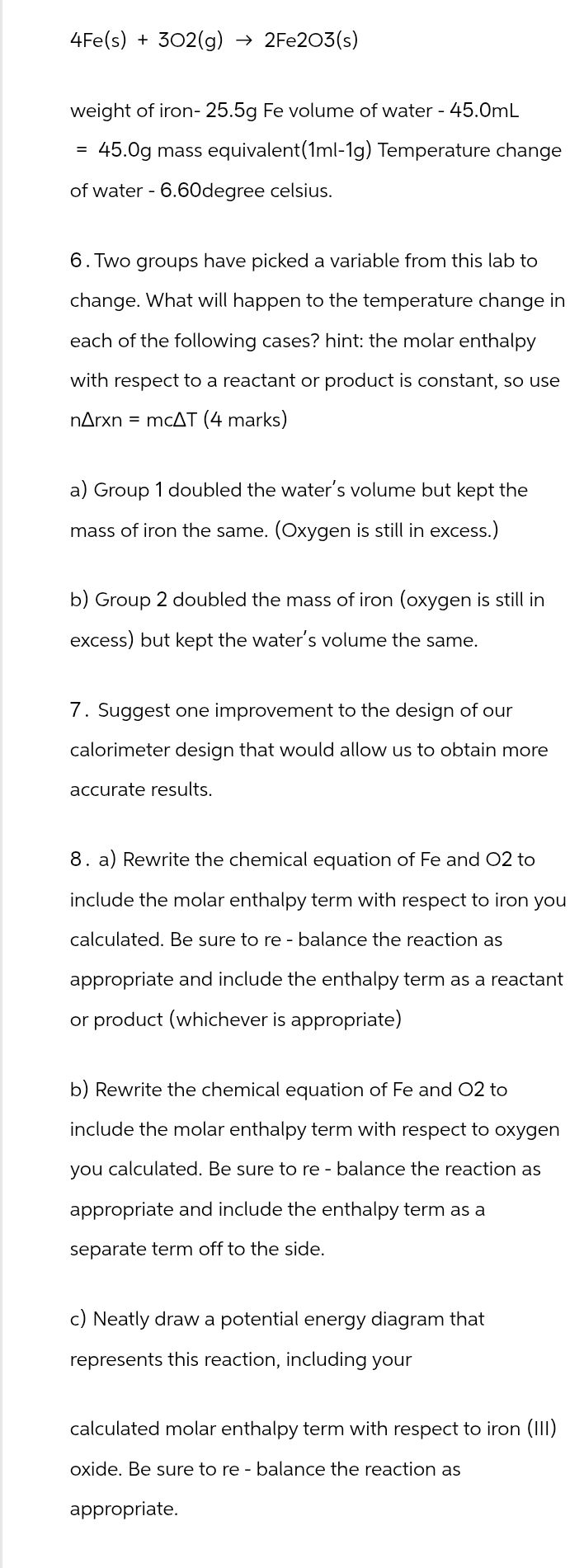
give answer in 2 step with explanation at the end of each step and final answer at the end:4Fe(s) + 302(g) — 2Fe203(s)
weight of iron- 25.59 Fe volume of water - 45.0mL
= 45.0g mass equivalent(1ml-1g) Temperature change
of water - 6.60degree celsius.
6. Two groups have picked a variable from this lab to
change. What will happen to the temperature change in
each of the following cases? hint: the molar enthalpy
with respect to a reactant or product is constant, so use
nArxn = mcAT (4 marks)
a) Group 1 doubled the water's volume but kept the
mass of iron the same. (Oxygen is still in excess.)
b) Group 2 doubled the mass of iron (oxygen is still in
excess) but kept the water's volume the same.
7. Suggest one improvement to the design of our
calorimeter design that would allow us to obtain more
accurate results.
8. a) Rewrite the chemical equation of Fe and O2 to
include the molar enthalpy term with respect to iron you
calculated. Be sure to re - balance the reaction as
appropriate and include the enthalpy term as a reactant
or product (whichever is appropriate)
b) Rewrite the chemical equation of Fe and O2 to
include the molar enthalpy term with respect to oxygen
you calculated. Be sure to re - balance the reaction as
appropriate and include the enthalpy term as a
separate term off to the side.
c) Neatly draw a potential energy diagram that
represents this reaction, including your
calculated molar enthalpy term with respect to iron (Ill)
oxide. Be sure to re - balance the reaction as
appropriate.
Question:
give answer in 2 step with explanation at the end of each step and final answer at the end:4Fe(s) + 302(g) — 2Fe203(s)
weight of iron- 25.59 Fe volume of water - 45.0mL
= 45.0g mass equivalent(1ml-1g) Temperature change
of water - 6.60degree celsius.
6. Two groups have picked a variable from this lab to
change. What will happen to the temperature change in
each of the following cases? hint: the molar enthalpy
with respect to a reactant or product is constant, so use
nArxn = mcAT (4 marks)
a) Group 1 doubled the water's volume but kept the
mass of iron the same. (Oxygen is still in excess.)
b) Group 2 doubled the mass of iron (oxygen is still in
excess) but kept the water's volume the same.
7. Suggest one improvement to the design of our
calorimeter design that would allow us to obtain more
accurate results.
8. a) Rewrite the chemical equation of Fe and O2 to
include the molar enthalpy term with respect to iron you
calculated. Be sure to re - balance the reaction as
appropriate and include the enthalpy term as a reactant
or product (whichever is appropriate)
b) Rewrite the chemical equation of Fe and O2 to
include the molar enthalpy term with respect to oxygen
you calculated. Be sure to re - balance the reaction as
appropriate and include the enthalpy term as a
separate term off to the side.
c) Neatly draw a potential energy diagram that
represents this reaction, including your
calculated molar enthalpy term with respect to iron (Ill)
oxide. Be sure to re - balance the reaction as
appropriate.
This is AI generated Response.
Asked by: Rahul
Created at: 2025-12-17 14:02:26
Final Answer:
RenderedRaw Text
Did you like this answer?
Let's answer **question 6** in two steps, with explanations at each step:
---
## Step 1: Write the relationship
Recall the relationship given in the hint:
\[
n\Delta H_{rxn} = mc\Delta T
\]
Where:
- \( n \) = moles of limiting reactant
- \( \Delta H_{rxn} \) = molar enthalpy change
- \( m \) = mass of water
- \( c \) = specific heat capacity of water
- \( \Delta T \) = temperature change
We solve for \( \Delta T \):
\[
\Delta T = \frac{n\Delta H_{rxn}}{mc}
\]
**Explanation:**
This equation shows that temperature change (\( \Delta T \)) is directly proportional to the number of moles reacting (if water mass is constant), and inversely proportional to the mass of water (if moles reacting are constant).
---
## Step 2: Analyze Each Case
### a) **Group 1 doubled the water’s volume but kept the mass of iron the same.**
- Mass of water doubles (\( m \rightarrow 2m \)), but moles of iron (and thus \( n \)) are the same.
- Using the equation above:
\[
\Delta T_{new} = \frac{n\Delta H_{rxn}}{2mc} = \frac{1}{2}\left(\frac{n\Delta H_{rxn}}{mc}\right) = \frac{1}{2}\Delta T_{original}
\]
**Explanation:**
Doubling the mass of water while keeping everything else constant will **halve the temperature change**.
---
### b) **Group 2 doubled the mass of iron but kept the water’s volume the same.**
- Moles of iron (\( n \)) double, but mass of water is constant.
- Using the equation above:
\[
\Delta T_{new} = \frac{2n\Delta H_{rxn}}{mc} = 2\left(\frac{n\Delta H_{rxn}}{mc}\right) = 2\Delta T_{original}
\]
**Explanation:**
Doubling the amount of iron (with excess oxygen and same water mass) will **double the temperature change**.
---
## **Final Answers**
### a) The temperature change will be **halved**.
### b) The temperature change will be **doubled**.
Question:
Solved all parts
This is AI generated Response.
Asked by: Rahul
Created at: 2025-12-17 14:02:54
Final Answer:
RenderedRaw Text
Did you like this answer?
# Question 7: Improvement Suggestion
## Suggestion for Calorimeter Design
### Improvement
- **Insulation Enhancement:** Increase the thermal insulation of the calorimeter to minimize heat exchange with the environment.
### Explanation
Improving insulation will ensure that more of the heat generated by the reaction is absorbed by the water, leading to more accurate temperature measurements.
---
# Question 8: Chemical Equations with Molar Enthalpy
## a) Chemical Equation with Molar Enthalpy (Iron)
### Equation
\[
4 \text{Fe}(s) + 3 \text{O}_2(g) + \Delta H = 2 \text{Fe}_2\text{O}_3(s)
\]
### Explanation
The enthalpy change (\( \Delta H \)) is included as a product, indicating heat is released during the reaction.
---
## b) Chemical Equation with Molar Enthalpy (Oxygen)
### Equation
\[
4 \text{Fe}(s) + 3 \text{O}_2(g) \rightarrow 2 \text{Fe}_2\text{O}_3(s) + \Delta H
\]
### Explanation
Here, the enthalpy change is shown as a separate term, indicating it is associated with the oxygen used in the reaction.
---
## c) Potential Energy Diagram
### Diagram Description
- **Y-axis:** Potential Energy
- **X-axis:** Reaction Progress
- **Reactants:** \(4 \text{Fe} + 3 \text{O}_2\) at a higher energy level
- **Products:** \(2 \text{Fe}_2\text{O}_3\) at a lower energy level
- **Activation Energy:** A peak indicating the energy required to initiate the reaction.
- **Enthalpy Change (\( \Delta H \))**: The difference in energy between reactants and products, indicated as a downward arrow.
### Explanation
This diagram visually represents the energy changes during the reaction, showing that energy is released as the reaction proceeds from reactants to products.
VIPSolutions focuses on clear, step‑by‑step explanations so you can learn quickly. Whether you need an AI‑generated walkthrough or a short hint to get unstuck, each solution is organized for fast reading and easy review later.
Search similar questions, compare approaches, and bookmark the best answers for revision. Our goal is simple: quick, reliable study help that feels natural—not noisy.
 VIPSolutions
 4Fe(s) + 302(g) — 2Fe203(s)
weight of iron- 25.59 Fe volume of water - 45.0mL
= 45.0g mass equivalent(1ml-1g) Temperature change
of water - 6.60degree celsius.
6. Two groups have picked a variable from this lab to
change. What will happen to the temperature change in
each of the following cases? hint: the molar enthalpy
with respect to a reactant or product is constant, so use
nArxn = mcAT (4 marks)
a) Group 1 doubled the water's volume but kept the
mass of iron the same. (Oxygen is still in excess.)
b) Group 2 doubled the mass of iron (oxygen is still in
excess) but kept the water's volume the same.
7. Suggest one improvement to the design of our
calorimeter design that would allow us to obtain more
accurate results.
8. a) Rewrite the chemical equation of Fe and O2 to
include the molar enthalpy term with respect to iron you
calculated. Be sure to re - balance the reaction as
appropriate and include the enthalpy term as a reactant
or product (whichever is appropriate)
b) Rewrite the chemical equation of Fe and O2 to
include the molar enthalpy term with respect to oxygen
you calculated. Be sure to re - balance the reaction as
appropriate and include the enthalpy term as a
separate term off to the side.
c) Neatly draw a potential energy diagram that
represents this reaction, including your
calculated molar enthalpy term with respect to iron (Ill)
oxide. Be sure to re - balance the reaction as
appropriate.