 VIPSolutions
solve with proper explanationA | 200i 35° H Q J! Fig. £20 and Pry 2.4 Two forces P and Q are applied as shown at point A of a hook support. Knowing that £ = 60 1h and © = 25 Ib, determine graphically the magnitude and direction of their resultant wsing (a) the parallelogram law. (5) the tangle rede. @®
Question:
solve with proper explanation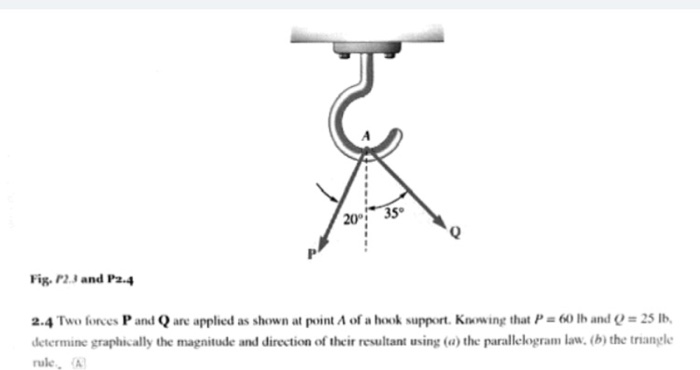 A
|
200i 35°
H Q
J!
Fig. £20 and Pry
2.4 Two forces P and Q are applied as shown at point A of a hook support. Knowing that £ = 60 1h and © = 25 Ib,
determine graphically the magnitude and direction of their resultant wsing (a) the parallelogram law. (5) the tangle
rede. @®
This is AI generated Response.
Asked by: manish kumar
Created at: 2025-08-15 10:24:57
Asked by: manish kumar
Created at: 2025-08-15 10:24:57
Final Answer:
Rendered
Raw Text
Did you like this answer?
Let's break down the solution step by step. Here’s the **problem restated**:
---
**Given:**
- Two forces applied at point A:
- \( P = 60 \) lb at \( 20^\circ \) to the vertical (left side)
- \( Q = 25 \) lb at \( 35^\circ \) to the vertical (right side)
- **Required:** Determine graphically the magnitude and direction of their resultant using:
- (a) the **parallelogram law**
- (b) the **triangle rule**
---
## 1. **Find the Angle Between the Forces**
The angle between \( P \) and \( Q \) is:
\[
\theta = 20^\circ + 35^\circ = 55^\circ
\]
---
## 2. **Parallelogram Law**
The parallelogram law states:
\[
R = \sqrt{P^2 + Q^2 + 2PQ\cos\theta}
\]
Where:
- \( P = 60 \) lb
- \( Q = 25 \) lb
- \( \theta = 55^\circ \)
### **Calculate:**
\[
R = \sqrt{60^2 + 25^2 + 2 \times 60 \times 25 \times \cos(55^\circ)}
\]
First, calculate \( \cos(55^\circ) \):
\[
\cos(55^\circ) \approx 0.5736
\]
Plug values in:
\[
R = \sqrt{3600 + 625 + 2 \times 60 \times 25 \times 0.5736}
\]
\[
2 \times 60 \times 25 = 3000
\]
\[
3000 \times 0.5736 = 1720.8
\]
\[
R = \sqrt{3600 + 625 + 1720.8}
\]
\[
R = \sqrt{5945.8}
\]
\[
R \approx 77.1 \text{ lb}
\]
---
### **Direction of Resultant (\(\alpha\))**
Let \(\alpha\) be the angle between \(P\) and \(R\):
\[
\tan\alpha = \frac{Q \sin\theta}{P + Q \cos\theta}
\]
Plug in values:
- \(Q = 25\)
- \(P = 60\)
- \(\sin(55^\circ) \approx 0.8192\)
- \(\cos(55^\circ) \approx 0.5736\)
\[
\tan\alpha = \frac{25 \times 0.8192}{60 + 25 \times 0.5736}
\]
\(25 \times 0.8192 = 20.48\)
\(25 \times 0.5736 = 14.34\)
\[
\tan\alpha = \frac{20.48}{74.34}
\]
\[
\tan\alpha \approx 0.2756
\]
\[
\alpha \approx \arctan(0.2756) \approx 15.4^\circ
\]
**This angle is measured from \(P\) towards the resultant \(R\).**
---
## 3. **Triangle Rule**
The triangle rule gives the same result as parallelogram law since it is just rearranging the vectors head-to-tail. The magnitude and direction will be identical:
- **Magnitude:** \(77.1\) lb
- **Direction:** \(15.4^\circ\) from \(P\) towards \(Q\)
---
## **Summary Table**
| Method | Magnitude (lb) | Direction (from \(P\)) |
|--------------------|----------------|------------------------|
| Parallelogram Law | 77.1 | \(15.4^\circ\) |
| Triangle Rule | 77.1 | \(15.4^\circ\) |
---
## **Graphical Representation** (Explanation)
- **Parallelogram law:** Draw vectors \(P\) and \(Q\) from point \(A\) at their given angles. Complete the parallelogram. The diagonal from \(A\) gives the resultant.
- **Triangle rule:** Draw \(P\) from \(A\), then \(Q\) from the tip of \(P\) at the correct angle. The vector from \(A\) to the tip of \(Q\) is the resultant.
---
If you need a graphical drawing or more details, let me know!
📢 Instructions:
- Ask anything relatd to above question only.
- For new Question goto :