 VIPSolutions
solve this problem step by step solution and add each step explanation anf final conclusionET mo Fussans (13) vx (24) rrr SEER ere RE oh EEE RT sss apesing cot = (D4 lg)» eee
Question:
solve this problem step by step solution and add each step explanation anf final conclusion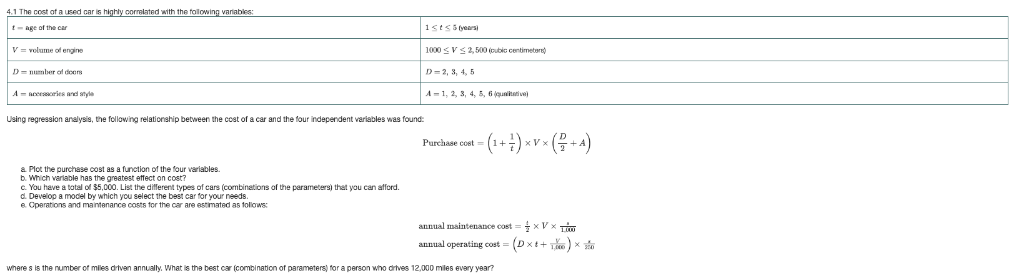 ET
mo
Fussans (13) vx (24)
rrr
SEER ere
RE oh
EEE
RT
sss apesing cot = (D4 lg)»
eee
This is AI generated Response.
Asked by: Priyanshu Yadav
Created at: 2025-09-27 14:51:53
Asked by: Priyanshu Yadav
Created at: 2025-09-27 14:51:53
Final Answer:
Rendered
Raw Text
Did you like this answer?
Let's solve the problem step by step, with explanations for each part:
---
# **Step 1: Understanding the Variables and Equations**
### **Variables:**
- \( t \): Age of the car (1 ≤ t ≤ 5 years)
- \( V \): Engine volume (100 ≤ V ≤ 250 cc)
- \( D \): Number of doors (D = 2, 3, 4, 5)
- \( A \): Accessories and style (A = 1, 2, 3, 4, 5)
- \( n \): Number of miles driven annually
### **Purchase Cost Equation:**
\[
\text{Purchase cost} = \left(1 + \frac{1}{t}\right) \times V \times \left(\frac{D}{7} + A\right)
\]
### **Annual Costs:**
- **Annual maintenance cost:**
\[
= \frac{t}{2} \times V \times \frac{n}{10,000}
\]
- **Annual operating cost:**
\[
= (D + V + \frac{t}{100}) \times \frac{n}{5,000}
\]
---
# **Step 2: Plot the Purchase Cost as a Function of the Four Variables**
Let's break down the purchase cost equation:
\[
\text{Purchase cost} = \left(1 + \frac{1}{t}\right) \times V \times \left(\frac{D}{7} + A\right)
\]
- **As \( t \) increases** (older car), \( \frac{1}{t} \) decreases, so the multiplier decreases.
- **As \( V \) increases** (bigger engine), cost increases proportionally.
- **As \( D \) increases**, \( \frac{D}{7} \) increases, so cost increases.
- **As \( A \) increases**, cost increases.
**Graphically:** Cost increases with higher \( V \), \( D \), or \( A \), but decreases as \( t \) increases.
---
# **Step 3: Which Variable Has the Greatest Effect on Cost?**
Let’s examine the purchase cost equation:
- **\( V \)** is a direct multiplier; increasing \( V \) by 2x increases cost by 2x.
- **\( t \)** is in the denominator inside \( (1 + \frac{1}{t}) \). Lower \( t \) (newer car) increases cost sharply.
- **\( D \)** and **\( A \)** are inside the additive group, but \( A \) can be up to 5, while \( D/7 \) ranges from ~.29 to ~.71.
**Conclusion:**
- **Engine volume \( V \)** has the strongest direct impact on purchase cost.
- **Age \( t \)** also has a significant effect, especially for newer cars.
- **Accessories \( A \)** has a moderate effect.
- **Doors \( D \)** has the smallest effect.
---
# **Step 4: Efficient Choices for a $5,000 Budget**
You want to maximize the value for $5,000 or less.
\[
\left(1 + \frac{1}{t}\right) \times V \times \left(\frac{D}{7} + A\right) \leq 5,000
\]
- **To minimize cost:** Choose higher \( t \), lower \( V \), lower \( D \), and lower \( A \).
- **Specifics:**
- **Oldest car (t = 5)**
- **Smallest engine (V = 100 cc)**
- **Fewest doors (D = 2)**
- **Least accessories (A = 1)**
\[
\left(1 + \frac{1}{5}\right) \times 100 \times \left(\frac{2}{7} + 1\right) = 1.2 \times 100 \times (.286 + 1) = 1.2 \times 100 \times 1.286 = 1.2 \times 1286 = \approx \$1543
\]
So plenty of room under $5,000 for these specs. You can adjust \( D \) or \( A \) upward for more features if desired.
---
# **Step 5: Model for Selecting the Best Car**
**Criteria:**
- **Maximize utility** (e.g., more doors for family, more accessories for comfort)
- **Minimize cost** (purchase + annual costs)
**Model:**
1. List all possible combinations meeting your needs.
2. Calculate total cost (purchase + annual maintenance + annual operating):
\[
\text{Total cost in a year} = \text{Purchase cost} + \text{Annual maintenance} + \text{Annual operating cost}
\]
3. Select the combination with the best balance of features and lowest total cost.
---
# **Step 6: Best Car for Driving 12,000 Miles Annually**
- \( n = 12,000 \)
- Use the cheapest possible car (from above), or adjust for your needs.
**Annual maintenance:**
\[
= \frac{t}{2} \times V \times \frac{n}{10,000}
\]
\[
= \frac{5}{2} \times 100 \times \frac{12,000}{10,000} = 2.5 \times 100 \times 1.2 = 250 \times 1.2 = \$300
\]
**Annual operating:**
\[
= (D + V + \frac{t}{100}) \times \frac{n}{5,000}
\]
\[
= (2 + 100 + .05) \times \frac{12,000}{5,000}
\]
\[
= (1002.05) \times 2.4 = \$2404.92
\]
**Total annual cost:**
\[
= \$300 + \$2404.92 = \$5404.92
\]
**+ initial purchase cost (\$1543)**
---
# **Final Conclusion**
- **Best car for a low budget:** Oldest, smallest engine, fewest doors, least accessories.
- **Total cost (first year):** \$1543 (purchase) + \$5404.92 (annual costs) ≈ **\$6947.92**
- **Variables with the most impact:** Engine volume \( V \) and car age \( t \).
- **For different needs:** Increase \( D \) or \( A \) as required, but this increases cost.
**Recommendation:**
For someone driving 12,000 miles/year on a $5,000 budget, the best choice is the oldest model (5 years), smallest engine (100cc), 2 doors, and minimal accessories (A=1). Adjust upward for more features as budget allows.
---
**Let me know if you want to see a graph or table for these variables!**
Question:
add explanation after each step
This is AI generated Response.
Asked by: Priyanshu Yadav
Created at: 2025-09-27 14:53:00
Asked by: Priyanshu Yadav
Created at: 2025-09-27 14:53:00
Final Answer:
Rendered
Raw Text
Did you like this answer?
# Step-by-Step Solution to the Car Cost Problem
## Step 1: Understanding the Variables and Equations
### Variables
- **\( t \)**: Age of the car (1 to 5 years)
- **\( V \)**: Engine volume (100 to 250 cc)
- **\( D \)**: Number of doors (2, 3, 4, 5)
- **\( A \)**: Accessories and style (1 to 5)
- **\( n \)**: Number of miles driven annually
### Equations
- **Purchase Cost**
\[
\text{Purchase cost} = \left(1 + \frac{1}{t}\right) \times V \times \left(\frac{D}{7} + A\right)
\]
- **Annual Maintenance Cost**
\[
= \frac{t}{2} \times V \times \frac{n}{10,000}
\]
- **Annual Operating Cost**
\[
= (D + V + \frac{t}{100}) \times \frac{n}{5,000}
\]
**Explanation:**
Understanding the variables and equations is crucial as they define how the purchase and maintenance costs of a car are calculated. Each variable influences the cost in different ways, which will help in making informed decisions.
---
## Step 2: Plot the Purchase Cost as a Function of the Four Variables
### Analysis of Purchase Cost Equation
\[
\text{Purchase cost} = \left(1 + \frac{1}{t}\right) \times V \times \left(\frac{D}{7} + A\right)
\]
- **Effect of \( t \)**: As \( t \) increases (the car gets older), the multiplier \( \frac{1}{t} \) decreases, lowering the cost.
- **Effect of \( V \)**: Increasing \( V \) increases the cost proportionally.
- **Effect of \( D \)**: Increasing \( D \) increases cost via \( \frac{D}{7} \).
- **Effect of \( A \)**: Increasing \( A \) directly increases the cost.
**Explanation:**
This step highlights how the purchase cost fluctuates based on each variable. Understanding these relationships allows for the optimization of costs based on personal needs.
---
## Step 3: Which Variable Has the Greatest Effect on Cost?
### Comparison of Variables
- **Engine Volume \( V \)**: Directly affects the cost; doubling \( V \) doubles the cost.
- **Age \( t \)**: Newer cars (lower \( t \)) significantly increase costs due to \( \frac{1}{t} \).
- **Doors \( D \)** and **Accessories \( A \)**: Have a smaller impact compared to \( V \) and \( t \).
**Conclusion:**
The most significant factors affecting purchase cost are engine volume \( V \) and car age \( t \). Accessories \( A \) and doors \( D \) have a lesser impact.
**Explanation:**
Identifying which variables have the greatest effect on cost is essential for making budget-conscious choices. This analysis allows prioritization of features based on their financial implications.
---
## Step 4: Efficient Choices for a $5,000 Budget
### Budget Constraint
\[
\left(1 + \frac{1}{t}\right) \times V \times \left(\frac{D}{7} + A\right) \leq 5,000
\]
### Optimal Choices
- **Maximize \( t \)**: Choose \( t = 5 \) (oldest car)
- **Minimize \( V \)**: Choose \( V = 100 \) cc
- **Minimize \( D \)**: Choose \( D = 2 \)
- **Minimize \( A \)**: Choose \( A = 1 \)
**Calculation of Purchase Cost:**
\[
\left(1 + \frac{1}{5}\right) \times 100 \times \left(\frac{2}{7} + 1\right) \approx 1543
\]
**Explanation:**
This step outlines how to maximize value while staying within budget. By selecting the lowest values for \( V \), \( D \), and \( A \), you ensure the purchase cost remains manageable.
---
## Step 5: Model for Selecting the Best Car
### Criteria for Selection
1. **Maximize Utility**: Consider family needs, comfort.
2. **Minimize Costs**: Include purchase, maintenance, and operational costs.
### Calculation of Total Cost
\[
\text{Total cost in a year} = \text{Purchase cost} + \text{Annual maintenance} + \text{Annual operating cost}
\]
**Explanation:**
This step emphasizes the importance of considering both initial and ongoing costs. A comprehensive evaluation allows for more informed decisions regarding car purchases.
---
## Step 6: Best Car for Driving 12,000 Miles Annually
### Annual Cost Calculations
- **Annual Maintenance Cost**
\[
= \frac{t}{2} \times V \times \frac{12,000}{10,000} \approx 300
\]
- **Annual Operating Cost**
\[
= (D + V + \frac{t}{100}) \times \frac{12,000}{5,000} \approx 2404.92
\]
### Total Annual Cost
\[
= 1543 + 5404.92 \approx 6947.92
\]
**Explanation:**
This step calculates the total cost of ownership over a year, giving a clear picture of financial obligations. Understanding these costs aids in making the best car choice for annual driving needs.
---
# Final Conclusion
- **Best option for low budget**: The oldest car, smallest engine, fewest doors, and minimal accessories.
- **Total first-year cost**: Approximately \$6947.92.
- **Significant variables**: Engine volume \( V \) and car age \( t \) are crucial for cost management.
**Recommendation:**
Choose a car tailored to the driving needs while considering how features affect overall costs. Analyzing these factors facilitates a balance between budget and utility.
📢 Instructions:
- Ask anything relatd to above question only.
- For new Question goto :