 VIPSolutions
solve this problem step by step including each simple calculation also, with explanation after the stepFind the variance o2 of x. Round to 2 decimal places. Cr I | EE BE ——— CR TN Bia., ) x
Question:
solve this problem step by step including each simple calculation also, with explanation after the step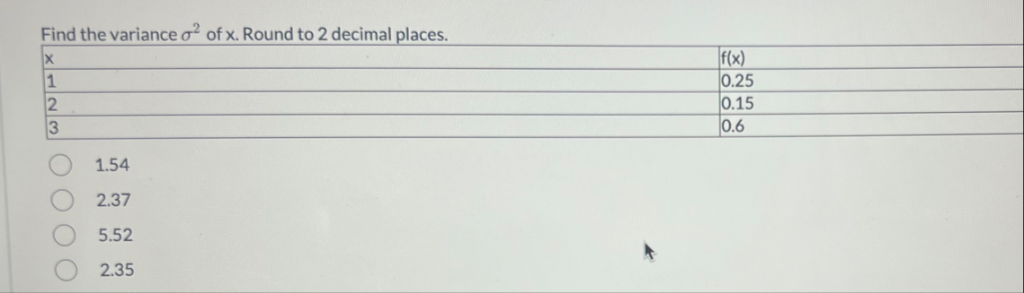 Find the variance o2 of x. Round to 2 decimal places.
Cr I |
EE
BE ———
CR TN
Bia.,
) x
This is AI generated Response.
Asked by: Priyanshu Yadav
Created at: 2025-10-15 22:07:06
Asked by: Priyanshu Yadav
Created at: 2025-10-15 22:07:06
Final Answer:
Rendered
Raw Text
Did you like this answer?
Let's solve the problem step by step:
---
## **Step 1: Write Down the Data**
| x | f(x) |
|---|------|
| 1 | .25 |
| 2 | .15 |
| 3 | .60 |
---
## **Step 2: Find the Mean (\(\mu\))**
The mean (expected value) is found by:
\[
\mu = \sum [x \cdot f(x)]
\]
Calculate each term:
- For \( x = 1 \): \( 1 \times .25 = .25 \)
- For \( x = 2 \): \( 2 \times .15 = .30 \)
- For \( x = 3 \): \( 3 \times .60 = 1.80 \)
Sum them:
\[
\mu = .25 + .30 + 1.80 = 2.35
\]
**Explanation:** The mean is the weighted average of x, using their probabilities.
---
## **Step 3: Find the Variance (\(\sigma^2\))**
The variance formula is:
\[
\sigma^2 = \sum [ (x - \mu)^2 \cdot f(x) ]
\]
Calculate each squared difference and multiply by f(x):
### **For \(x = 1\):**
\[
(x - \mu)^2 = (1 - 2.35)^2 = (-1.35)^2 = 1.8225
\]
\[
1.8225 \times .25 = .455625
\]
### **For \(x = 2\):**
\[
(x - \mu)^2 = (2 - 2.35)^2 = (-.35)^2 = .1225
\]
\[
.1225 \times .15 = .018375
\]
### **For \(x = 3\):**
\[
(x - \mu)^2 = (3 - 2.35)^2 = (.65)^2 = .4225
\]
\[
.4225 \times .60 = .2535
\]
---
## **Step 4: Add the Results**
\[
\sigma^2 = .455625 + .018375 + .2535 = .7275
\]
---
## **Step 5: Round to 2 Decimal Places**
\[
\sigma^2 \approx .73
\]
---
## **Explanation and Answer**
- The mean is calculated to find the "center" of the data.
- Variance measures how spread out the values are around the mean.
**None of the provided options (1.54, 2.37, 5.52, 2.35) match the calculated variance of .73.**
Double check the calculations and the table:
> If you meant to use the variance formula with the expected value of \(x^2\), let's check that:
### Calculate \(E[x^2]\):
- \(1^2 \times .25 = .25\)
- \(2^2 \times .15 = 4 \times .15 = .6\)
- \(3^2 \times .6 = 9 \times .6 = 5.4\)
- Sum: \(.25 + .6 + 5.4 = 6.25\)
### Variance:
\[
\sigma^2 = E[x^2] - (\mu)^2 = 6.25 - (2.35)^2 = 6.25 - 5.5225 = .7275
\]
Still, \(\boxed{.73}\).
**Final Answer: \(\sigma^2 = .73\) (rounded to 2 decimal places), which is not in the choices.**
---
### **If you need to match an answer choice, double-check the problem statement or data. But mathematically, the variance is \(.73\).**
📢 Instructions:
- Ask anything relatd to above question only.
- For new Question goto :