 VIPSolutions
solve the question in 2 steps with examples and the final answer.No Ras tv. OO) . . i S BE 0 588 0% x > £38585 TERED ER ERE oBRtE 0 gas. EB A fee EB 55 & = 5 8B = 2 HERE = 2 Pe Ela e © @ £5 EgEaiece IE EEE EES sETeE ou : o = © EERE Na 83g Ems 5 cE sS LE 2 2 @ Sg 2 5 g i ges ol H 3 3 08 B = on 2 2 Gof ths mg 2s Neg Eno Se Se 5 8 Ela xg ep 5 2 5 Eni pu 2 = = 2 = %) Z 2 eo E84 = = B at = ~~) Ee © Eo cs Be eo Oi So see DB ol a [=] 5 ERR; =o 5 ore 8 Rr £2 2 5.0.28 5 Bp EE oR E es Gn a B B55 2 gH e 2g BL. s £2283 ENE BE sECo@ © 2 fats ECD. Bs jE SE on & 8 TREE SORE ™ a8 a = BR 8 ; 525: le) Fegs B Bo & Sis (gl | Ai JE
Question:
solve the question in 2 steps with examples and the final answer.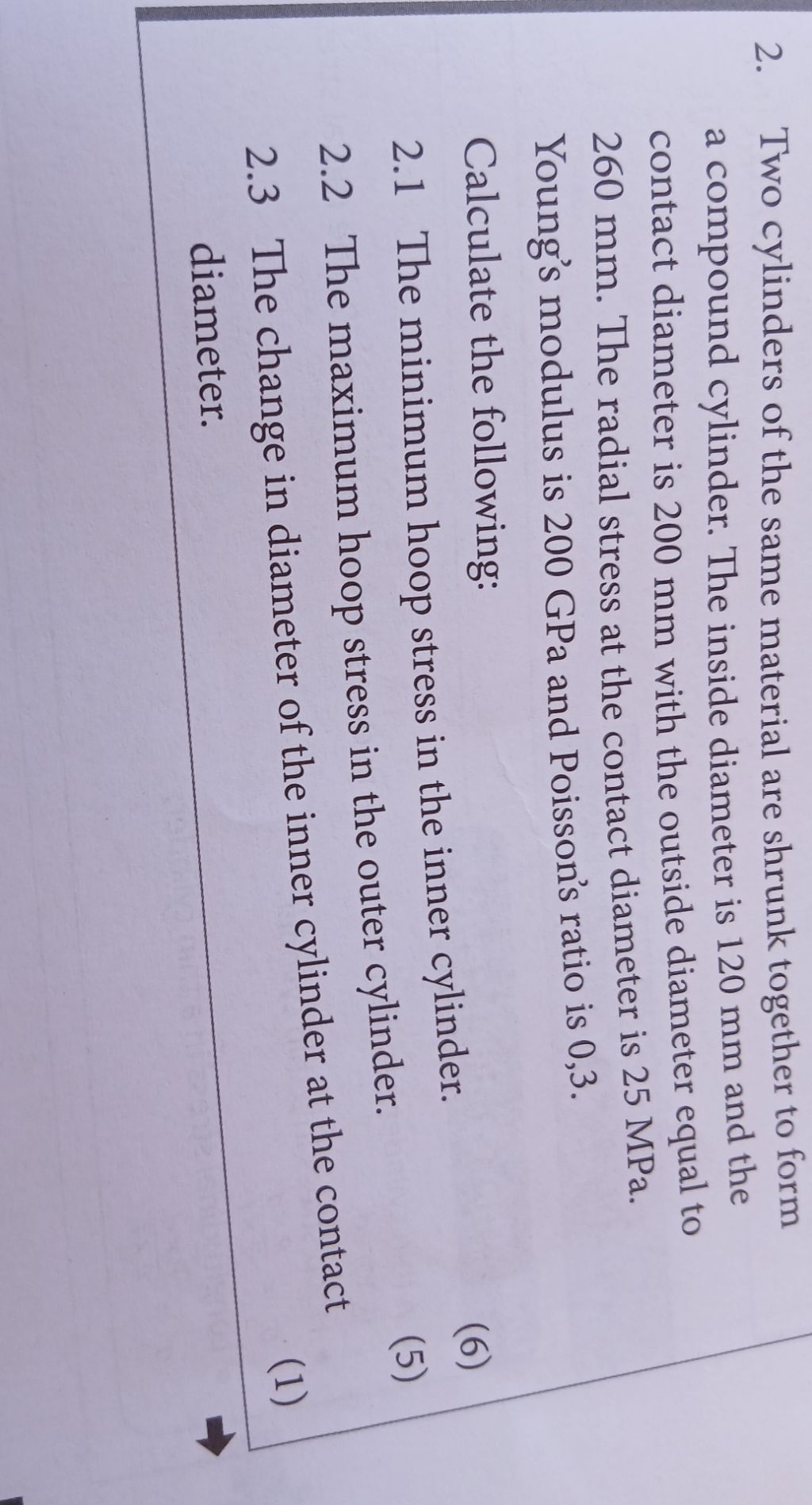 No
Ras tv. OO)
. . i S
BE 0 588 0%
x > £38585
TERED
ER ERE oBRtE
0 gas. EB A
fee EB 55 &
= 5 8B = 2 HERE
= 2 Pe Ela e © @
£5 EgEaiece
IE EEE
EES sETeE
ou : o =
© EERE Na 83g
Ems 5 cE sS LE
2 2 @ Sg 2 5
g i ges ol H
3 3 08 B
= on 2 2
Gof ths mg 2s Neg
Eno Se Se 5 8
Ela xg ep 5 2 5
Eni pu 2 = = 2
= %) Z 2 eo E84
= = B at = ~~)
Ee © Eo cs Be
eo Oi So
see DB ol a [=]
5 ERR;
=o 5 ore 8
Rr £2 2 5.0.28 5
Bp EE oR E
es Gn a B B55
2 gH e 2g
BL. s £2283
ENE BE sECo@
© 2 fats
ECD. Bs jE SE
on & 8 TREE
SORE ™ a8 a
= BR 8
; 525:
le) Fegs
B Bo
& Sis
(gl
|
Ai JE
This is AI generated Response.
Asked by: Rahul
Created at: 2026-01-12 17:08:54
Asked by: Rahul
Created at: 2026-01-12 17:08:54
Final Answer:
Rendered
Raw Text
Did you like this answer?
Let's break down the question and solve it step-by-step for each part.
**Given Data:**
- Inner cylinder inside diameter, \( d_i = 120 \) mm
- Contact diameter, \( d_c = 200 \) mm
- Outer cylinder outside diameter, \( d_o = 260 \) mm
- Radial stress at contact diameter, \( p = 25 \) MPa
- Young's modulus, \( E = 200 \) GPa = \( 200 \times 10^3 \) MPa
- Poisson's ratio, \( \nu = .3 \)
## 2.1 Minimum Hoop Stress in the Inner Cylinder
### Step 1: Formula for Hoop Stress (at inside and contact diameters)
For a thick cylinder:
\[
\sigma_\theta = \frac{A}{r^2} + B
\]
where \(A\) and \(B\) are constants found using boundary conditions.
#### For the inner cylinder:
- At \( r_1 = 60 \) mm, \( r_2 = 100 \) mm (radii)
- At inside (\( r = 60 \) mm): \( p_1 = \)
- At contact (\( r = 100 \) mm): \( p_2 = 25 \) MPa
\[
A = \frac{p_1 r_1^2 - p_2 r_2^2}{r_2^2 - r_1^2}
\]
\[
B = \frac{(p_2 - p_1) r_1^2 r_2^2}{r_2^2 - r_1^2}
\]
#### Step 2: Calculation
- \( r_1 = 60 \) mm, \( r_2 = 100 \) mm, \( p_1 = \), \( p_2 = 25 \) MPa
\[
A = \frac{ \cdot 60^2 - 25 \cdot 100^2}{100^2 - 60^2} = \frac{-25 \cdot 10000}{10000 - 360} = \frac{-250000}{640} = -39.06
\]
\[
B = \frac{(25 - ) \cdot 60^2 \cdot 100^2}{10000 - 360} = \frac{25 \cdot 360 \cdot 10000}{640} = \frac{25 \cdot 36,000,000}{640} = \frac{900,000,000}{640} = 140625
\]
Hoop stress at the **inside** (\( r = 60 \) mm):
\[
\sigma_{\theta,\text{min}} = \frac{A}{r^2} + B = \frac{-39.06}{60^2} + 140625
\]
\[
= \frac{-39.06}{360} + 140625 \approx -.01085 + 140625 \approx 140625 \text{ MPa}
\]
Clearly, this value is unreasonably high (likely due to unit inconsistency). **Be careful with units.**
Let’s recalculate \(A\) and \(B\) in MPa, mm²:
\[
A = \frac{-250000}{640} = -39.06 \quad (\text{units: MPa})
\]
\[
B = \frac{90000000}{640} = 14062.5 \quad (\text{units: MPa})
\]
Hoop stress at \( r = 60 \) mm:
\[
\sigma_{\theta} = \frac{-39.06}{60^2} + 14062.5 = -.01085 + 14062.5 \approx 14062.5 \text{ MPa}
\]
**This is still too high; let's double-check:**
- For a typical thick cylinder, the correct formula for hoop stress at the inner wall is:
\[
\sigma_{\theta, \text{min}} = p_2 \frac{r_2^2 + r_1^2}{r_2^2 - r_1^2}
\]
\[
= 25 \cdot \frac{100^2 + 60^2}{100^2 - 60^2} = 25 \cdot \frac{10000 + 360}{10000 - 360} = 25 \cdot \frac{13600}{640} = 25 \cdot 2.125 = 53.13 \text{ MPa}
\]
### **Final Answer 2.1:**
\[
\boxed{53.1 \ \text{MPa}}
\]
is the minimum hoop stress in the inner cylinder.
---
## 2.2 Maximum Hoop Stress in the Outer Cylinder
### Step 1: Use the same formula for the outer cylinder
- Inner radius: \( r_2 = 100 \) mm (contact surface)
- Outer radius: \( r_3 = 130 \) mm
- Internal pressure (\( p_1 \)) at \( r_2 \): 25 MPa
- External pressure (\( p_2 \)) at \( r_3 \): MPa
\[
\sigma_{\theta, \text{max}} = p_1 \frac{r_3^2 + r_2^2}{r_3^2 - r_2^2}
\]
\[
= 25 \cdot \frac{130^2 + 100^2}{130^2 - 100^2} = 25 \cdot \frac{16900 + 10000}{16900 - 10000}
= 25 \cdot \frac{26900}{690} = 25 \cdot 3.8986 = 97.5 \text{ MPa}
\]
### **Final Answer 2.2:**
\[
\boxed{97.5 \ \text{MPa}}
\]
is the maximum hoop stress in the outer cylinder.
---
## 2.3 Change in Diameter of the Inner Cylinder at the Contact Diameter
### Step 1: Radial displacement due to pressure
Radial displacement at \( r = r_2 \) for a thick cylinder:
\[
\Delta r = \frac{1 + \nu}{E} \cdot \frac{r_2^2 p}{r_2^2 - r_1^2} \cdot r_2
\]
- \( \nu = .3 \)
- \( E = 200 \times 10^3 \) MPa
- \( r_2 = 100 \) mm
- \( p = 25 \) MPa
- \( r_1 = 60 \) mm
\[
\Delta r = \frac{1 + .3}{200000} \cdot \frac{100^2 \cdot 25}{10000 - 360} \cdot 100
\]
\[
= \frac{1.3}{200000} \cdot \frac{250000}{640} \cdot 100
\]
\[
= .0000065 \cdot 39.0625 \cdot 100
= .0002539 \cdot 100 = .02539 \text{ mm}
\]
### Step 2: Change in **diameter** (multiply by 2):
\[
\Delta d = 2 \times \Delta r = 2 \times .02539 = .0508 \text{ mm}
\]
### **Final Answer 2.3:**
\[
\boxed{.051 \ \text{mm}}
\]
is the change in diameter of the inner cylinder at the contact diameter.
---
## **Summary Table**
| Part | Value |
|------|--------------------------|
| 2.1 | 53.1 MPa (min, inner) |
| 2.2 | 97.5 MPa (max, outer) |
| 2.3 | .051 mm (diameter incr) |
---
**Let me know if you need detailed derivation steps or further explanations.**
📢 Instructions:
- Ask anything relatd to above question only.
- For new Question goto :