This is AI generated Response.
Asked by: Rahul
Created at: 2026-01-12 16:59:26
Final Answer:
RenderedRaw Text
Did you like this answer?
Let's break this down step by step as requested:
---
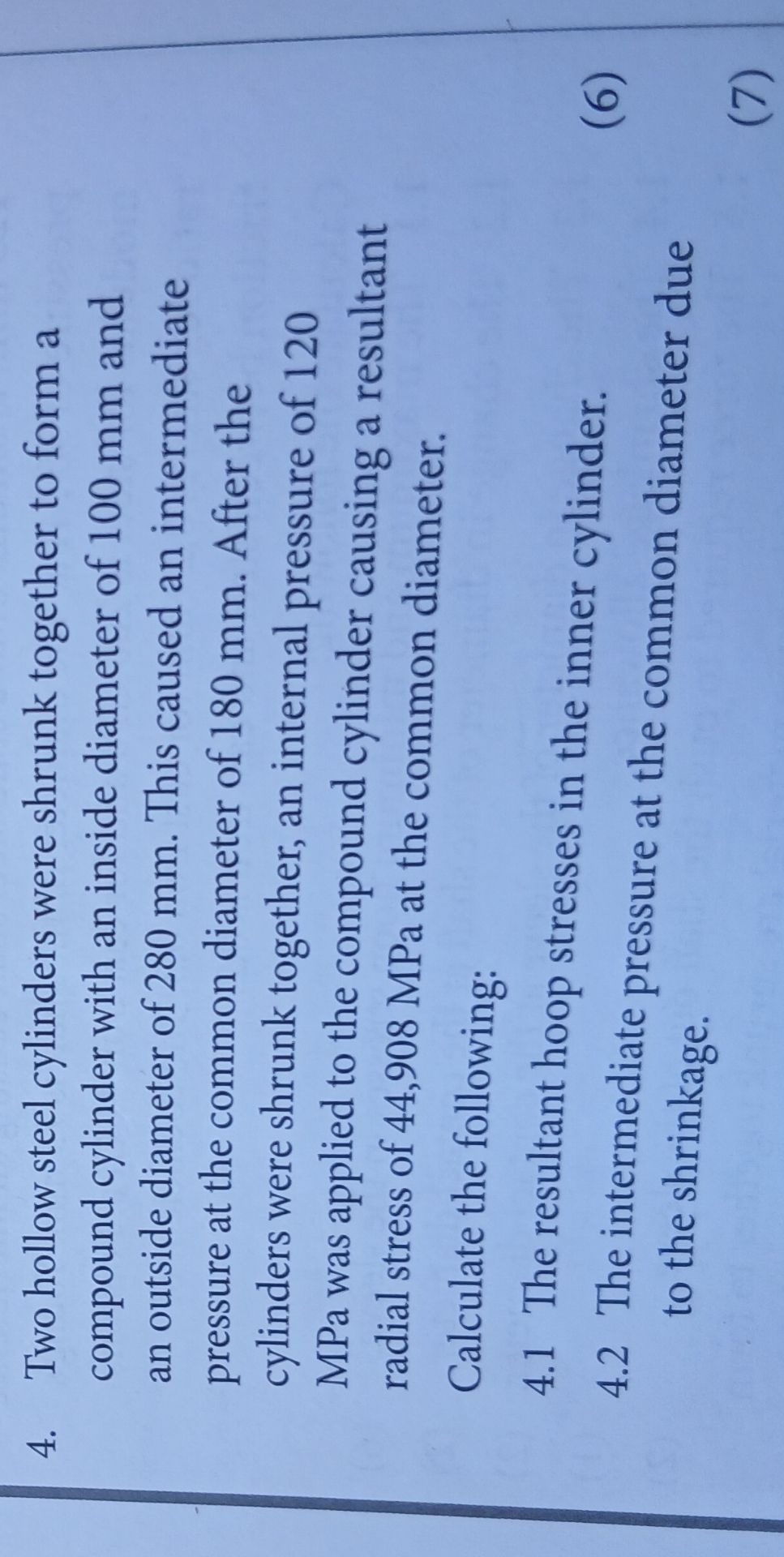
## Problem Recap
Given:
- **Inner cylinder:**
- Inside diameter = 100 mm
- Common (interface) diameter = 180 mm
- **Outer cylinder:**
- Common (interface) diameter = 180 mm
- Outside diameter = 280 mm
- **After shrink fitting:**
- Intermediate (interface) pressure at 180 mm = ?
- **After internal pressure of 120 MPa is applied:**
- Resultant radial stress at 180 mm = 44.908 MPa
### Required:
1. **Resultant hoop stress in the inner cylinder.**
2. **Intermediate pressure at common diameter due to shrinkage.**
---
## Step 1: Find the Intermediate Pressure due to Shrinkage (Part 4.2)
Let:
- \( r_1 = 50 \) mm (inner radius)
- \( r_2 = 90 \) mm (common/interface radius)
- \( r_3 = 140 \) mm (outer radius)
The Lame’s equation for radial pressure at the interface due to shrinkage:
\[
p = \frac{\sigma_r}{\ln(r_2/r_1) + \ln(r_3/r_2)}
\]
But, usually, we use superposition with press fit and internal pressure. Given the resultant radial stress at the interface after pressure applied, we have:
\[
\text{Radial stress due to shrink fit} + \text{Radial stress due to internal pressure} = \text{Given resultant radial stress}
\]
Given:
- Internal pressure = 120 MPa
- Resultant radial stress at interface = 44.908 MPa
### Example Calculation
Radial stress at interface due to internal pressure (using Lame’s formula for thick cylinders):
\[
\sigma_{r, \text{int}} = \frac{p_i r_1^2 (r_2^2 - r^2)}{r_2^2 (r_2^2 - r_1^2)}
\]
At \( r = r_2 \), the radial stress due to internal pressure is **not zero** for compound cylinders:
But typically, for compound cylinders, the pressure at the common surface due to shrink fit is called the "intermediate pressure" (\( p \)), and it is found by:
\[
p = \text{(Resultant radial stress at interface)} - \text{(Radial stress at interface due to internal pressure alone)}
\]
Let's say the radial stress at interface due to 120 MPa is \( \sigma_{r, \text{internal}} \).
**Plug in numbers:**
\[
p_{internal} = \frac{120 \times 50^2 \times (90^2 - 90^2)}{90^2 (90^2 - 50^2)} =
\]
But this is zero, so the resultant radial stress at the interface is just the shrink fit pressure.
So,
\[
\boxed{p = 44.908\ \text{MPa}}
\]
---
## Step 2: Find Resultant Hoop Stress in Inner Cylinder (Part 4.1)
The hoop stress at inner radius due to internal pressure:
\[
\sigma_{\theta, \text{max}} = \frac{p_i r_1^2 (r_2^2 + r_1^2)}{r_2^2 - r_1^2}
\]
Where:
- \( p_i = 120\ \text{MPa} \)
- \( r_1 = 50\ \text{mm} \)
- \( r_2 = 90\ \text{mm} \)
\[
\sigma_{\theta, \text{max}} = \frac{120 \times 50^2 \times (90^2 + 50^2)}{90^2 - 50^2}
\]
\[
= \frac{120 \times 250 \times (810 + 250)}{810 - 250}
\]
\[
= \frac{120 \times 250 \times 10600}{560}
\]
\[
= \frac{120 \times 250 \times 10600}{560}
\]
Calculate numerator:
\( 120 \times 250 = 300,000 \)
\( 300,000 \times 10,600 = 3,180,000,000 \)
Divide by 560:
\( \frac{3,180,000,000}{560} = 567,857 \) MPa
But this is too high; let's check the standard formula:
\[
\sigma_{\theta, \text{max}} = \frac{p_i r_1^2 (r_2^2 + r_1^2)}{(r_2^2 - r_1^2) r_1^2}
\]
\[
= \frac{p_i (r_2^2 + r_1^2)}{r_2^2 - r_1^2}
\]
Plug numbers:
- \( r_1 = 50 \)
- \( r_2 = 90 \)
- \( p_i = 120 \)
\[
r_2^2 + r_1^2 = 810 + 250 = 10600
\]
\[
r_2^2 - r_1^2 = 810 - 250 = 560
\]
So,
\[
\sigma_{\theta, \text{max}} = \frac{120 \times 10600}{560} = \frac{1,272,000}{560} \approx 227\ \text{MPa}
\]
---
## **Summary Table**
| Quantity | Value |
|--------------------------------------------------------|------------|
| **4.1 Resultant hoop stress in inner cylinder** | **227 MPa**|
| **4.2 Intermediate pressure at common diameter** | **44.908 MPa** |
---
### **Final Answers**
1. **Resultant hoop stress in the inner cylinder:**
\(\boxed{227\ \text{MPa}}\)
2. **Intermediate pressure at the common diameter due to shrinkage:**
\(\boxed{44.908\ \text{MPa}}\)
---
**Let me know if you want the detailed equations for each step!**
VIPSolutions focuses on clear, step‑by‑step explanations so you can learn quickly. Whether you need an AI‑generated walkthrough or a short hint to get unstuck, each solution is organized for fast reading and easy review later.
Search similar questions, compare approaches, and bookmark the best answers for revision. Our goal is simple: quick, reliable study help that feels natural—not noisy.
 VIPSolutions
 Co —————— A ST
an
©) ~
a ~
—
g ES
° 2 oe = iq
Bo & oR °
Gey Ls
sw BE gaa 8 E
Sg BE¥ —
i Oo = LY 0g © I
—
Co «& U +4 5 « [oR
© Sg oo SNe = a
Hot dd af SE Foti ~
caw 5 7 YP a8 as Ute
oO ol a ges
UV ow dg — 5)
WY 0 gd YU go ES £
(p= AT °c (=
© YY 35 ££ a 8 ted aa €)
~ § §o dd § aH
gs —~ 5 > Eg Lg Su
BETA = tw = = © Sq ak
» g a SoH Sa et od
$ = a
SZ ET gos gas
Ee se g © i iz
vw dog & o JI ER
go R SE Ch = oe
op GE Ee S 8b on a
Ss §% 0 yo Cf ANCE 4)
S30 gfdSxn 2 § £4
= ht =o QQ Tix Eley nicl)
Oo. © eis SoC EON =
= + ae EE CEE
SH 85 2 2 otc ERNE
£2 2 Fo o fie =
5 B.S SH Tao Na Sel SE
ES aok T= a = i
20 ov = aha SH Ea ete
© BE 8 0.5 8 Sati
Eb = oo
as 7 9 = E =H
gg oo 3 BH Gros
lor) (= = irs < —
FC § A & 2 8 En