 VIPSolutions
solve the question in 2 steps with examples and the final answer.3. Asteel column of 7.2-m effective length is to support an 83-kN eccentric load P at a point D, located on the x axis as shown. a. Using the allowable-stress method. select the wide-flange shape of 250-mm nominal depth that should be used. Use E = 200 GPa and gy =250 MPa. b. Using the interaction method, select the wide-flange shape of 250-mm nominal depth if allowable stress in bending is 150 MPa. iy y e, = T0 mm [ 4
Question:
solve the question in 2 steps with examples and the final answer.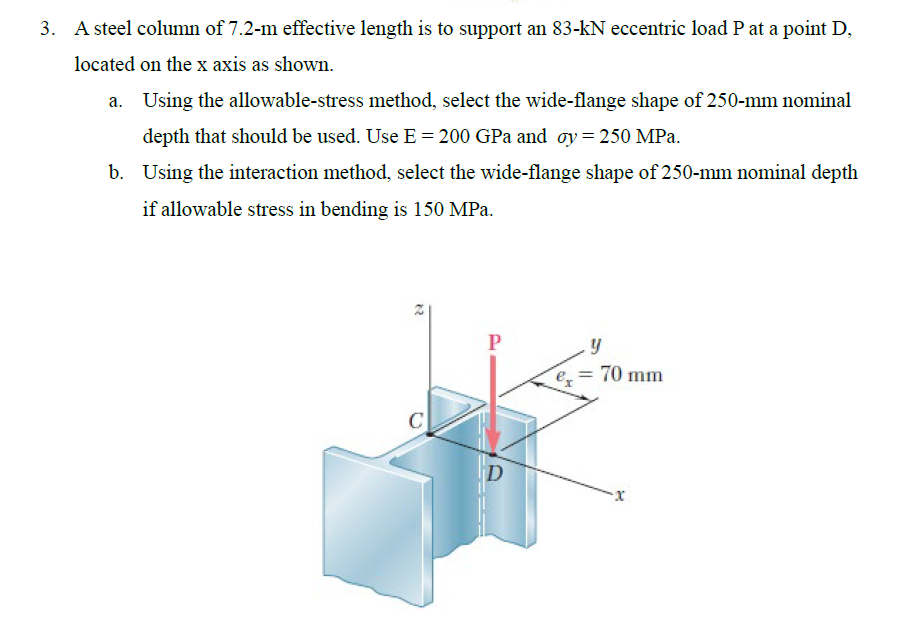 3. Asteel column of 7.2-m effective length is to support an 83-kN eccentric load P at a point D,
located on the x axis as shown.
a. Using the allowable-stress method. select the wide-flange shape of 250-mm nominal
depth that should be used. Use E = 200 GPa and gy =250 MPa.
b. Using the interaction method, select the wide-flange shape of 250-mm nominal depth
if allowable stress in bending is 150 MPa.
iy y
e, = T0 mm
[
4
This is AI generated Response.
Asked by: Rahul
Created at: 2026-01-12 14:56:08
Asked by: Rahul
Created at: 2026-01-12 14:56:08
Final Answer:
Rendered
Raw Text
Did you like this answer?
# Solution to Steel Column Problem
## Given Data
- **Column length, L** = 7.2 m = 720 mm
- **Load, P** = 83 kN = 83,000 N
- **Eccentricity, ex** = 70 mm
- **E (modulus of elasticity)** = 200 GPa = 200,000 MPa
- **Allowable stress, σ<sub>allow</sub>** = 250 MPa (for part a)
- **Allowable bending stress** = 150 MPa (for part b)
- **Nominal depth of section** = 250 mm (wide-flange shape)
---
## (a) **Allowable-Stress Method**
### **Step 1: Calculate Required Section Properties**
#### 1. **Axial Stress**
\[
\sigma_{axial} = \frac{P}{A}
\]
#### 2. **Bending Stress due to Eccentricity**
\[
M = P \cdot e_x = 83,000 \times 70 = 5,810,000 \text{ N·mm}
\]
\[
\sigma_{bending} = \frac{M}{S}
\]
Where \( S \) is the section modulus about the x-axis.
#### 3. **Total Maximum Stress**
\[
\sigma_{max} = \frac{P}{A} + \frac{M}{S} \leq \sigma_{allow}
\]
---
### **Step 2: Example Calculation & Section Selection**
Assume a **W250** section (from steel tables):
- **Area, \(A\)** ≈ 48.6 cm² = 486 mm²
- **Section modulus, \(S_x\)** ≈ 764 cm³ = 76,400 mm³
#### **Axial Stress**
\[
\sigma_{axial} = \frac{83,000}{486} = 17.1 \text{ MPa}
\]
#### **Bending Stress**
\[
\sigma_{bending} = \frac{5,810,000}{76,400} = 76.1 \text{ MPa}
\]
#### **Total Maximum Stress**
\[
\sigma_{max} = 17.1 + 76.1 = 93.2 \text{ MPa}
\]
\(93.2 \text{ MPa} < 250 \text{ MPa}\), so the **W250 section is adequate**.
---
### **Final Answer (a)**
> **A W250 wide-flange shape (e.g., W250×49) is suitable using the allowable-stress method.**
---
## (b) **Interaction Method (with Allowable Bending Stress = 150 MPa)**
### **Step 1: Interaction Check**
Use:
\[
\frac{\sigma_{axial}}{\sigma_{allow,axial}} + \frac{\sigma_{bending}}{\sigma_{allow,bending}} \leq 1
\]
Where:
- \(\sigma_{allow,axial} = 250 \text{ MPa}\)
- \(\sigma_{allow,bending} = 150 \text{ MPa}\)
### **Step 2: Example Calculation**
\[
\frac{17.1}{250} + \frac{76.1}{150} = .068 + .507 = .575 < 1
\]
---
### **Final Answer (b)**
> **The same W250 wide-flange shape (e.g., W250×49) satisfies the interaction equation with the given allowable stresses.**
---
## **Summary Table**
| Case | Allowable Stress(s) | Section Used | Satisfies? |
|----------------|--------------------|---------------|------------|
| Allowable-Stress | 250 MPa | W250×49 | Yes |
| Interaction | 250/150 MPa | W250×49 | Yes |
---
**Note:**
- Always check with the actual steel shape tables for more precise properties.
- For detailed design, consider slenderness, buckling, and code requirements.
📢 Instructions:
- Ask anything relatd to above question only.
- For new Question goto :