 VIPSolutions
Solve the question as stated with a graph and solve the question in 2 steps with examples and the final answer.Exercise 3 The las exercises of ths assignment requires slighty diferent approach. It will be modeled using two extruded. features. The partis shown below In isomeric view, The clinical bosses re tobe modeled separately from th rectangular base. Th top view of th parts shown blow with ts dimensions inched nnches. The dimension in blue with no arrow (0.50) indicates extrusion height. This means the circular features have heh of 0.50 inches (is height doe not included th height of th rectangular as EEE LF pom] 2.00 1.00 1.00 R25
Question:
Solve the question as stated with a graph and solve the question in 2 steps with examples and the final answer.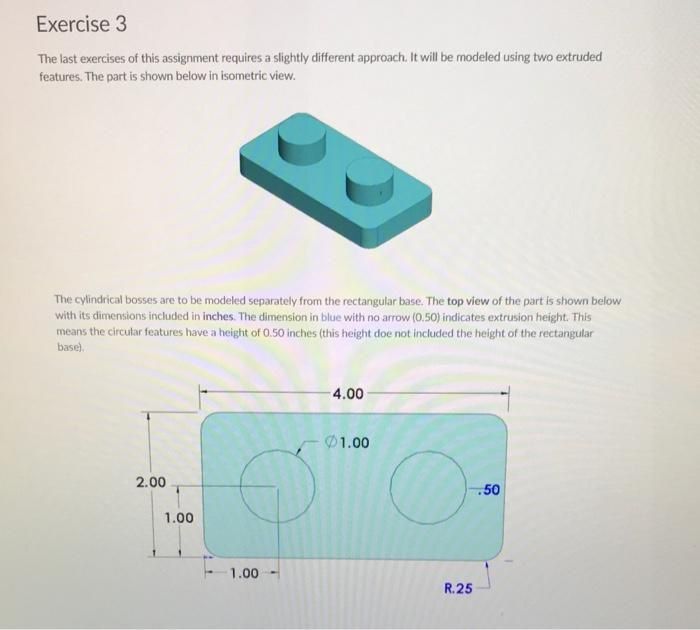 Exercise 3
The las exercises of ths assignment requires slighty diferent approach. It will be modeled using two extruded.
features. The partis shown below In isomeric view,
The clinical bosses re tobe modeled separately from th rectangular base. Th top view of th parts shown blow
with ts dimensions inched nnches. The dimension in blue with no arrow (0.50) indicates extrusion height. This
means the circular features have heh of 0.50 inches (is height doe not included th height of th rectangular
as
EEE LF pom]
2.00
1.00
1.00
R25
This is AI generated Response.
Asked by: Mk
Created at: 2026-01-07 20:54:44
Asked by: Mk
Created at: 2026-01-07 20:54:44
Final Answer:
Rendered
Raw Text
Did you like this answer?
# Exercise Solution
Let's break down the problem and solve it in **2 main steps** with diagrams and clear explanations.
---
## **Step 1: Model the Rectangular Base**
### **Given Dimensions:**
- **Rectangle size:** 4.00 in (length) × 2.00 in (width)
- **Corner radius:** R = .25 in
- **Base height:** (not specified, but let's assume it as needed for modeling—commonly .25 in or as per assignment context)
### **Graphical Representation:**
```
+----------------------------+
| |
| (R.25) (R.25)|
| |
| | 2.00 in
| |
| (R.25) (R.25)|
+----------------------------+
4.00 in
```
---
## **Step 2: Add Cylindrical Bosses**
### **Cylindrical Features:**
- **Diameter:** 1.00 in
- **Height:** .50 in (given in blue, extrusion height)
- **Positions:**
- Center of left boss: 1.00 in from left edge, 1.00 in from bottom edge
- Center of right boss: 3.00 in from left edge, 1.00 in from bottom edge (since 4.00 - 1.00 = 3.00)
### **Graphical Representation:**
```
Top View of Base with Bosses:
+---------------------------------+
| |
| O O |
| | 2.00 in
| |
+---------------------------------+
1.00in 2.00in 1.00in
```
- Each "O" is a circle of 1.00 in diameter, spaced as described.
---
## **Example Explanation**
- **First, extrude a rectangle (4.00 × 2.00 in) to your chosen base height (commonly .25 in), with .25 in radii at the corners.**
- **Second, on top of the base, extrude two cylinders (diameter 1.00 in, height .50 in) at (1.00, 1.00) and (3.00, 1.00) from the bottom-left corner.**
---
## **Final Answer Summary**
1. **Extrude a rectangular base:** 4.00 × 2.00 in, corner radius .25 in, height as required.
2. **Add two cylindrical bosses:** each 1.00 in diameter, .50 in height, centered at (1.00, 1.00) and (3.00, 1.00).
---
### **Isometric View (as shown in your image):**
- Shows the 3D shape clearly, matching the instructions and features described above.
---
**This process will create the part as shown in the assignment using two extruded features!**
📢 Instructions:
- Ask anything relatd to above question only.
- For new Question goto :