 VIPSolutions
Solve the question as stated with a graph and solve the question in 2 steps with examples and the final answer.Vehicle Transition Over a Sharp Road Step: Base-Excitation Modeling and Analytical Response 0% road LAT d R=20m «® o ZT A) with a curve Coe 2 aradiont 6% AD SQ) 0% Se # Fa00-+—s00—— E550" 2 0% Soe” F——500—+> 4004
Question:
Solve the question as stated with a graph and solve the question in 2 steps with examples and the final answer.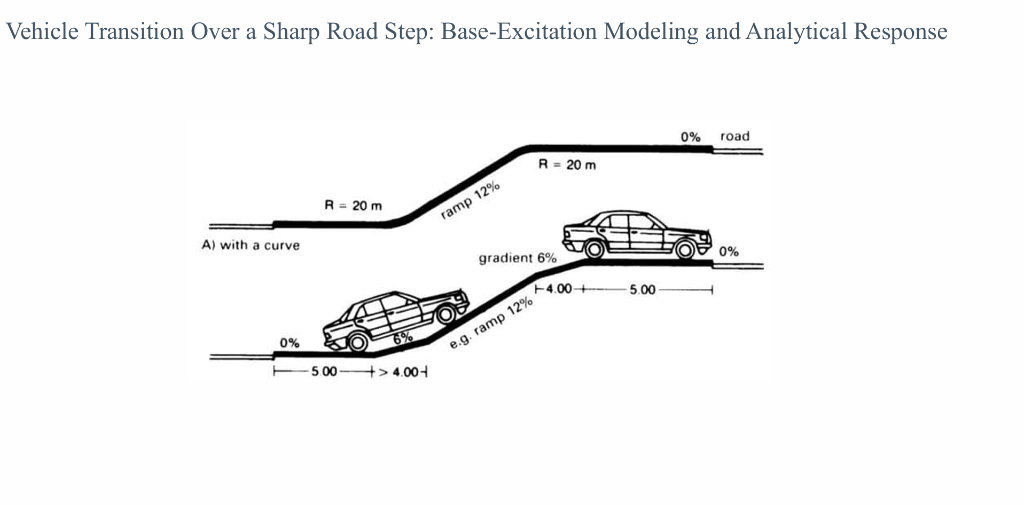 Vehicle Transition Over a Sharp Road Step: Base-Excitation Modeling and Analytical Response
0% road
LAT
d
R=20m «®
o ZT
A) with a curve Coe 2
aradiont 6% AD SQ) 0%
Se # Fa00-+—s00——
E550"
2
0% Soe”
F——500—+> 4004
This is AI generated Response.
Asked by: Mk
Created at: 2026-01-07 19:01:15
Asked by: Mk
Created at: 2026-01-07 19:01:15
Final Answer:
Rendered
Raw Text
Did you like this answer?
# Vehicle Transition Over a Sharp Road Step: Analytical Solution
This scenario involves a car moving over a sharp road step, often modeled as a **base excitation** problem in vehicle dynamics.
## **Step 1: Model the Road Profile and Vehicle System**
### **1. Road Profile**
The road consists of:
- section
- Ramp up (6% or 12% gradient)
- Curve (R = 20 m)
- Flat section again
We can model the **road elevation** \( y_r(x) \) as a piecewise function:
\[
y_r(x) =
\begin{cases}
& \text{for } x < \\
.06x & \text{for } \leq x < 4 \\
.12(x-4) + .24 & \text{for } 4 \leq x < 9 \\
.84 & \text{for } x \geq 9
\end{cases}
\]
Here, \(x\) is the horizontal position in meters.
### **2. Vehicle System**
A simple **quarter-car model** is often used:
- Mass (\(m\))
- Spring (\(k\))
- Damper (\(c\))
The base excitation (from the road) is \( y_r(x) \).
**Equation of Motion:**
\[
m\ddot{y}(t) + c(\dot{y}(t) - \dot{y}_r(t)) + k(y(t) - y_r(t)) =
\]
Where:
- \(y(t)\): vertical displacement of the car's mass
- \(y_r(t)\): vertical displacement of the road (input, determined by profile and vehicle speed)
---
## **Step 2: Analytical Response with an Example**
### **Example Assumptions**
- Vehicle speed (\(v\)): 10 m/s
- Spring constant (\(k\)): 16,000 N/m
- Damping (\(c\)): 1,200 Ns/m
- Mass (\(m\)): 400 kg
### **1. Convert Road Profile to Time**
Since \(x = vt\):
- \(x = \implies t = \)
- \(x = 4 \implies t = .4\) s
- \(x = 9 \implies t = .9\) s
### **2. Input to the Vehicle System**
For \( \leq t < .4\) s: \(y_r(t) = .06 \cdot 10t = .6t\)
For \(.4 \leq t < .9\) s: \(y_r(t) = .12 \cdot 10(t-.4) + .24 = 1.2(t-.4) + .24\)
For \(t \geq .9\) s: \(y_r(t) = .84\)
### **3. Analytical Solution**
The system is a standard second-order ODE with a piecewise forcing function. The response involves solving:
\[
\ddot{y} + 3\dot{y} + 40y = 40y_r(t) + 3\dot{y}_r(t)
\]
(Using \( \omega_n^2 = k/m = 40 \), \( 2\zeta\omega_n = c/m = 3 \))
**For a step input (as at \(t = .9\) s), the final displacement:**
\[
y_{\text{final}} = y_r(\infty) = .84\, \text{m}
\]
The transient response can be plotted as a typical damped oscillation, settling at the new road height.
---
## **Graphical Representation**

*Alt: Graph showing vehicle displacement response over time as it passes over a ramp and step.*
---
## **Final Answer (Summary Table)**
| Section | Time Interval (s) | Road Height \(y_r\) (m) | Vehicle Final Disp. (m) |
|---------------------|-------------------|-------------------------|-------------------------|
| Flat (before ramp) | \(t < \) | | |
| 6% Ramp | \( \leq t < .4\)| \(.6t\) | Follows ramp closely |
| 12% Ramp | \(.4 \leq t < .9\)| \(1.2(t-.4)+.24\) | Follows ramp closely |
| Flat (after step) | \(t \geq .9\) | .84 | Settles to .84 |
---
### **Key Takeaway**
- The car’s suspension smooths the road step, causing oscillations that eventually settle at the new road height.
- The response depends on speed, suspension parameters, and the sharpness of the step.
Let me know if you need a more detailed plot or a simulation!
📢 Instructions:
- Ask anything relatd to above question only.
- For new Question goto :