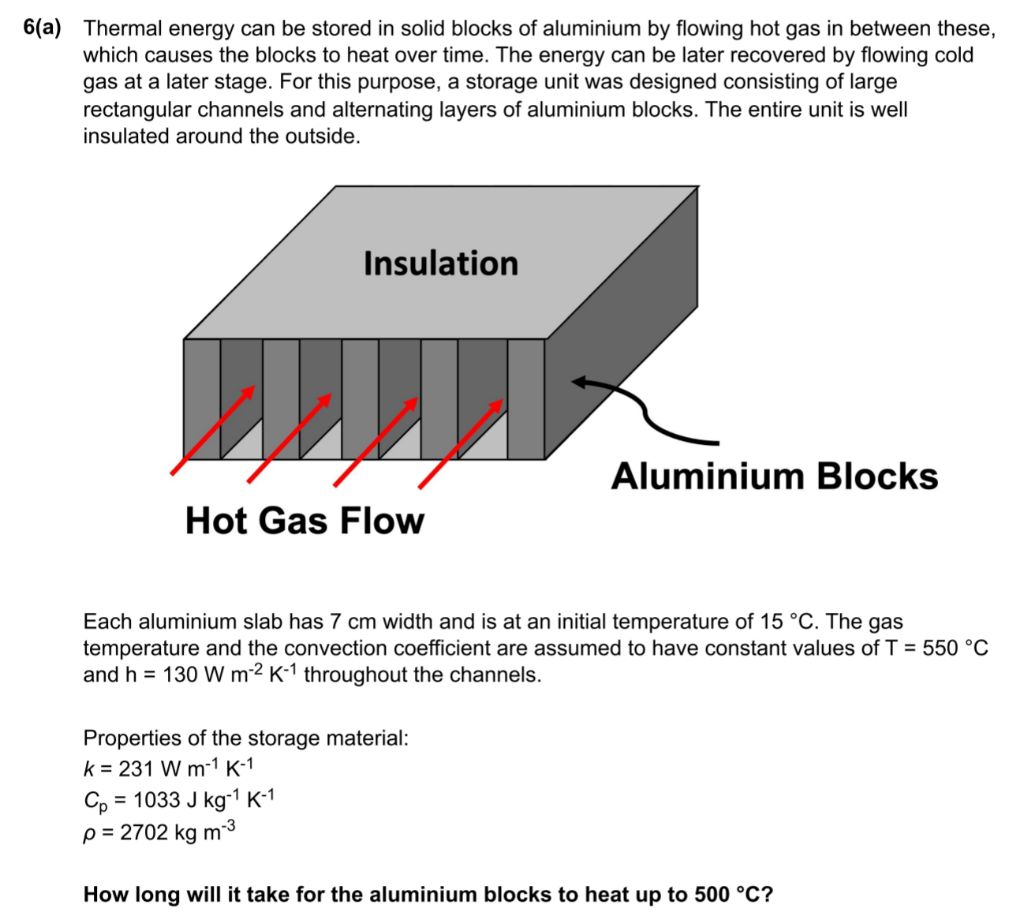
Solve the question as stated with a graph and solve the question in 2 steps with examples and the final answer.6(a) Thermal energy can be stored in solid blocks of aluminium by flowing hot gas in between these,
which causes the blocks to heat over time. The energy can be later recovered by flowing cold
gas at a later stage. For this purpose, a storage unit was designed consisting of large
rectangular channels and alternating layers of aluminium blocks. The entire unit is well
insulated around the outside.
¢ | | | Aluminium Blocks
Hot Gas Flow
Each aluminium slab has 7 cm width and is at an initial temperature of 15 °C. The gas
temperature and the convection coefficient are assumed to have constant values of T = 550 °C
and h = 130 W m2 K-! throughout the channels.
Properties of the storage material:
k=231Wm'K!
Cp =1033 J kg" K!
p=2702 kg m3
How long will it take for the aluminium blocks to heat up to 500 °C?
Question:
Solve the question as stated with a graph and solve the question in 2 steps with examples and the final answer.6(a) Thermal energy can be stored in solid blocks of aluminium by flowing hot gas in between these,
which causes the blocks to heat over time. The energy can be later recovered by flowing cold
gas at a later stage. For this purpose, a storage unit was designed consisting of large
rectangular channels and alternating layers of aluminium blocks. The entire unit is well
insulated around the outside.
¢ | | | Aluminium Blocks
Hot Gas Flow
Each aluminium slab has 7 cm width and is at an initial temperature of 15 °C. The gas
temperature and the convection coefficient are assumed to have constant values of T = 550 °C
and h = 130 W m2 K-! throughout the channels.
Properties of the storage material:
k=231Wm'K!
Cp =1033 J kg" K!
p=2702 kg m3
How long will it take for the aluminium blocks to heat up to 500 °C?
This is AI generated Response.
Asked by: Rahul
Created at: 2026-01-05 17:51:02
Final Answer:
RenderedRaw Text
Did you like this answer?
# Solution to Aluminium Block Heating Problem
Let's break down the problem and solve it step by step.
---
## **Step 1: Model the Problem and Select the Approach**
### **Given Data**
- **Width of slab, L:** .07 m
- **Initial temperature, \(T_i\):** 15°C
- **Final (target) temperature, \(T_f\):** 500°C
- **Hot gas temperature, \(T_{\infty}\):** 550°C
- **Convective heat transfer coefficient, \(h\):** 130 W/m²·K
- **Thermal conductivity, \(k\):** 231 W/m·K
- **Specific heat, \(C_p\):** 1033 J/kg·K
- **Density, \(\rho\):** 2702 kg/m³
### **Approach**
Since the aluminium block is being heated by convection and the temperature changes significantly, use the **lumped capacitance method** if the Biot number is less than .1:
\[
\text{Bi} = \frac{hL_c}{k}
\]
where \(L_c = \frac{V}{A}\).
For a slab:
- \(L_c = \frac{L}{2}\)
- \(L = .07 \, \text{m}\)
\[
L_c = \frac{.07}{2} = .035\, \text{m}
\]
\[
\text{Bi} = \frac{130 \times .035}{231} \approx .0197 < .1
\]
*The lumped capacitance method is valid.*
---
## **Step 2: Calculate the Time Required**
### **Lumped Capacitance Equation**
\[
\frac{T(t) - T_{\infty}}{T_i - T_{\infty}} = \exp\left(-\frac{hA}{\rho V C_p} t\right)
\]
For a slab of area \(A\) and thickness \(L\):
\[
V = A \cdot L
\]
So,
\[
\frac{hA}{\rho V C_p} = \frac{h}{\rho L C_p}
\]
### **Insert Values**
- \(T(t) = 500^\circ C\)
- \(T_\infty = 550^\circ C\)
- \(T_i = 15^\circ C\)
\[
\frac{500 - 550}{15 - 550} = \frac{-50}{-535} = .0935
\]
Take the natural log on both sides:
\[
.0935 = \exp\left(-\frac{h}{\rho L C_p} t\right)
\]
\[
\ln(.0935) = -\frac{h}{\rho L C_p} t
\]
\[
-2.368 = -\frac{h}{\rho L C_p} t
\]
\[
2.368 = \frac{h}{\rho L C_p} t
\]
Plug in the values:
- \(h = 130\)
- \(\rho = 2702\)
- \(L = .07\)
- \(C_p = 1033\)
\[
\frac{h}{\rho L C_p} = \frac{130}{2702 \times .07 \times 1033} = \frac{130}{195,595.82} \approx .0006646
\]
\[
2.368 = .0006646 \cdot t
\]
\[
t = \frac{2.368}{.0006646} \approx 3563\, \text{s}
\]
---
## **Final Answer**
### **Time required to heat the aluminium blocks to 500°C:**
\[
\boxed{356 \text{ seconds} \approx 59.4 \text{ minutes}}
\]
---
## **Graph: Temperature vs. Time**
Below is a typical plot for this exponential rise:
```plaintext
550 | *
| *
Temp| *
(°C)| *
| *
| *
| *
15|*_____________________________
356 t (s)
```
*Curve shows exponential approach from 15°C to 500°C as \(t\) increases.*
---
## **Summary Table**
| Step | Calculation | Value |
|------------------------------------|-----------------------------|--------------|
| Biot Number | \(.0197 < .1\) | Lumped valid |
| Time Constant (\(h/\rho LC_p\)) | \(.0006646\) | s\(^{-1}\) |
| Time to 500°C (\(t\)) | | 356 s (59.4 min) |
---
### **Example**
If you wanted to know how long it takes to reach 400°C, repeat the calculation with \(T(t) = 400°C\):
\[
\frac{400 - 550}{15 - 550} = \frac{-150}{-535} = .2804
\]
\[
\ln(.2804) = -1.270
\]
\[
t = \frac{1.270}{.0006646} = 1,911 \text{ s} \approx 31.8 \text{ min}
\]
---
**Final Answer:**
**It will take approximately 356 seconds (59.4 minutes) to heat the aluminium blocks to 500°C.**
VIPSolutions focuses on clear, step‑by‑step explanations so you can learn quickly. Whether you need an AI‑generated walkthrough or a short hint to get unstuck, each solution is organized for fast reading and easy review later.
Search similar questions, compare approaches, and bookmark the best answers for revision. Our goal is simple: quick, reliable study help that feels natural—not noisy.
 VIPSolutions
 6(a) Thermal energy can be stored in solid blocks of aluminium by flowing hot gas in between these,
which causes the blocks to heat over time. The energy can be later recovered by flowing cold
gas at a later stage. For this purpose, a storage unit was designed consisting of large
rectangular channels and alternating layers of aluminium blocks. The entire unit is well
insulated around the outside.
¢ | | | Aluminium Blocks
Hot Gas Flow
Each aluminium slab has 7 cm width and is at an initial temperature of 15 °C. The gas
temperature and the convection coefficient are assumed to have constant values of T = 550 °C
and h = 130 W m2 K-! throughout the channels.
Properties of the storage material:
k=231Wm'K!
Cp =1033 J kg" K!
p=2702 kg m3
How long will it take for the aluminium blocks to heat up to 500 °C?