 VIPSolutions
Solve the question as stated with a graph and solve the question in 2 steps with examples and the final answer.10.5-12 A railroad tie (or sleeper) is subjected to two rail loads, each of magnitude P = 175 kN, acting as shown in the figure. The reaction ¢ of the ballast is assumed to be uniformly distributed over the length of the tie, which has cross-sectional dimensions b =300 mmand 4 = 250 mm. Calculate the maximum bending stress or, in the tie due to the loads P, assuming the distance L = 1500 mmand the overhang length ¢ = 500 mm . JZ JZ i L—> “— [— > BE q
Question:
Solve the question as stated with a graph and solve the question in 2 steps with examples and the final answer.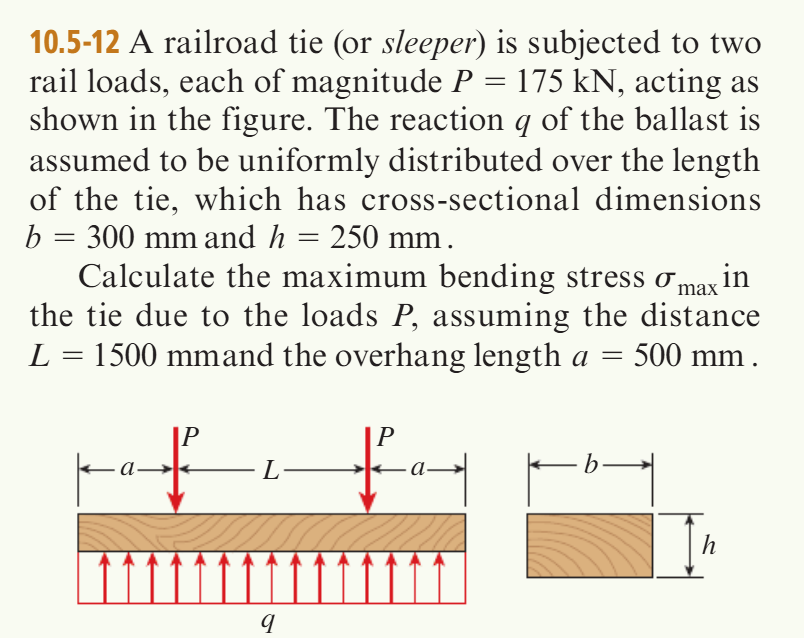 10.5-12 A railroad tie (or sleeper) is subjected to two
rail loads, each of magnitude P = 175 kN, acting as
shown in the figure. The reaction ¢ of the ballast is
assumed to be uniformly distributed over the length
of the tie, which has cross-sectional dimensions
b =300 mmand 4 = 250 mm.
Calculate the maximum bending stress or, in
the tie due to the loads P, assuming the distance
L = 1500 mmand the overhang length ¢ = 500 mm .
JZ JZ
i L—> “— [— >
BE
q
This is AI generated Response.
Asked by: Rahul
Created at: 2026-01-02 19:14:37
Asked by: Rahul
Created at: 2026-01-02 19:14:37
Final Answer:
Rendered
Raw Text
Did you like this answer?
# Solution to Maximum Bending Stress in Railroad Tie
Let's break the solution into **2 steps** and include a diagram for clarity.
---
## **Given Data**
- Load \( P = 175\, \text{kN} = 175,000\, \text{N} \)
- Overhang \( a = 500\, \text{mm} \)
- Distance between loads \( L = 150\, \text{mm} \)
- Width \( b = 300\, \text{mm} \)
- Height \( h = 250\, \text{mm} \)
---
## **Step 1: Find the Maximum Bending Moment**
The tie is simply supported by the ballast (uniformly distributed support), with two concentrated loads.
- **Total length supported by ballast:** \( L + 2a \)
- **Maximum moment occurs under each load.**
The **reaction per unit length** \( q \) is:
\[
q = \frac{2P}{L + 2a}
\]
The **maximum bending moment** at the point under the load (distance \( a \) from the end) is:
\[
M_{\text{max}} = P \cdot a - q \cdot \frac{a^2}{2}
\]
### **Calculations:**
\[
L + 2a = 150 + 2 \times 500 = 250\, \text{mm}
\]
\[
q = \frac{2 \times 175,000}{250} = 140\, \text{N/mm}
\]
\[
M_{\text{max}} = 175,000 \times 500 - 140 \times \frac{500^2}{2}
\]
\[
M_{\text{max}} = 87,500,000 - 140 \times 125,000
\]
\[
M_{\text{max}} = 87,500,000 - 17,500,000 = 70,000,000\, \text{N}\cdot\text{mm}
\]
---
## **Step 2: Find the Maximum Bending Stress (\( \sigma_{\text{max}} \))**
The maximum bending stress is:
\[
\sigma_{\text{max}} = \frac{M_{\text{max}} \cdot c}{I}
\]
Where:
- \( c = \frac{h}{2} = 125\, \text{mm} \)
- \( I = \frac{b h^3}{12} = \frac{300 \times 250^3}{12} \)
### **Calculations:**
\[
I = \frac{300 \times 15,625,000}{12} = \frac{4,687,500,000}{12} = 390,625,000\, \text{mm}^4
\]
\[
\sigma_{\text{max}} = \frac{70,000,000 \times 125}{390,625,000}
\]
\[
\sigma_{\text{max}} = \frac{8,750,000,000}{390,625,000}
\]
\[
\sigma_{\text{max}} \approx 22.4\, \text{MPa}
\]
---
## **Graph Illustration**
```plaintext
|<---a-->|<------L------>|<---a--->
|-------|==============|-------|
^ ^
| |
P P
Uniform distributed reaction q over entire length
b (width) = 300 mm, h (height) = 250 mm (cross-section)
```
---
## **Final Answer**
**The maximum bending stress in the tie is:**
\[
\boxed{22.4\, \text{MPa}}
\]
📢 Instructions:
- Ask anything relatd to above question only.
- For new Question goto :