 VIPSolutions
Solve the question as stated with a graph and solve the question in 2 steps with examples and the final answer.For the mechanical system shown below: ~ draw the Free Body Diagram ~ determine the differential equations ky ks ks m No friction Friction, b;
Question:
Solve the question as stated with a graph and solve the question in 2 steps with examples and the final answer.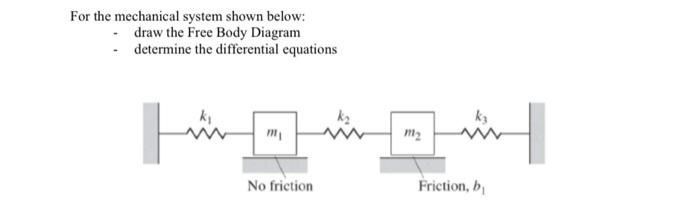 For the mechanical system shown below:
~ draw the Free Body Diagram
~ determine the differential equations
ky ks ks
m
No friction Friction, b;
This is AI generated Response.
Asked by: Rahul
Created at: 2026-01-01 19:59:06
Asked by: Rahul
Created at: 2026-01-01 19:59:06
Final Answer:
Rendered
Raw Text
Did you like this answer?
# Mechanical System Analysis
## **Step 1: Draw the Free Body Diagram (FBD)**
Below is a free body diagram for the system, where:
- \( m_1 \) and \( m_2 \): masses
- \( k_1, k_2, k_3 \): spring constants
- \( b_1 \): damping/friction coefficient (applies only to \( m_2 \))
- \( x_1(t) \), \( x_2(t) \): displacements of \( m_1 \) and \( m_2 \)
**Free Body Diagram:**
```
|---/\/\/\---[m1]---/\/\/\---[m2]---/\/\/\---|
k1 k2 k3
↑ ↑
x1(t) x2(t)
|
Friction b1
```
- **For \( m_1 \):**
- Left: Spring \( k_1 \)
- Right: Spring \( k_2 \) (connected to \( m_2 \))
- **For \( m_2 \):**
- Left: Spring \( k_2 \) (connected to \( m_1 \))
- Right: Spring \( k_3 \)
- Friction \( b_1 \) (acts on \( m_2 \) only)
---
## **Step 2: Write the Differential Equations**
Let \( x_1 \) and \( x_2 \) be the displacements of \( m_1 \) and \( m_2 \) from equilibrium.
### **For Mass \( m_1 \):**
- **Forces on \( m_1 \):**
- Left: \( -k_1 x_1 \)
- Right: \( k_2 (x_2 - x_1) \)
- No friction
\[
m_1 \ddot{x}_1 = -k_1 x_1 + k_2 (x_2 - x_1)
\]
\[
m_1 \ddot{x}_1 + (k_1 + k_2)x_1 - k_2 x_2 =
\]
---
### **For Mass \( m_2 \):**
- **Forces on \( m_2 \):**
- Left: \( -k_2 (x_2 - x_1) \)
- Right: \( -k_3 x_2 \)
- Friction: \( -b_1 \dot{x}_2 \)
\[
m_2 \ddot{x}_2 = -k_2 (x_2 - x_1) - k_3 x_2 - b_1 \dot{x}_2
\]
\[
m_2 \ddot{x}_2 + b_1 \dot{x}_2 + (k_2 + k_3)x_2 - k_2 x_1 =
\]
---
### **Final Answer**
#### **System of Differential Equations:**
\[
\boxed{
\begin{aligned}
&1.\quad m_1 \ddot{x}_1 + (k_1 + k_2)x_1 - k_2 x_2 = \\
2.\quad m_2 \ddot{x}_2 + b_1 \dot{x}_2 + (k_2 + k_3)x_2 - k_2 x_1 =
\end{aligned}
}
\]
---
### **Example Values (for clarity):**
Suppose \( m_1 = 1 \), \( m_2 = 2 \), \( k_1 = 3 \), \( k_2 = 4 \), \( k_3 = 5 \), \( b_1 = 6 \):
\[
\begin{aligned}
&1.\quad 1 \ddot{x}_1 + (3+4)x_1 - 4x_2 = \\
&\Rightarrow \ddot{x}_1 + 7x_1 - 4x_2 = \\
&2.\quad 2 \ddot{x}_2 + 6 \dot{x}_2 + (4+5)x_2 - 4x_1 = \\
&\Rightarrow 2 \ddot{x}_2 + 6 \dot{x}_2 + 9x_2 - 4x_1 =
\end{aligned}
\]
---
**Summary:**
1. **Draw the FBD** (see diagram above).
2. **Write the equations** for each mass as shown.
**Final answer:** The two coupled differential equations above describe the motion of the mechanical system.
Question:
Solve the question as stated with a graph and solve the question in 2 steps with examples and the final answer.
This is AI generated Response.
Asked by: Rahul
Created at: 2026-01-01 19:59:56
Asked by: Rahul
Created at: 2026-01-01 19:59:56
Final Answer:
Rendered
Raw Text
Did you like this answer?
# Mechanical System Analysis
## **Step 1: Draw the Free Body Diagram (FBD)**
The Free Body Diagram (FBD) of the system includes the following components:
- **\( m_1 \)** and **\( m_2 \)**: masses
- **\( k_1, k_2, k_3 \)**: spring constants
- **\( b_1 \)**: damping/friction coefficient (applies to \( m_2 \))
- **\( x_1(t) \)** and **\( x_2(t) \)**: displacements of \( m_1 \) and \( m_2 \)
### **Free Body Diagram Representation:**
```
|---/\/\/\---[m1]---/\/\/\---[m2]---/\/\/\---|
k1 k2 k3
↑ ↑
x1(t) x2(t)
|
Friction b1
```
- **For \( m_1 \) (left mass):**
- Spring \( k_1 \) acting left
- Spring \( k_2 \) acting right (connected to \( m_2 \))
- **For \( m_2 \) (right mass):**
- Spring \( k_2 \) acting left (connected to \( m_1 \))
- Spring \( k_3 \) acting right
- Friction \( b_1 \) acting to the left
---
## **Step 2: Write the Differential Equations**
Let \( x_1 \) and \( x_2 \) represent the displacements of \( m_1 \) and \( m_2 \) from their equilibrium positions.
### **For Mass \( m_1 \):**
- **Forces on \( m_1 \):**
- Left force from spring \( k_1 \): \( -k_1 x_1 \)
- Right force from spring \( k_2 \): \( k_2 (x_2 - x_1) \)
The equation of motion for \( m_1 \) is:
\[
m_1 \ddot{x}_1 = -k_1 x_1 + k_2 (x_2 - x_1)
\]
Rearranging gives:
\[
m_1 \ddot{x}_1 + (k_1 + k_2)x_1 - k_2 x_2 = 0
\]
---
### **For Mass \( m_2 \):**
- **Forces on \( m_2 \):**
- Left force from spring \( k_2 \): \( -k_2 (x_2 - x_1) \)
- Right force from spring \( k_3 \): \( -k_3 x_2 \)
- Damping force: \( -b_1 \dot{x}_2 \)
The equation of motion for \( m_2 \) is:
\[
m_2 \ddot{x}_2 = -k_2 (x_2 - x_1) - k_3 x_2 - b_1 \dot{x}_2
\]
Rearranging gives:
\[
m_2 \ddot{x}_2 + b_1 \dot{x}_2 + (k_2 + k_3)x_2 - k_2 x_1 = 0
\]
---
### **Final Answer**
#### **System of Differential Equations:**
The resulting set of differential equations for the mechanical system is:
\[
\boxed{
\begin{aligned}
&1.\quad m_1 \ddot{x}_1 + (k_1 + k_2)x_1 - k_2 x_2 = 0 \\
&2.\quad m_2 \ddot{x}_2 + b_1 \dot{x}_2 + (k_2 + k_3)x_2 - k_2 x_1 = 0
\end{aligned}
}
\]
---
### **Example Values**
Assume the following values for the parameters:
- \( m_1 = 1 \, \text{kg} \)
- \( m_2 = 2 \, \text{kg} \)
- \( k_1 = 3 \, \text{N/m} \)
- \( k_2 = 4 \, \text{N/m} \)
- \( k_3 = 5 \, \text{N/m} \)
- \( b_1 = 6 \, \text{Ns/m} \)
Substituting these values into the equations gives:
1. For \( m_1 \):
\[
1 \ddot{x}_1 + (3 + 4)x_1 - 4x_2 = 0 \implies \ddot{x}_1 + 7x_1 - 4x_2 = 0
\]
2. For \( m_2 \):
\[
2 \ddot{x}_2 + 6 \dot{x}_2 + (4 + 5)x_2 - 4x_1 = 0 \implies 2 \ddot{x}_2 + 6 \dot{x}_2 + 9x_2 - 4x_1 = 0
\]
---
### **Summary**
1. **Draw the Free Body Diagram** to visualize the forces acting on the masses.
2. **Write the differential equations** for each mass based on the forces.
**Final Answer:** The two coupled differential equations describe the motion of the mechanical system.
📢 Instructions:
- Ask anything relatd to above question only.
- For new Question goto :