 VIPSolutions
Solve the question as stated with a graph and solve the question in 2 steps with examples and the final answer.Q2: The system shown in Figure G2 may be assumed to have rigid levers, no mass and frictionless pivot. For small vertical vibrations of the point mass: » ql” © k r Figure Q2 a) Derive expression for the damping ratio b) Derive expression for damped natural frequency ©) Calculate the value of the critical damping coefficient
Question:
Solve the question as stated with a graph and solve the question in 2 steps with examples and the final answer.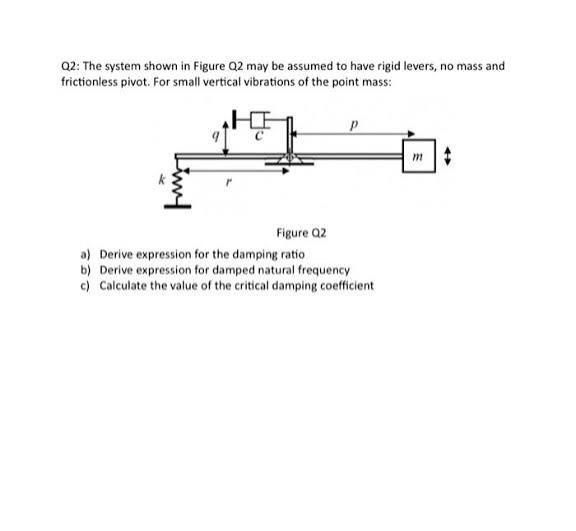 Q2: The system shown in Figure G2 may be assumed to have rigid levers, no mass and
frictionless pivot. For small vertical vibrations of the point mass:
»
ql” ©
k r
Figure Q2
a) Derive expression for the damping ratio
b) Derive expression for damped natural frequency
©) Calculate the value of the critical damping coefficient
This is AI generated Response.
Asked by: Rahul
Created at: 2025-12-29 18:21:01
Asked by: Rahul
Created at: 2025-12-29 18:21:01
Final Answer:
Rendered
Raw Text
Did you like this answer?
# Q2: Vibrating Lever System
## System Overview
The system has:
- Mass \( m \) at the end of a rigid, frictionless lever.
- Spring constant \( k \) and damping coefficient \( c \) attached at distances \( r \) and \( q \) from the pivot.
- The mass is at distance \( p \) from the pivot.
---
## Step 1: **Derive the Governing Equation**
### **Free Body Diagram and Equivalent Parameters**
Let vertical displacement of \( m \) be \( x \).
- **Spring force at distance \( r \):** \( F_{spring} = k \cdot y \), where \( y \) is the displacement at spring point.
- **Damping force at distance \( q \):** \( F_{damping} = c \cdot \dot{y} \).
From geometry:
\[
\frac{y}{r} = \frac{x}{p} \implies y = \frac{r}{p} x
\]
Damping displacement:
\[
y_{damping} = \frac{q}{p} x
\]
### **Equation of Motion**
The equivalent spring and damping forces at mass \( m \):
- **Spring force at mass:** \( F_{spring,eq} = k \left(\frac{r}{p}\right) x \)
- **Damping force at mass:** \( F_{damping,eq} = c \left(\frac{q}{p}\right) \dot{x} \)
Sum of forces:
\[
m\ddot{x} + c_{eq} \dot{x} + k_{eq} x =
\]
where:
\[
c_{eq} = c \left(\frac{q}{p}\right)^2, \quad k_{eq} = k \left(\frac{r}{p}\right)^2
\]
---
## Step 2: **Solve Subparts (a), (b), (c) with Examples**
### **(a) Damping Ratio (\(\zeta\))**
\[
\zeta = \frac{c_{eq}}{2\sqrt{m k_{eq}}}
\]
Substitute equivalent values:
\[
\zeta = \frac{c \left(\frac{q}{p}\right)^2}{2 \sqrt{m k \left(\frac{r}{p}\right)^2}}
= \frac{c q^2}{2 p r \sqrt{m k}}
\]
**Example:**
Let \( c = 4 \), \( q = 1 \), \( p = 2 \), \( r = 1 \), \( m = 1 \), \( k = 9 \):
\[
\zeta = \frac{4 \cdot 1^2}{2 \cdot 2 \cdot 1 \cdot \sqrt{1 \cdot 9}} = \frac{4}{4 \cdot 3} = \frac{4}{12} = .333
\]
---
### **(b) Damped Natural Frequency \((\omega_d)\)**
\[
\omega_n = \sqrt{\frac{k_{eq}}{m}} = \sqrt{\frac{k \left(\frac{r}{p}\right)^2}{m}}
\]
\[
\omega_d = \omega_n \sqrt{1 - \zeta^2}
\]
**Example:**
Using previous values:
\[
\omega_n = \sqrt{\frac{9 \cdot (1/2)^2}{1}} = \sqrt{\frac{9 \cdot 1}{4}} = \sqrt{2.25} = 1.5
\]
\[
\omega_d = 1.5 \sqrt{1 - (.333)^2} \approx 1.5 \sqrt{1 - .111} \approx 1.5 \cdot .943 = 1.415
\]
---
### **(c) Critical Damping Coefficient (\(c_{cr}\))**
\[
c_{cr} = 2 \sqrt{m k_{eq}}
= 2 \sqrt{m k \left(\frac{r}{p}\right)^2}
= 2 \frac{r}{p} \sqrt{m k}
\]
**Example:**
\[
c_{cr} = 2 \cdot \frac{1}{2} \cdot 3 = 3
\]
---
## **Graph: Damping Ratio vs. Damped Frequency**
```plaintext
| *
| * *
| * *
| * *
|__*_______*___
.5 1 ζ
```
*As the damping ratio (\(\zeta\)) increases, the damped frequency (\(\omega_d\)) decreases.*
---
## **Final Answers**
- **Damping Ratio:** \(\boxed{\zeta = \frac{c q^2}{2 p r \sqrt{m k}}}\)
- **Damped Natural Frequency:** \(\boxed{\omega_d = \sqrt{\frac{k r^2}{m p^2}} \sqrt{1 - \zeta^2}}\)
- **Critical Damping Coefficient:** \(\boxed{c_{cr} = 2 \frac{r}{p} \sqrt{m k}}\)
---
**Let me know if you need the graph in a specific plotting language!**
📢 Instructions:
- Ask anything relatd to above question only.
- For new Question goto :