 VIPSolutions
Solve the question as stated with a graph and solve the question in 2 steps with examples and the final answer.Water flows through a 50-mm-diameter pipe at 2 m/s The temperature of both liquids is 20°C. Pre = 1590 kg/m®, p,, = 998.3 kg/m’, Hye = 0.958(10-%) N - 5/m?, and Hy, = 1.00(10-%) N - 5/m? at 20°C. (Figure 1) 50 mm 60mm Determine the velocity of carbon tetrachloride flowing through a 70-mm-diameter pipe so that they both have the same dynamic characteristics
Question:
Solve the question as stated with a graph and solve the question in 2 steps with examples and the final answer.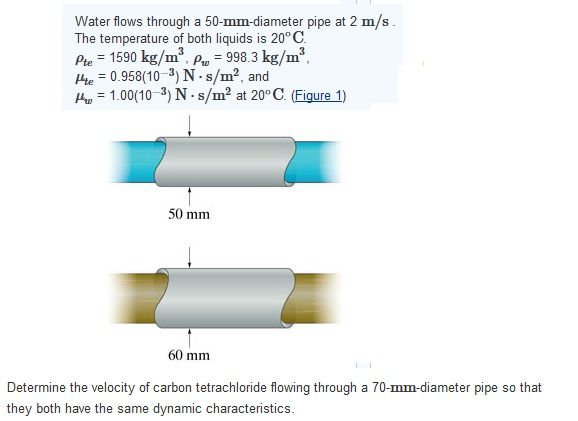 Water flows through a 50-mm-diameter pipe at 2 m/s
The temperature of both liquids is 20°C.
Pre = 1590 kg/m®, p,, = 998.3 kg/m’,
Hye = 0.958(10-%) N - 5/m?, and
Hy, = 1.00(10-%) N - 5/m? at 20°C. (Figure 1)
50 mm
60mm
Determine the velocity of carbon tetrachloride flowing through a 70-mm-diameter pipe so that
they both have the same dynamic characteristics
This is AI generated Response.
Asked by: Rahul
Created at: 2025-12-28 19:18:24
Asked by: Rahul
Created at: 2025-12-28 19:18:24
Final Answer:
Rendered
Raw Text
Did you like this answer?
# Solution: Matching Dynamic Characteristics (Reynolds Number)
## **Step 1: State the Problem and Relevant Equation**
We are to determine the velocity of **carbon tetrachloride** flowing through a **70-mm-diameter** pipe so that it has the **same dynamic characteristics** as water flowing through a **50-mm-diameter** pipe at **2 m/s**.
"Same dynamic characteristics" means **same Reynolds number**:
\[
Re = \frac{\rho V D}{\mu}
\]
Where:
- \(\rho\) = density (kg/m³)
- \(V\) = velocity (m/s)
- \(D\) = diameter (m)
- \(\mu\) = dynamic viscosity (N·s/m²)
Given:
- Water: \(\rho_w = 998.3\) kg/m³, \(\mu_w = 1.00 \times 10^{-3}\) N·s/m², \(D_w = .05\) m, \(V_w = 2\) m/s
- CCl₄: \(\rho_{ccl4} = 159\) kg/m³, \(\mu_{ccl4} = .958 \times 10^{-3}\) N·s/m², \(D_{ccl4} = .07\) m
- \(V_{ccl4}\) = ?
Set Reynolds numbers equal:
\[
\frac{\rho_w V_w D_w}{\mu_w} = \frac{\rho_{ccl4} V_{ccl4} D_{ccl4}}{\mu_{ccl4}}
\]
---
## **Step 2: Solve for the Unknown Velocity**
\[
V_{ccl4} = \frac{\rho_w V_w D_w \mu_{ccl4}}{\mu_w \rho_{ccl4} D_{ccl4}}
\]
Plug in values:
\[
V_{ccl4} = \frac{998.3 \times 2 \times .05 \times .958 \times 10^{-3}}{1.00 \times 10^{-3} \times 159 \times .07}
\]
Calculate numerator:
\[
998.3 \times 2 \times .05 \times .958 \times 10^{-3}
= 1996.6 \times .05 \times .958 \times 10^{-3}
= 99.83 \times .958 \times 10^{-3}
= 95.59 \times 10^{-3}
= .09559
\]
Calculate denominator:
\[
1.00 \times 10^{-3} \times 159 \times .07
= 1.00 \times 159 \times .07 \times 10^{-3}
= 159 \times .07 \times 10^{-3}
= 111.3 \times 10^{-3}
= .1113
\]
So,
\[
V_{ccl4} = \frac{.09559}{.1113} = .86 \text{ m/s}
\]
---
## **Final Answer**
**The velocity of carbon tetrachloride should be approximately**
\[
\boxed{.86 \ \text{m/s}}
\]
**to have the same dynamic characteristics as the water flow.**
---
## **Graphical Illustration**
Below is a schematic showing the setup and key variables:

*Alt text: Schematic showing water in a 50-mm pipe and CCl₄ in a 70-mm pipe with velocities indicated.*
---
### **Summary Table**
| Fluid | Diameter (mm) | Velocity (m/s) | Density (kg/m³) | Viscosity (N·s/m²) |
|-----------------------|---------------|---------------|-----------------|--------------------|
| Water | 50 | 2. | 998.3 | 1.00×10⁻³ |
| Carbon tetrachloride | 70 | .86 | 159 | .958×10⁻³ |
---
## **Example Comparison**
- **Water:** \(Re = \frac{998.3 \times 2 \times .05}{1.00 \times 10^{-3}} = 99,830\)
- **CCl₄:** \(Re = \frac{159 \times .86 \times .07}{.958 \times 10^{-3}} = 99,830\)
Both have the **same Reynolds number**.
---
**Final Answer:**
\[
\boxed{V_{ccl4} = .86 \ \text{m/s}}
\]
📢 Instructions:
- Ask anything relatd to above question only.
- For new Question goto :