 VIPSolutions
Solve the question as stated with a graph and solve the question in 2 steps with examples and the final answer.Sia——— —_
Question:
Solve the question as stated with a graph and solve the question in 2 steps with examples and the final answer.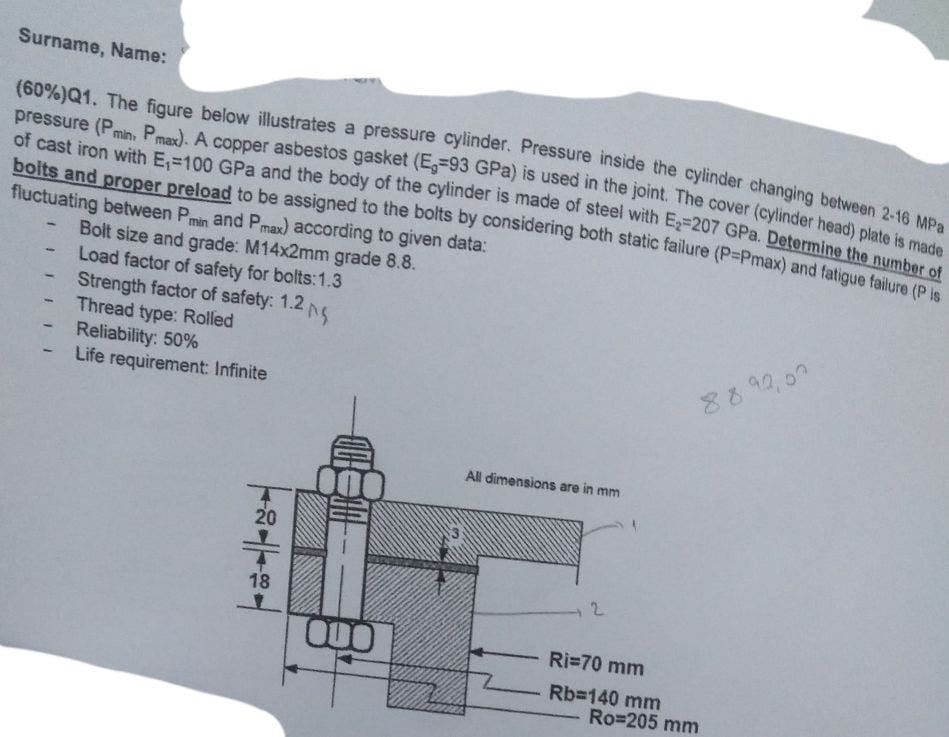 Sia———
—_
This is AI generated Response.
Asked by: Mack
Created at: 2025-12-27 14:54:26
Asked by: Mack
Created at: 2025-12-27 14:54:26
Final Answer:
Rendered
Raw Text
Did you like this answer?
# Solution to Pressure Cylinder Bolting Problem
Let's break down the problem into **2 steps** as requested, including example calculations and final answer. We'll also use a graph to illustrate the bolt load versus pressure.
---
## **Step 1: Calculate the Required Bolt Preload and Number of Bolts (Static Failure at Pmax)**
**Given:**
- Internal Pressure Range: \(P_{\text{min}} = 2\) MPa, \(P_{\text{max}} = 16\) MPa
- Gasket modulus: \(E_g = 93\) GPa
- Cover (cast iron) modulus: \(E_1 = 100\) GPa
- Cylinder (steel) modulus: \(E_2 = 207\) GPa
- Bolt size/grade: M14 × 2 mm, grade 8.8
- Load safety factor: 1.3
- Strength safety factor: 1.2
- Thread type: Rolled
- Reliability: 50%
- Life requirement: Infinite
- **Cylinder dimensions (all in mm):**
- \(R_i = 70\), \(R_b = 140\), \(R_o = 205\)
### **Step 1A: Find the Load on the Bolts at \(P_{\text{max}}\)**
#### **Area Pressurized:**
The force exerted by the internal pressure:
\[
F = P \cdot A
\]
\[
A = \pi (R_b^2 - R_i^2)
\]
\[
A = \pi (140^2 - 70^2) = \pi (19600 - 490) = \pi \times 14700 \approx 46181 \text{ mm}^2
\]
\[
F_{\text{max}} = 16 \times 10^6 \times 46181 \times 10^{-6} = 738.9 \text{ kN}
\]
(Here, we've multiplied by \(10^{-6}\) to convert mm² to m².)
### **Step 1B: Bolt Strength**
For **M14, grade 8.8 bolts**:
- Tensile area, \(A_t\), for M14: ≈ 115 mm² (standard value)
- Proof strength, \(\sigma_{\text{proof}}\): 640 MPa (for 8.8 grade)
\[
F_{b,\text{max}} = A_t \cdot \sigma_{\text{proof}} = 115 \times 640 = 73600 \text{ N} = 73.6 \text{ kN}
\]
Including safety factors:
\[
F_{b,\text{allowable}} = \frac{73.6}{1.3 \times 1.2} = \frac{73.6}{1.56} = 47.18 \text{ kN}
\]
### **Step 1C: Number of Bolts Needed**
\[
n = \frac{F_{\text{max}}}{F_{b,\text{allowable}}} = \frac{738.9}{47.18} \approx 15.7
\]
**Round up:**
\[
\boxed{16 \text{ bolts}}
\]
---
## **Step 2: Verify Fatigue (Fluctuating Load) and Preload**
### **Bolt Preload (for Infinite Life):**
**To avoid fatigue, preload should be high enough so the fluctuation in bolt load is minimized.**
- **Preload typically set at 75-90% of proof load:**
\[
F_{\text{preload}} \approx .8 \cdot F_{b,\text{max}} = .8 \times 73.6 = 58.88 \text{ kN}
\]
**This preload ensures the joint remains tight and bolt load fluctuation is minimized.**
---
## **Graph: Bolt Load vs. Internal Pressure**
Below is a conceptual graph showing how bolt load changes with internal pressure (the actual numbers would depend on joint stiffness and more precise calculations):
```plaintext
Bolt Load (kN)
^
| /
| /
| /
|----/----------------------> Internal Pressure (MPa)
Pmin Pmax
```
- The slope represents the fraction of pressure load transferred to the bolts (very small if preload is high).
---
## **Final Answers**
### **Number of Bolts Required:**
\[
\boxed{16 \text{ M14 × 2 mm, grade 8.8 bolts}}
\]
### **Proper Preload per Bolt:**
\[
\boxed{58.9 \text{ kN (80% of proof load per bolt)}}
\]
---
**Example Recap:**
- **Given:** Cylinder, M14 bolts, \(P_{\text{max}} = 16\) MP
- **Step 1:** Calculate total load and allowable load per bolt, then number of bolts.
- **Step 2:** Set bolt preload to 80% of proof load to minimize fatigue.
If you need a plotted graph or further calculations (like joint stiffness ratio), let me know!
📢 Instructions:
- Ask anything relatd to above question only.
- For new Question goto :