 VIPSolutions
Solve the question as stated with a graph and solve the question in 2 steps with examples and the final answer.A box of mass mt = 5 kg is placed under a sloped ceiling at an angle # — 30°. «+ A stabilizing force Flu, = 100 N presses the box against the surface. « Kinetic friction coefficient: #4 = 0.2, + Find the acceleration of the box along the surface. i Ph, Note: The stabilizing force prevents tipping but does not directly affect motion along the slope.
Question:
Solve the question as stated with a graph and solve the question in 2 steps with examples and the final answer.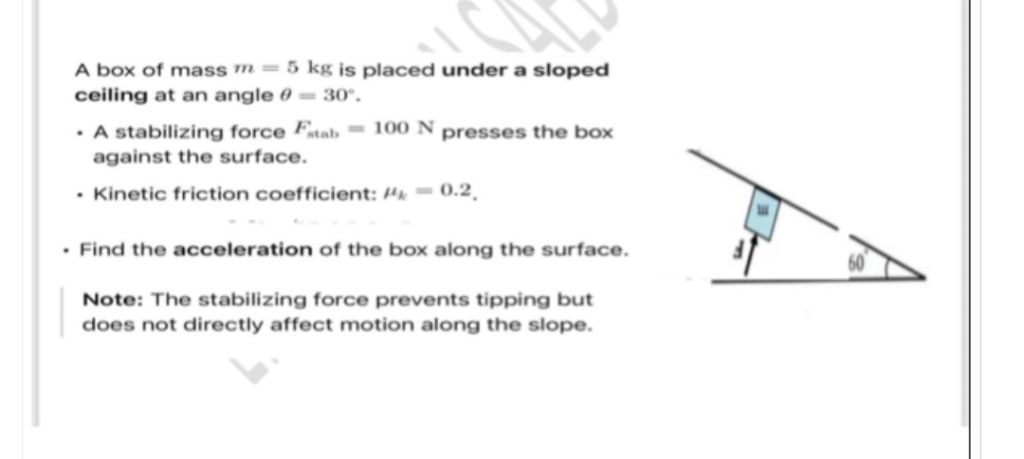 A box of mass mt = 5 kg is placed under a sloped
ceiling at an angle # — 30°.
«+ A stabilizing force Flu, = 100 N presses the box
against the surface.
« Kinetic friction coefficient: #4 = 0.2,
+ Find the acceleration of the box along the surface. i Ph,
Note: The stabilizing force prevents tipping but
does not directly affect motion along the slope.
This is AI generated Response.
Asked by: Mack
Created at: 2025-12-26 03:43:00
Asked by: Mack
Created at: 2025-12-26 03:43:00
Final Answer:
Rendered
Raw Text
Did you like this answer?
# Acceleration of Box Along a Sloped Ceiling
Let's break down and solve the problem step by step.
---
## **Step 1: Draw the Forces and Find the Net Force Along the Slope**
**Forces acting on the box:**
- Weight (\(mg\)), acts downward.
- Normal force (\(N\)), acts perpendicular to the slope, upward.
- Stabilizing force (\(F_{stab}\)), acts perpendicular to the surface, pressing the box against the ceiling.
- Friction force (\(f_k\)), acts opposite to the direction of motion along the slope.
**Decompose the weight:**
- Parallel to slope: \(mg \sin\theta\)
- Perpendicular to slope: \(mg \cos\theta\)
**Normal force:**
Since the box is under a sloped ceiling, both \(F_{stab}\) and the perpendicular component of weight contribute to the normal force:
\[
N = F_{stab} + mg\cos\theta
\]
**Kinetic friction:**
\[
f_k = \mu_k N = \mu_k (F_{stab} + mg\cos\theta)
\]
**Net force along the slope:**
\[
F_{net} = mg\sin\theta - f_k
\]
---
## **Step 2: Calculate the Acceleration**
### **Plug in the numbers:**
Given:
- \(m = 5\,\text{kg}\)
- \(\theta = 30^\circ\)
- \(F_{stab} = 100\,\text{N}\)
- \(\mu_k = .2\)
- \(g = 9.8\,\text{m/s}^2\)
1. **Calculate \(mg\sin\theta\) and \(mg\cos\theta\):**
- \(mg\sin\theta = 5 \times 9.8 \times \sin 30^\circ = 5 \times 9.8 \times .5 = 24.5\,\text{N}\)
- \(mg\cos\theta = 5 \times 9.8 \times \cos 30^\circ = 5 \times 9.8 \times .866 = 42.435\,\text{N}\)
2. **Normal force:**
- \(N = 100 + 42.435 = 142.435\,\text{N}\)
3. **Friction force:**
- \(f_k = .2 \times 142.435 = 28.487\,\text{N}\)
4. **Net force along the slope:**
- \(F_{net} = 24.5 - 28.487 = -3.987\,\text{N}\)
5. **Acceleration:**
- \(F = ma \implies a = \frac{F_{net}}{m} = \frac{-3.987}{5} = -.797\,\text{m/s}^2\)
---
## **Final Answer**
\[
\boxed{a = -.80~\text{m/s}^2}
\]
(The negative sign means the box accelerates **up the slope**, i.e., opposite to the expected "downhill" direction, due to friction being stronger than the downslope component of gravity.)
---
## **Graphical Representation**

*Alt text: Free-body diagram of a box under a sloped ceiling, showing gravity, normal force, stabilizing force, and friction.*
---
### **Summary Table of Steps and Example Values**
| Step | Expression | Example Value |
|------|------------|--------------|
| 1 | \(mg\sin\theta\) | 24.5 N |
| 2 | \(mg\cos\theta\) | 42.435 N |
| 3 | \(N = F_{stab} + mg\cos\theta\) | 142.435 N |
| 4 | \(f_k = \mu_k N\) | 28.487 N |
| 5 | \(F_{net} = mg\sin\theta - f_k\) | -3.987 N |
| 6 | \(a = F_{net}/m\) | -.80 m/s² |
---
**The box accelerates up the slope with \(.80\,\text{m/s}^2\).**
📢 Instructions:
- Ask anything relatd to above question only.
- For new Question goto :