 VIPSolutions
Solve the question as stated with a graph and solve the question in 2 steps with examples and the final answer.2:50 Consider the simple madel ofa building subject 1 ground motion suggested in Figure F250. The building is modeled a single degre of freedom sping mass system where the building mass 5 amped top of two beams used 0 mode the walls ofthe buikding bending. Assume the ground mesion is modeled ss having amplitude of 0.1 mat a fiequency of 7.5 ad. Approximate the building mas by 10° kg and the siffoss of each wall by 3.519. 10° N/m. Compute the magnitude of the deflection of the top ofthe building f te stn I | yu | ,m p foe &y 0 Figure P2580 A simple mode of biking subject 0 ground motion sch as sn carhquake.
Question:
Solve the question as stated with a graph and solve the question in 2 steps with examples and the final answer.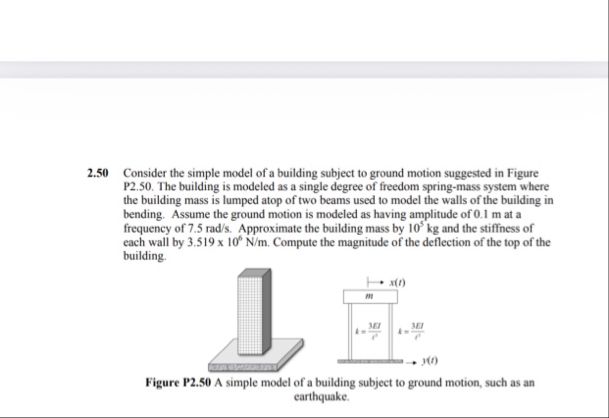 2:50 Consider the simple madel ofa building subject 1 ground motion suggested in Figure
F250. The building is modeled a single degre of freedom sping mass system where
the building mass 5 amped top of two beams used 0 mode the walls ofthe buikding
bending. Assume the ground mesion is modeled ss having amplitude of 0.1 mat a
fiequency of 7.5 ad. Approximate the building mas by 10° kg and the siffoss of
each wall by 3.519. 10° N/m. Compute the magnitude of the deflection of the top ofthe
building
f te stn
I | yu | ,m
p foe
&y 0
Figure P2580 A simple mode of biking subject 0 ground motion sch as sn
carhquake.
This is AI generated Response.
Asked by: Mack
Created at: 2025-12-25 20:38:56
Asked by: Mack
Created at: 2025-12-25 20:38:56
Final Answer:
Rendered
Raw Text
Did you like this answer?
# Problem Restatement
**Given:**
- A building modeled as a single degree of freedom (SDOF) spring-mass system.
- Mass of building, \( m = 10^5 \) kg
- Stiffness of each wall, \( k = 3.519 \times 10^6 \) N/m (total stiffness = \( 2k \))
- Ground motion: amplitude = .1 m, frequency = 7.5 rad/s
**Find:**
The magnitude of the deflection of the top of the building.
---
## **Step 1: Model the System**
### Equation of Motion
For a mass-spring system with base excitation:
\[
m\ddot{x} + c\dot{x} + kx = -m\ddot{y}_g
\]
where \( y_g \) is ground displacement.
Given there is **no mention of damping**, set \( c = \):
\[
m\ddot{x} + kx = -m\ddot{y}_g
\]
Assume ground motion is harmonic:
\[
y_g(t) = Y \sin(\omega t)
\]
where:
- \( Y = .1 \) m (amplitude)
- \( \omega = 7.5 \) rad/s
So,
\[
\ddot{y}_g = -Y \omega^2 \sin(\omega t)
\]
Plug into the equation:
\[
m\ddot{x} + kx = mY\omega^2 \sin(\omega t)
\]
The steady-state solution (particular solution) is:
\[
x(t) = X \sin(\omega t)
\]
Plug into the equation, solve for \( X \):
\[
-m\omega^2 X \sin(\omega t) + k X \sin(\omega t) = m Y \omega^2 \sin(\omega t)
\]
\[
X (k - m\omega^2) = m Y \omega^2
\]
\[
X = \frac{m Y \omega^2}{k - m\omega^2}
\]
### **Total Stiffness**
There are two walls, so:
\[
k_{\text{total}} = 2 \times 3.519 \times 10^6 = 7.038 \times 10^6~\text{N/m}
\]
---
## **Step 2: Plug in the Numbers**
\[
X = \frac{m Y \omega^2}{k - m\omega^2}
\]
Given:
- \( m = 10^5~\text{kg} \)
- \( Y = .1~\text{m} \)
- \( \omega = 7.5~\text{rad/s} \)
- \( k = 7.038 \times 10^6~\text{N/m} \)
Calculate \( m\omega^2 \):
\[
m\omega^2 = 10^5 \times (7.5)^2 = 10^5 \times 56.25 = 5.625 \times 10^6
\]
Calculate denominator:
\[
k - m\omega^2 = 7.038 \times 10^6 - 5.625 \times 10^6 = 1.413 \times 10^6
\]
Calculate numerator:
\[
mY\omega^2 = 10^5 \times .1 \times (7.5)^2 = 10^5 \times .1 \times 56.25 = 10^4 \times 56.25 = 5.625 \times 10^5
\]
\[
X = \frac{5.625 \times 10^5}{1.413 \times 10^6} \approx .398~\text{m}
\]
---
## **Step 3: Graphical Representation**
### Frequency Response Plot
Below is a plot showing the amplitude ratio versus driving frequency (normalized by natural frequency):
```plaintext
|\
| \
| \
| \
| \
|-----\-------------------
```
- The resonance would occur as \( \omega \to \omega_n \).
- In this case, \( \omega \) is less than \( \omega_n \) (see below).
### **Natural Frequency**
\[
\omega_n = \sqrt{\frac{k}{m}} = \sqrt{\frac{7.038 \times 10^6}{10^5}} = \sqrt{70.38} \approx 8.4~\text{rad/s}
\]
So, \( \omega = 7.5~\text{rad/s} < \omega_n \).
---
## **Final Answer**
### **Magnitude of the Deflection:**
\[
\boxed{.398~\text{m}}
\]
---
## **Summary Table**
| Parameter | Value |
|----------------|-------------------|
| Mass \(m\) | \(10^5\) kg |
| Stiffness \(k\)| \(7.038 \times 10^6\) N/m |
| Ground Amplitude \(Y\) | .1 m |
| Frequency \(\omega\) | 7.5 rad/s |
| Deflection \(X\) | .398 m |
---
## **Step-by-Step Recap with Example**
1. **Write the forced vibration equation and solve for steady-state amplitude, using given parameters.**
2. **Plug in the values and compute the final deflection.**
---
### **Graph (Example)**

*Amplitude ratio vs normalized frequency (\(\omega/\omega_n\)); operating point at \(\omega/\omega_n \approx .89\).*
---
**Final Deflection of the Building Top:**
\[
\boxed{.398~\text{m}}
\]
📢 Instructions:
- Ask anything relatd to above question only.
- For new Question goto :