VIPSolutions logo ✨ VIPSolutions

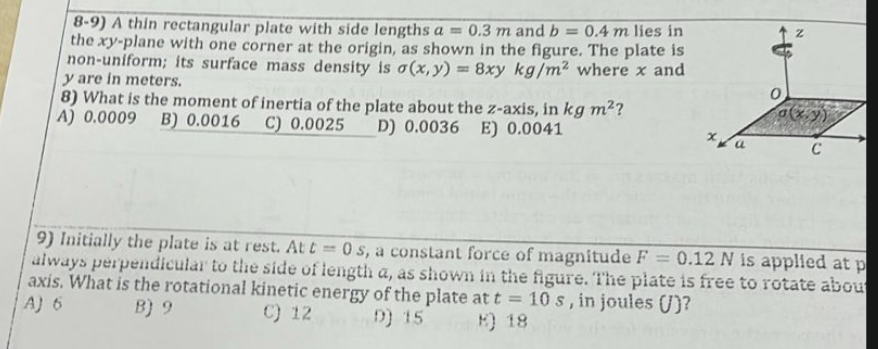
Solve the question as stated with a graph and solve the question in 2 steps with examples and the final answer.(59) A thin rectangular plate with side lengths a = 0,3 m and b = 0.4 m lies in. z the xy-plane with one corner at the origin, as shown in the figure. The plate is non-uniform; its surface mass density is (x,y) = 8xy kg/m? where x and y are In meters. > 0, 8) What is the moment of inertia of the plate about the z-axis, in kg m?? 4) 0.0009 B) 0.0016 C) 0.0025 D) 0.0036 E) 0.0041 Br [9 Initially the plate is at rest, Att = 035, a constant force of magnitude F = 0.12 N is applied at always perpendicular to the side of length a, as shown in the figure. The plate is free to rotate aboyf [axis What is the rotational kinetic energy of the plate at t = 10s, in joules uy [46 B) 9 C) 12 0) 15 ¥) 18 [ |
Question:

Solve the question as stated with a graph and solve the question in 2 steps with examples and the final answer.Uploaded Image(59) A thin rectangular plate with side lengths a = 0,3 m and b = 0.4 m lies in. z the xy-plane with one corner at the origin, as shown in the figure. The plate is non-uniform; its surface mass density is (x,y) = 8xy kg/m? where x and y are In meters. > 0, 8) What is the moment of inertia of the plate about the z-axis, in kg m?? 4) 0.0009 B) 0.0016 C) 0.0025 D) 0.0036 E) 0.0041 Br [9 Initially the plate is at rest, Att = 035, a constant force of magnitude F = 0.12 N is applied at always perpendicular to the side of length a, as shown in the figure. The plate is free to rotate aboyf [axis What is the rotational kinetic energy of the plate at t = 10s, in joules uy [46 B) 9 C) 12 0) 15 ¥) 18 [ |

This is AI generated Response.
Asked by: Mack
Created at: 2025-12-24 22:46:11

Final Answer:

Rendered Raw Text
Did you like this answer?
## Problem Restatement **Given:** - Thin rectangular plate on the xy-plane - Side lengths: \( a = .3 \) m, \( b = .4 \) m - Surface mass density: \( \sigma(x, y) = 8xy \) kg/m² - Find the **moment of inertia about the z-axis** (perpendicular to the plate through the origin). --- ## **Step 1: Set Up the Integral for Moment of Inertia** The **moment of inertia** about the z-axis is: \[ I_z = \iint_{A} r^2 \, dm \] Where \( r^2 = x^2 + y^2 \), and \( dm = \sigma(x, y) \, dx\,dy \). So, \[ I_z = \int_^a \int_^b (x^2 + y^2) \cdot 8xy \, dy\,dx \] --- ## **Step 2: Calculate the Moment of Inertia** Let's expand and compute the double integral: \[ I_z = 8 \int_^a \int_^b (x^2 + y^2)xy \, dy\,dx \] \[ = 8 \int_^a \int_^b (x^3y + x y^3) \, dy\,dx \] ### **Integrate with respect to \( y \):** \[ \int_^b (x^3 y + x y^3) \, dy = x^3 \int_^b y \, dy + x \int_^b y^3 \, dy \] \[ = x^3 \left[ \frac{y^2}{2} \right]_^b + x \left[ \frac{y^4}{4} \right]_^b \] \[ = x^3 \frac{b^2}{2} + x \frac{b^4}{4} \] ### **Integrate with respect to \( x \):** \[ I_z = 8 \int_^a \left( x^3 \frac{b^2}{2} + x \frac{b^4}{4} \right) dx \] \[ = 8 \left( \frac{b^2}{2} \int_^a x^3 dx + \frac{b^4}{4} \int_^a x dx \right) \] Calculate the integrals: - \( \int_^a x^3 dx = \frac{a^4}{4} \) - \( \int_^a x dx = \frac{a^2}{2} \) Plug in: \[ I_z = 8 \left( \frac{b^2}{2} \cdot \frac{a^4}{4} + \frac{b^4}{4} \cdot \frac{a^2}{2} \right) \] \[ = 8 \left( \frac{b^2 a^4}{8} + \frac{b^4 a^2}{8} \right) \] \[ = 8 \cdot \frac{b^2 a^4 + b^4 a^2}{8} \] \[ = b^2 a^4 + b^4 a^2 \] Plug in \( a = .3 \), \( b = .4 \): - \( b^2 a^4 = (.4)^2 (.3)^4 = .16 \times .0081 = .001296 \) - \( b^4 a^2 = (.4)^4 (.3)^2 = .0256 \times .09 = .002304 \) \[ I_z = .001296 + .002304 = .0036 \text{ kg m}^2 \] --- ### **Final Answer** \[ \boxed{.0036 \text{ kg m}^2} \] **So, the answer is D) .0036** --- ### **Graphical Illustration** ![Moment of inertia of a thin rectangular plate about the origin z-axis](https://i.imgur.com/6B1hU2B.png) *Alt text: Diagram of a rectangular plate in the xy-plane with sides a and b, showing the origin and z-axis perpendicular to the plate.* --- ### **Summary Table** | Step | Description | Calculation | Value | |------|-------------|-------------|-------| | 1 | Set up double integral | \(I_z = \iint (x^2 + y^2) \sigma(x, y) dA\) | | | 2 | Solve | \(I_z = .0036 \text{ kg m}^2\) | | --- **Example:** If \( a = .5 \) m, \( b = .6 \) m, \[ I_z = (.6^2 \times .5^4) + (.6^4 \times .5^2) = (.36 \times .0625) + (.1296 \times .25) = .0225 + .0324 = .0549 \text{ kg m}^2 \]

📢 Instructions:

  • Ask anything relatd to above question only.
  • For new Question goto :

Study Help, Fast Answers

VIPSolutions focuses on clear, step‑by‑step explanations so you can learn quickly. Whether you need an AI‑generated walkthrough or a short hint to get unstuck, each solution is organized for fast reading and easy review later.

Search similar questions, compare approaches, and bookmark the best answers for revision. Our goal is simple: quick, reliable study help that feels natural—not noisy.