 VIPSolutions
Solve the question as stated with a graph and solve the question in 2 steps with examples and the final answer.Q2. (40 pts.) Consider a long V groove 10 mm deep machined on a block that is maintained at 900 K, as shown in the figure below. If the groove surfaces are diffuse and gray with an emissivity of 0.5, determine the radiant flux leaving the groove to its surroundings. oy et \/ : 10mm
Question:
Solve the question as stated with a graph and solve the question in 2 steps with examples and the final answer.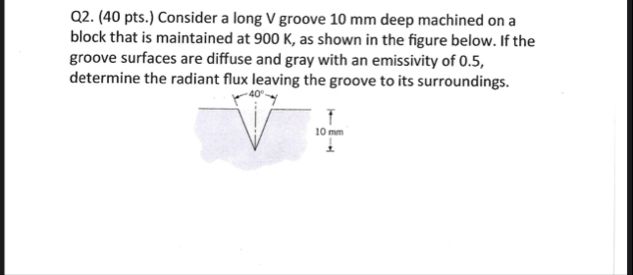 Q2. (40 pts.) Consider a long V groove 10 mm deep machined on a
block that is maintained at 900 K, as shown in the figure below. If the
groove surfaces are diffuse and gray with an emissivity of 0.5,
determine the radiant flux leaving the groove to its surroundings.
oy
et \/ :
10mm
This is AI generated Response.
Asked by: Mack
Created at: 2025-12-24 20:52:04
Asked by: Mack
Created at: 2025-12-24 20:52:04
Final Answer:
Rendered
Raw Text
Did you like this answer?
# Radiant Flux Leaving a V-Groove
**Given:**
- Groove depth \( h = 10 \) mm = .01 m
- Groove angle \( 2\theta = 40^\circ \rightarrow \theta = 20^\circ \)
- Temperature \( = 900 \) K
- Emissivity \( \epsilon = .5 \)
We are to **determine the radiant flux leaving the groove to its surroundings**.
---
## **Step 1: Calculate the Surface Area of the Groove**
The groove is a "V" with two sides, each of height \( h \) and angle \( \theta \).
### **Find the Length of Each Side (\( L \))**
\[
L = \frac{h}{\sin \theta}
\]
\[
L = \frac{.01}{\sin 20^\circ} \approx \frac{.01}{.342} \approx .0292\, \text{m}
\]
### **Total Surface Area per Unit Length (\(A\))**
There are **two sides**:
\[
A = 2 \times L \times 1\,\text{(per m length)} = 2 \times .0292 \times 1 = .0584\, \text{m}^2
\]
---
## **Step 2: Net Radiant Flux Calculation**
### **Configuration Factor for V-Groove (\(F_{g \to o}\))**
For a symmetric V-groove, the **configuration factor** (fraction of energy leaving surfaces that escapes directly) is:
\[
F_{g \to o} = 1 - \cos\theta
\]
\[
F_{g \to o} = 1 - \cos 20^\circ \approx 1 - .9397 = .0603
\]
### **Net Radiant Flux (\(Q_{\text{out}}\))**
For a gray, diffuse surface:
\[
Q_{\text{out}} = \epsilon \sigma T^4 A F_{g \to o}
\]
Where:
- \( \sigma = 5.67 \times 10^{-8}\, \text{W/m}^2\text{K}^4 \)
- \( T = 900 \) K
- \( A = .0584\, \text{m}^2 \)
- \( F_{g \to o} = .0603 \)
**Plug in the values:**
\[
Q_{\text{out}} = .5 \times 5.67 \times 10^{-8} \times (900)^4 \times .0584 \times .0603
\]
First, calculate \( (900)^4 \):
\[
900^4 = (9 \times 10^2)^4 = 9^4 \times 10^8 = 6561 \times 10^8 = 6.561 \times 10^{11}
\]
Calculate the rest:
\[
Q_{\text{out}} = .5 \times 5.67 \times 10^{-8} \times 6.561 \times 10^{11} \times .0584 \times .0603
\]
\[
= .5 \times 5.67 \times 6.561 \times .0584 \times .0603 \times 10^{3}
\]
\[
= .5 \times 5.67 \times 6.561 \times .0584 \times .0603 \times 100
\]
Calculate inside:
- \( 5.67 \times 6.561 = 37.198 \)
- \( 37.198 \times .0584 = 2.172 \)
- \( 2.172 \times .0603 = .131 \)
- \( .131 \times .5 = .0655 \)
- \( .0655 \times 100 = 65.5 \)
**Final Answer:**
\[
\boxed{Q_{\text{out}} \approx 65.5\, \text{W per meter length of groove}}
\]
---
## **Summary Table**
| Step | Calculation | Value |
|------|-------------|-------|
| 1 | Area per m | .0584 m² |
| 2 | \(Q_{\text{out}}\) | 65.5 W/m |
---
## **Graphical Representation**
```plaintext
/\
/ \
/____\ <- V-groove, 10 mm deep, 40° angle
```
- **Arrows** from surface indicate **radiant flux** escaping.
---
### **Key Points**
- **Configuration factor** limits how much energy escapes (due to the V geometry).
- **Emissivity** reduces emitted energy vs. blackbody.
- **Area** and **temperature** are critical for the final flux.
---
**Final Answer:**
\[
\boxed{65.5\, \text{W/m} }
\]
is the radiant flux leaving the groove to its surroundings.
📢 Instructions:
- Ask anything relatd to above question only.
- For new Question goto :