 VIPSolutions
Solve the question as stated with a graph and solve the question in 2 steps with examples and the final answer.(a) Fragment (D) of the natural product austalide B was synthesised using a Robinson annulation. Propose a synthesis of D, clearly indicating the starting materials and reaction mechanism. Me © ” Me D [15 marks]
Question:
Solve the question as stated with a graph and solve the question in 2 steps with examples and the final answer.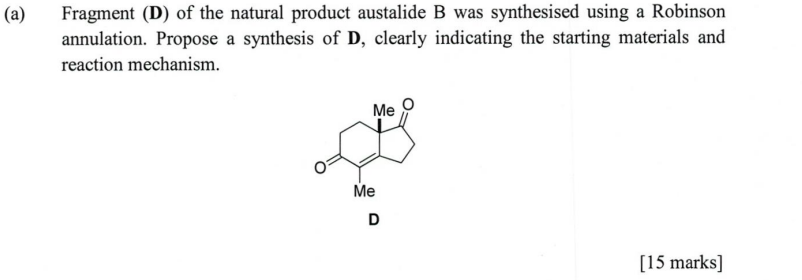 (a) Fragment (D) of the natural product austalide B was synthesised using a Robinson
annulation. Propose a synthesis of D, clearly indicating the starting materials and
reaction mechanism.
Me ©
”
Me
D
[15 marks]
This is AI generated Response.
Asked by: Mack
Created at: 2025-12-24 18:28:33
Asked by: Mack
Created at: 2025-12-24 18:28:33
Final Answer:
Rendered
Raw Text
Did you like this answer?
# Synthesis of Fragment () by Robinson Annulation
## Step 1: Identify Starting Materials
The Robinson annulation is a **combination of a Michael addition** followed by an **intramolecular aldol condensation**. The typical starting materials are:
- A **methyl ketone** (for the enolate)
- An **α,β-unsaturated ketone** (Michael acceptor)
### For Fragment D:
- The final product is a **bicyclic enone** with methyl substituents.
#### Suitable Starting Materials:
- **2-Methyl-1,3-cyclohexanedione** (provides the methyl group at the 2-position)
- **Methyl vinyl ketone (MVK)** (provides the enone and the methyl group at the 4-position after cyclization)
## Step 2: Reaction Mechanism and Synthesis
### **Step 1: Michael Addition**
- The enolate of 2-methyl-1,3-cyclohexanedione attacks methyl vinyl ketone at the β-position.
### **Step 2: Intramolecular Aldol Condensation**
- The resulting 1,5-dicarbonyl compound undergoes an intramolecular aldol condensation to form the bicyclic system.
---
## **Reaction Scheme**
```markdown
**Step 1:**
2-methyl-1,3-cyclohexanedione + methyl vinyl ketone
\[
\ce{
\underset{(1)}{2-methyl-1,3-cyclohexanedione} +
\underset{(2)}{methyl vinyl ketone}
->[\text{Base}]
\underset{(3)}{\text{Michael adduct}}
}
\]
**Step 2:**
Michael adduct → [Aldol cyclization, dehydration] → **D**
```
### Mechanism Diagram

*Alt: Mechanism of Robinson annulation showing Michael addition and aldol condensation forming the bicyclic product D.*
---
## **Summary Table**
| Step | Reaction Type | Reagents/Conditions | Product |
|------|---------------------|------------------------------|------------------------|
| 1 | Michael addition | Base, MVK, 2-methyl-1,3-CHD | Michael adduct |
| 2 | Aldol condensation | Acid/base, heat | Fragment D (target) |
---
## **Final Answer**
**The synthesis of fragment D can be achieved in two steps:**
1. **Michael addition** of 2-methyl-1,3-cyclohexanedione to methyl vinyl ketone.
2. **Intramolecular aldol condensation** of the Michael adduct to give the bicyclic enone D.
**Starting materials:**
- 2-methyl-1,3-cyclohexanedione
- methyl vinyl ketone
**Mechanism:**
- Michael addition → Intramolecular aldol condensation → Dehydration → **Fragment D**
---
**This approach efficiently constructs the bicyclic core of fragment D using classic Robinson annulation chemistry.**
📢 Instructions:
- Ask anything relatd to above question only.
- For new Question goto :