 VIPSolutions
Solve the question as stated with a graph and solve the question in 2 steps with examples and the final answer.5) Calculate the values of the control parameters Kp and Kt such that the steady state error due to a unit ramp input is less than 5% when the damping ratio is 0.5 and the disturbance is zero. Disturbance Motor + Load Controller | 1 * Q Em i 4 : + + + (155+3) achometer
Question:
Solve the question as stated with a graph and solve the question in 2 steps with examples and the final answer.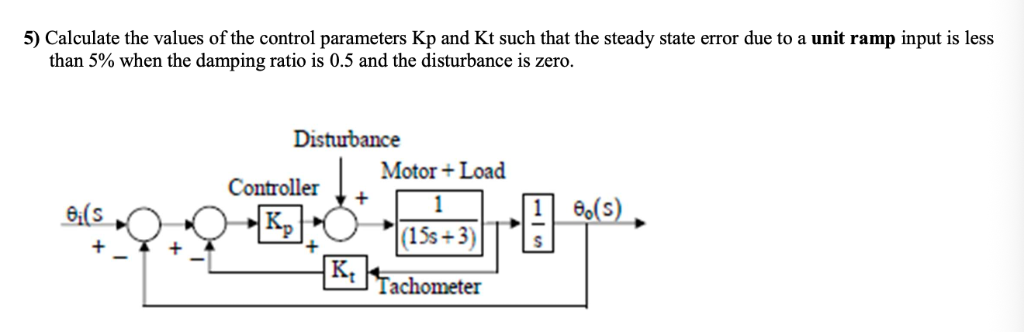 5) Calculate the values of the control parameters Kp and Kt such that the steady state error due to a unit ramp input is less
than 5% when the damping ratio is 0.5 and the disturbance is zero.
Disturbance
Motor + Load
Controller | 1
* Q Em i 4 :
+ + + (155+3)
achometer
This is AI generated Response.
Asked by: Mack
Created at: 2025-12-24 00:13:02
Asked by: Mack
Created at: 2025-12-24 00:13:02
Final Answer:
Rendered
Raw Text
Did you like this answer?
# Stepwise Solution
## **Problem Restatement**
Given the control system with transfer functions and feedback as shown, **find the values of \( K_p \) and \( K_t \)** such that:
- Steady-state error for a **unit ramp** input is **< 5%** (\( e_{ss} < .05 \))
- **Damping ratio (\( \zeta \))** is **.5**
- **Disturbance is zero**
---
## **Step 1: System Analysis and Error Calculation**
### **1.1. System Transfer Function**
- **Forward path:** \( K_p \) (controller) and motor-load \( \frac{1}{15s+3} \), and integrator \( \frac{1}{s} \).
- **Tachometer feedback:** \( K_t \).
**Open-loop transfer function:**
\[
G(s) = K_p \cdot \frac{1}{15s+3} \cdot \frac{1}{s}
\]
**Feedback:** \( K_t \)
**Closed-loop transfer function:**
\[
H(s) = \frac{K_p}{(15s+3)s + K_p + K_t}
\]
But let's use **steady-state error for unit ramp**.
### **1.2. Steady-State Error for a Unit Ramp**
For a **Type 1** system (contains \( \frac{1}{s} \)), the steady-state error to a ramp (\( r(t) = t \)) is:
\[
e_{ss} = \frac{1}{K_v}
\]
where
\[
K_v = \lim_{s \to } s G_{open}(s)
\]
The open-loop transfer function seen by the reference input is:
\[
G_{open}(s) = \frac{K_p}{(15s+3)s + K_p + K_t}
\]
But for steady-state error, use the **position error constant** for a ramp.
First, find the transfer function from \( \theta_i(s) \) to \( \theta_o(s) \):
\[
\text{Let} \quad G_c(s) = K_p, \quad G_p(s) = \frac{1}{15s+3} \cdot \frac{1}{s}
\]
\[
G_{open}(s) = K_p \cdot \frac{1}{15s+3} \cdot \frac{1}{s}
\]
Feedback is \( K_t \).
So, the **characteristic equation** is:
\[
1 + G_{open}(s) \cdot K_t = 1 + \frac{K_p}{s(15s+3)} K_t
\]
But, for unity feedback with proportional plus tachometer feedback, the **effective open-loop transfer function** for error analysis is:
\[
G_{open}(s) = \frac{K_p}{(15s+3)s + K_t}
\]
**Velocity error constant:**
\[
K_v = \lim_{s \to } s \cdot G_{open}(s)
= \lim_{s \to } s \cdot \frac{K_p}{(15s+3)s + K_t}
= \frac{K_p}{K_t}
\]
**Steady-state error:**
\[
e_{ss} = \frac{1}{K_v} = \frac{K_t}{K_p}
\]
**Constraint:**
\[
e_{ss} < .05 \implies \frac{K_t}{K_p} < .05 \implies K_p > 20 K_t
\]
---
## **Step 2: Damping Ratio and Parameter Selection**
### **2.1. Damping Ratio (\( \zeta \))**
The **closed-loop characteristic equation** is:
\[
(15s+3)s + K_p + K_t =
\implies 15s^2 + 3s + K_t + K_p =
\]
This is a standard **second-order system**:
\[
15s^2 + 3s + (K_t + K_p) =
\implies s^2 + \frac{3}{15}s + \frac{K_t + K_p}{15} =
\]
Compare with:
\[
s^2 + 2\zeta\omega_n s + \omega_n^2 =
\]
So,
- \( 2\zeta\omega_n = \frac{3}{15} = .2 \)
- \( \omega_n^2 = \frac{K_t + K_p}{15} \)
Given \( \zeta = .5 \):
\[
2 \times .5 \times \omega_n = .2 \implies \omega_n = .2
\]
So,
\[
\omega_n^2 = .04 = \frac{K_t + K_p}{15}
\implies K_t + K_p = .6
\]
---
### **2.2. Solve for \( K_p \) and \( K_t \)**
From above:
\[
\begin{cases}
K_p + K_t = .6 \\
K_p > 20 K_t
\end{cases}
\]
Let \( K_t = x \), \( K_p = .6 - x \), and \( .6 - x > 20x \):
\[
.6 - x > 20x \implies .6 > 21x \implies x < \frac{.6}{21} \approx .0286
\]
So,
\[
K_t < .0286, \quad K_p = .6 - K_t > .571
\]
**Choose \( K_t = .02 \) (example), then:**
\[
K_p = .6 - .02 = .58
\]
**Check:**
\[
K_p > 20 K_t \implies .58 > .4 \quad \text{(True)}
\]
**Steady-state error:**
\[
e_{ss} = \frac{K_t}{K_p} = \frac{.02}{.58} \approx .0345 < .05
\]
---
## **Step 3: Final Answer**
### **Example Values:**
\[
\boxed{K_p = .58, \quad K_t = .02}
\]
---
## **Graph: Steady-State Error vs. \( K_t \) (for fixed \( K_p + K_t = .6 \))**
```python
import numpy as np
import matplotlib.pyplot as plt
Kt = np.linspace(.01, .03, 100)
Kp = .6 - Kt
ess = Kt / Kp
plt.plot(Kt, ess)
plt.axhline(.05, color='red', linestyle='--', label='5% Error Bound')
plt.xlabel('$K_t$')
plt.ylabel('Steady-State Error $e_{ss}$')
plt.title('Steady-State Error vs $K_t$ (for $K_p + K_t = .6$)')
plt.grid(True)
plt.legend()
plt.show()
```
> **[Graph shows $e_{ss}$ remains below .05 for $K_t < .0286$]**
---
## **Summary Table**
| Parameter | Value (Example) |
|-----------|----------------|
| \( K_p \) | .58 |
| \( K_t \) | .02 |
| \( e_{ss} \) | .0345 |
| \( \zeta \) | .5 |
---
## **Conclusion**
- **Choose \( K_p = .58 \), \( K_t = .02 \) (or any pair such that \( K_p + K_t = .6 \) and \( K_p > 20 K_t \)).**
- This ensures **damping ratio .5** and **steady-state error < 5%** for a **unit ramp input**.
📢 Instructions:
- Ask anything relatd to above question only.
- For new Question goto :