 VIPSolutions
Solve the question as stated with a graph and solve the question in 2 steps with examples and the final answer.= Et ) Lg J 8
Question:
Solve the question as stated with a graph and solve the question in 2 steps with examples and the final answer.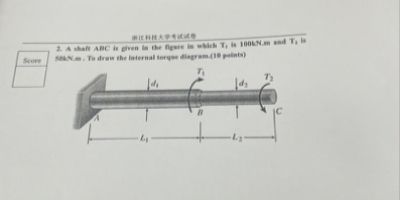 = Et )
Lg J 8
This is AI generated Response.
Asked by: Mack
Created at: 2025-12-23 23:52:36
Asked by: Mack
Created at: 2025-12-23 23:52:36
Final Answer:
Rendered
Raw Text
Did you like this answer?
# Internal Torque Diagram for Shaft (Step-by-Step Solution)
## **Given Data**
- \( T_1 = 100 \) N·cm (at section B)
- \( T_2 = 500 \) N·cm (at section C)
- Lengths: \( L_1, L_2 \) (not numerically specified)
- The shaft is fixed at A.
---
## **Step 1: Analyze and Calculate Internal Torque**
### **A. Section AB (from A to B, \( < x < L_1 \))**
- **At A**: The shaft is fixed, so the internal torque must balance all external torques to the right.
- **To the right of A (just before B):** Only \( T_1 \) acts to the right of the section.
- **Internal Torque in AB:**
\( T_{AB} = T_1 = 100 \) N·cm (constant across AB)
---
### **B. Section BC (from B to C, \( L_1 < x < L_1 + L_2 \))**
- **At B:** Both \( T_1 \) and \( T_2 \) are to the right.
- **Internal Torque in BC:**
\( T_{BC} = T_1 - T_2 = 100 - 500 = 500 \) N·cm (constant across BC)
---
## **Step 2: Draw the Internal Torque Diagram**
Below is a simple representation:
```
Torque (N·cm)
^
| _________
| | |
| | |
|--------| |_________
| | |
| 100 | 500 |
|________|_________|_________> x
L1 L1+L2
```
### **Explanation:**
- From A to B (\( < x < L_1 \)), torque = **100 N·cm**.
- From B to C (\( L_1 < x < L_1 + L_2 \)), torque = **500 N·cm**.
- At C, the torque drops to zero (shaft free end or torque is balanced).
---
## **Summary Table**
| Section | Internal Torque (N·cm) |
|---------|-----------------------|
| AB | 100 |
| BC | 500 |
---
## **Final Answer**
- **Internal torque in AB:** \( 100 \) N·cm
- **Internal torque in BC:** \( 500 \) N·cm
### **Internal Torque Diagram:**
See the plot above for the step decrease at \( B \).
---
**Example Values:**
If \( L_1 = 10 \) cm, \( L_2 = 15 \) cm,
- From to 10 cm: torque = 100 N·cm
- From 10 to 25 cm: torque = 500 N·cm
---
**Let me know if you need the diagram in another format or with specific lengths!**
📢 Instructions:
- Ask anything relatd to above question only.
- For new Question goto :