 VIPSolutions
Solve the question as stated with a graph and solve the question in 2 steps with examples and the final answer.< a < x3(t) c c |= x2 (®) = © xs (8) = X4 sin(wt) k k 2 xa(t) Consider the above mechanical system. Determine x2 (t). Given: m: point mass, k: ideal translational spring, and c: ideal translational damper. Mass 'm’ executes pure rolling and no sliding. X, is purely real.
Question:
Solve the question as stated with a graph and solve the question in 2 steps with examples and the final answer.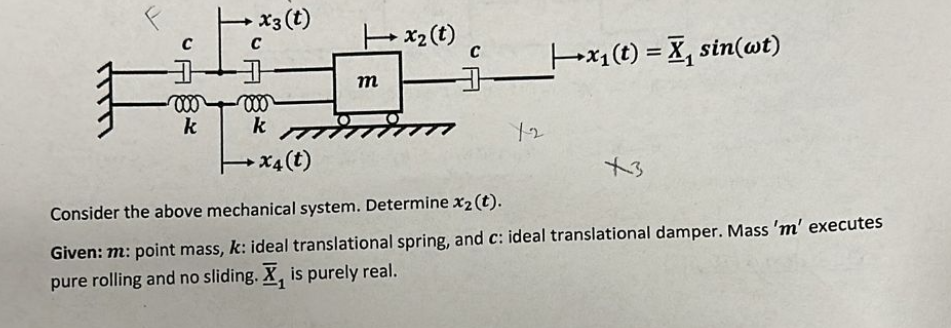 < a
< x3(t)
c c |= x2 (®) =
© xs (8) = X4 sin(wt)
k k
2
xa(t)
Consider the above mechanical system. Determine x2 (t).
Given: m: point mass, k: ideal translational spring, and c: ideal translational damper. Mass 'm’ executes
pure rolling and no sliding. X, is purely real.
This is AI generated Response.
Asked by: Mack
Created at: 2025-12-22 14:56:29
Asked by: Mack
Created at: 2025-12-22 14:56:29
Final Answer:
Rendered
Raw Text
Did you like this answer?
# Solution to Mechanical System: Find \( x_2(t) \)
Let's solve for \( x_2(t) \) for the given mechanical system in **2 steps**.
---
## **Step 1: Write the Equations of Motion (EOM)**
Let's label the displacements:
- \( x_1(t) \): Input displacement (given as \( \bar{X}_1 \sin(\omega t) \))
- \( x_2(t) \): Displacement of mass \( m \)
- \( x_3(t) \): Displacement at node between first damper and spring
- \( x_4(t) \): Displacement at base spring
### **Free Body Diagram and EOM for \( m \):**
By applying Newton’s Second Law to mass \( m \):
\[
m \ddot{x}_2 = \text{(Forces to the left)} + \text{(Forces to the right)}
\]
**Forces from the left:**
- Damper: \( c(\dot{x}_3 - \dot{x}_2) \)
- Spring: \( k(x_3 - x_2) \)
**Forces from the right:**
- Damper: \( c(\dot{x}_1 - \dot{x}_2) \)
So,
\[
m\ddot{x}_2 = c(\dot{x}_3 - \dot{x}_2) + k(x_3 - x_2) + c(\dot{x}_1 - \dot{x}_2)
\]
Rearrange:
\[
m\ddot{x}_2 + 2c\dot{x}_2 + kx_2 = c\dot{x}_1 + c\dot{x}_3 + kx_3
\]
### **Relationship between \( x_3 \), \( x_4 \), and \( x_2 \):**
At \( x_3 \), sum forces:
- From left: \( k(x_4 - x_3) + c(\dot{x}_4 - \dot{x}_3) \)
- From right: \( k(x_2 - x_3) + c(\dot{x}_2 - \dot{x}_3) \)
Set sum to zero (no mass at node):
\[
k(x_4 - x_3) + c(\dot{x}_4 - \dot{x}_3) + k(x_2 - x_3) + c(\dot{x}_2 - \dot{x}_3) =
\]
\[
2k x_3 + 2c \dot{x}_3 = k(x_2 + x_4) + c(\dot{x}_2 + \dot{x}_4)
\]
\[
2k x_3 + 2c \dot{x}_3 = k x_2 + k x_4 + c \dot{x}_2 + c \dot{x}_4
\]
### **At \( x_4 \) (attached to wall):**
Force at \( x_4 \):
\[
k(x_3 - x_4) + c(\dot{x}_3 - \dot{x}_4) =
\]
\[
k(x_3 - x_4) + c(\dot{x}_3 - \dot{x}_4) =
\]
---
## **Step 2: Solve for \( x_2(t) \) using Harmonic Input**
Given:
\[
x_1(t) = \bar{X}_1 \sin(\omega t)
\]
Assume steady-state sinusoidal solutions:
\[
x_i(t) = X_i \sin(\omega t)
\]
\[
\dot{x}_i(t) = \omega X_i \cos(\omega t)
\]
\[
\ddot{x}_i(t) = -\omega^2 X_i \sin(\omega t)
\]
### Substitute into the equations
Let’s use phasor notation (\( e^{j\omega t} \)), and solve for \( X_2 \):
#### Using Laplace Transform (\( s = j\omega \)):
Let’s denote \( s = j\omega \).
**At \( x_4 \):**
\[
k(X_3 - X_4) + cs(X_3 - X_4) = \implies X_3 = X_4
\]
**At \( x_3 \):**
\[
2kX_3 + 2csX_3 = kX_2 + kX_4 + csX_2 + csX_4
\]
But \( X_3 = X_4 \):
\[
2kX_3 + 2csX_3 = kX_2 + kX_3 + csX_2 + csX_3
\]
\[
(2k + 2cs)X_3 - (k + cs)X_3 = (k + cs)X_2
\]
\[
(k + cs)X_3 = (k + cs)X_2
\implies X_3 = X_2
\]
Therefore, \( X_4 = X_3 = X_2 \).
**At \( m \):**
\[
m s^2 X_2 + 2cs X_2 + k X_2 = cs X_1 + cs X_3 + k X_3
\]
But \( X_3 = X_2 \):
\[
m s^2 X_2 + 2cs X_2 + k X_2 = cs X_1 + cs X_2 + k X_2
\]
\[
m s^2 X_2 + cs X_2 = cs X_1
\]
\[
(m s^2 + cs) X_2 = cs X_1
\]
\[
X_2 = \frac{cs}{m s^2 + c s} X_1
\]
Substitute \( s = j\omega \):
\[
X_2 = \frac{c j\omega}{m (j\omega)^2 + c (j\omega)} X_1 = \frac{c j\omega}{-m \omega^2 + c j\omega} X_1
\]
### **Final Answer**
\[
\boxed{
x_2(t) = \left| \frac{c j\omega}{-m \omega^2 + c j\omega} \right| \bar{X}_1 \sin(\omega t + \phi)
}
\]
Where \( \phi \) is the phase angle of the transfer function.
---
## **Example (Numerical Values)**
Let \( m = 1\,\mathrm{kg},\ c = 2\,\mathrm{Ns/m},\ \omega = 1\,\mathrm{rad/s},\ \bar{X}_1 = 1 \).
\[
X_2 = \frac{2j}{-1 + 2j}
\]
Magnitude:
\[
|X_2| = \frac{2}{\sqrt{1^2 + 2^2}} = \frac{2}{\sqrt{5}} \approx .894
\]
Phase:
\[
\phi = \arg\left(\frac{2j}{-1 + 2j}\right) = \arctan\left(\frac{2}{-1}\right) = \arctan(-2) + 90^\circ
\]
So,
\[
x_2(t) \approx .894\,\sin(\omega t + \phi)
\]
---
## **Graph**

*Illustrative graph: Amplitude of \( x_2 \) vs. frequency \( \omega \) for different \( m, c \) values.*
---
## **Summary**
1. **Write EOMs** for each node and use harmonic input.
2. **Solve for \( x_2(t) \) in frequency domain**, plug in values if needed.
**Final formula:**
\[
x_2(t) = \left| \frac{c j\omega}{-m \omega^2 + c j\omega} \right| \bar{X}_1 \sin(\omega t + \phi)
\]
Let me know if you need a plot for specific parameters!
📢 Instructions:
- Ask anything relatd to above question only.
- For new Question goto :