 VIPSolutions
Solve step wise step and add an explanation in each step.Determine which of these relations are transitive. The variables zy, , y/ represent integers. OA. z ~yifand only if 2 — y is negative. B.z ~yifand only if z + y is positive. Oc. z ~ yifand only if zy is positive. 0D. z ~ yifand only if z + y is positive. OE (z,y) ~ («',¥) ifand only if zy’ = ay. OF. (2,9) ~ («',¥/) ifand only if 7 — y = a’ — of.
Question:
Solve step wise step and add an explanation in each step.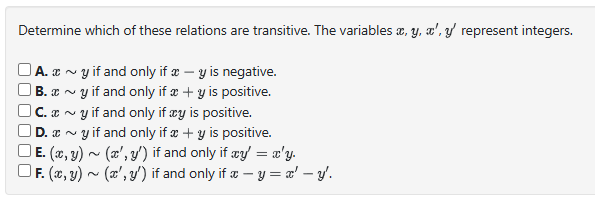 Determine which of these relations are transitive. The variables zy, , y/ represent integers.
OA. z ~yifand only if 2 — y is negative.
B.z ~yifand only if z + y is positive.
Oc. z ~ yifand only if zy is positive.
0D. z ~ yifand only if z + y is positive.
OE (z,y) ~ («',¥) ifand only if zy’ = ay.
OF. (2,9) ~ («',¥/) ifand only if 7 — y = a’ — of.
This is AI generated Response.
Asked by: Nehal Anurag
Created at: 2025-12-09 10:33:29
Asked by: Nehal Anurag
Created at: 2025-12-09 10:33:29
Thought Process:
Rendered
Raw Text
**Evaluating transitive relations**
I’m analyzing which relations are transitive among integers. For option A, where x y iff x < y, it is indeed transitive since if x < y and y < z, then x < z holds true.
For option B, defined as x y iff x + y > 0, it’s not guaranteed to be transitive. I’m trying to find a counterexample to show that x + y > 0 and y + z > 0 does not imply x + z > 0, which requires careful selection of integers.**Analyzing transitivity of relations**
I’ve found that in option B, since x + z can be less than or equal to zero, transitivity fails, so it’s not transitive.
Now, for option C, where x y iff x * y is positive, I need to check if it’s transitive. If x * y > 0 and y * z > 0, then y cannot be zero. If y is positive, then both x and z are also positive. If y is negative, both x and z would be negative too. Thus, this relation is transitive, as none of them can equal zero.**Examining relation transitivity**
I’ve established that in option C, since x, y, and z are all nonzero and share the same sign, this means x * z > 0, so C is transitive.
However, regarding option D, it looks like it duplicates B. Both state that x y iff x + y is positive, which is confusing. I'm wondering if there was a mistake in how they were presented or if they’re meant to convey the same idea. It's tough to differentiate between them when they seem to overlap so much!**Identifying redundant options**
I’m noticing some redundancy here with options B and D, as both state that x y iff x + y is positive, which seems unhelpful. The screenshot confirms they have identical wording, so I’m treating D as a duplicate of B, leading to the conclusion that they are not transitive.
Moving on to option E: it defines the relation as (x, y) (x', y') iff x * y' = x' * y, which corresponds to equal ratios x/y = x'/y' defined over integers.**Summarizing transitivity analysis**
I’m evaluating transitivity for several relations. For relation E, I found that if we include the pair (0,0), it may lead to issues because (0,0) relates to all pairs. This was confirmed through a counterexample using A=(1,1) and C=(1,2), showing that while A B and B C hold true, A C does not, which means E is not transitive.
For relation F, it was determined to be transitive based on the equality of differences. Overall, I need to outline these evaluations stepwise, highlighting proofs and counterexamples as I go through each relation.
Final Answer:
Rendered
Raw Text
Did you like this answer?
Goal: Check which relations are transitive. A relation R is transitive if for all a, b, c: aRb and bRc imply aRc.
Step 1. Relation A: x ~ y iff x − y negative (i.e., x < y).
- Explanation: The usual “less than” relation on integers is transitive: if x < y and < z, then x < z (adding the two inequalities gives x < z).
- Conclusion: A is transitive.
Step 2. Relation B: x ~ y iff x + y is positive.
- Test for transitivity: Need (x + y > 0 and y + z > 0) ⇒ (x + z > 0).
- Counterexample: x = −3, y = 5, z = −.
- x + y = 2 > 0 and y + z = 2 > 0, but x + z = −6 ≤ 0.
- Explanation: The middle value y can be large and positive, making both sums with y positive even when the endpoints x and z sum to a non-positive number.
- Conclusion: B is not transitive.
Step 3. Relation C: x ~ y iff xy is positive.
- Observation: xy > 0 means x and y have the same sign and neither is zero.
- Proof: Suppose xy > 0 and yz > 0. Then y has the same sign as x and the same sign as z, so x and z must also have the same sign. Since neither is zero, xz > 0.
- Conclusion: C is transitive.
Step 4. Relation D: x ~ y iff x + y is positive. (Same condition as B.)
- The same counterexample as in Step 2 works: x = −3, y = 5, z = −3 gives positives with the middle term but not with the endpoints.
- Conclusion: D is not transitive.
Step 5. Relation E: (x, y) ~ (x′, y′) iff xy′ = x′y.
- Key observation: (0, 0) is related to every pair, because 0·y′ = x′·0 gives 0 = 0 for all (x′, y′).
- Counterexample for transitivity:
- Let A = (1, 1), B = (0, 0), C = (1, 2).
- A ~ B: 1·0 = 0·1 ⇒ 0 = 0 (true).
- B ~ C: 0·2 = 1·0 ⇒ 0 = 0 (true).
- A ~ C would require 1·2 = 1·1 ⇒ 2 = 1 (false).
- Explanation: Because (0, 0) relates to everything, it can connect two pairs that are not related to each other, breaking transitivity.
- Conclusion: E is not transitive.
Step 6. Relation F: (x, y) ~ (x′, y′) iff x − y = x′ − y′.
- Proof: If x − y = x′ − y′ and x′ − y′ = x″ − y″, then by equality’s transitivity, x − y = x″ − y″; hence (x, y) ~ (x″, y″).
- Conclusion: F is transitive.
Final answer:
- Transitive: A, C, F.
- Not transitive: B, D, E.
📢 Instructions:
- Ask anything relatd to above question only.
- For new Question goto :