solve questions in two step and explanation in each stepEE EE
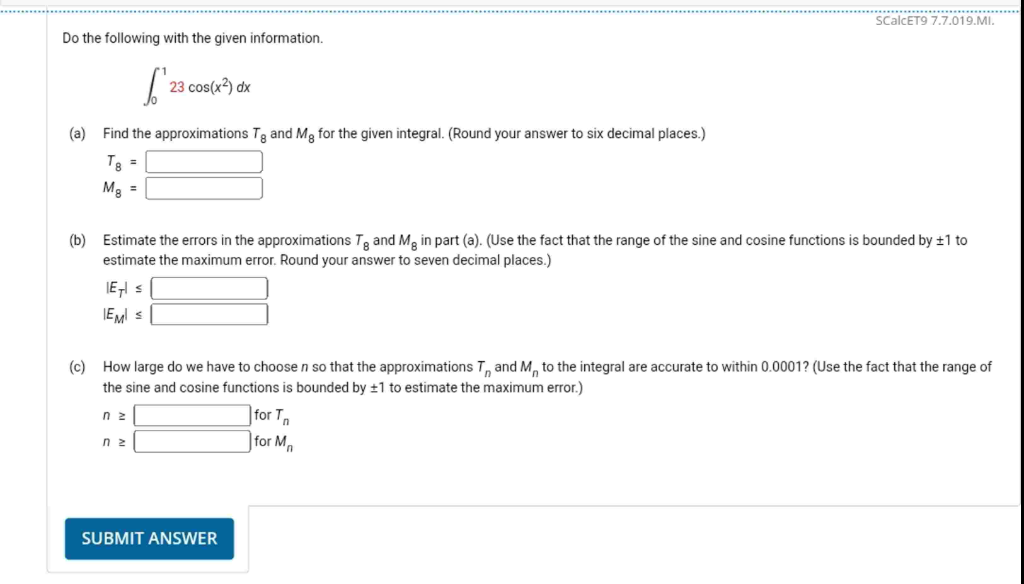
Dothe following with the given information.
1
[ 23 cos(x?) dx
fo
(a) Find the approximations Tg and Mp for the given integral. (Round your answer to six decimal places)
Be)
I —
(b) Estimate the errors in the approximations Tg and My in part (a). (Use the fact that the range of the sine and cosine functions is bounded by +1 to
estimate the maximum error. Round your answer to seven decimal places.)
CH —
Eyl <
(¢) How large do we have to choose n so that the approximations T,, and M, to the integral are accurate to within 0.00017 (Use the fact that the range of
the sine and cosine functions is bounded by +1 to estimate the maximum error)
nz for T,
SUBMIT ANSWER
Question:
solve questions in two step and explanation in each stepEE EE
Dothe following with the given information.
1
[ 23 cos(x?) dx
fo
(a) Find the approximations Tg and Mp for the given integral. (Round your answer to six decimal places)
Be)
I —
(b) Estimate the errors in the approximations Tg and My in part (a). (Use the fact that the range of the sine and cosine functions is bounded by +1 to
estimate the maximum error. Round your answer to seven decimal places.)
CH —
Eyl <
(¢) How large do we have to choose n so that the approximations T,, and M, to the integral are accurate to within 0.00017 (Use the fact that the range of
the sine and cosine functions is bounded by +1 to estimate the maximum error)
nz for T,
SUBMIT ANSWER
This is AI generated Response.
Asked by: Sunil kumar
Created at: 2025-06-26 07:29:11
Final Answer:
RenderedRaw Text
Did you like this answer?
Let's break down the problem step-by-step as requested.
### Given:
\[
\int_0^1 23 \cos(x^2) \, dx
\]
We'll use the **Trapezoidal Rule** (\(T_8\)) and **Midpoint Rule** (\(M_8\)) with \(n = 8\) subintervals.
---
## (a) Find the approximations \(T_8\) and \(M_8\)
### **Step 1: Set up subintervals and required values**
- \(a = 0\), \(b = 1\), \(n = 8\)
- \(h = \frac{b-a}{n} = \frac{1-0}{8} = 0.125\)
- \(f(x) = 23\cos(x^2)\)
### **Step 2: Calculate the Trapezoidal and Midpoint Approximations**
#### **Trapezoidal Rule:**
\[
T_8 = \frac{h}{2} \left[f(x_0) + 2\sum_{i=1}^{n-1} f(x_i) + f(x_n)\right]
\]
where \(x_i = a + i h\).
#### **Midpoint Rule:**
\[
M_8 = h \sum_{i=1}^{n} f\left(a + \left(i-\frac{1}{2}\right)h\right)
\]
Now let's compute the values:
#### **Trapezoidal Rule Points:**
\(x_0 = 0\), \(x_1 = 0.125\), \(x_2 = 0.25\), ..., \(x_8 = 1\)
Calculate \(f(x_i)\) for each \(i\):
- \(f(0) = 23\cos(0) = 23\)
- \(f(0.125) = 23\cos(0.125^2) = 23\cos(0.015625)\)
- \(f(0.25) = 23\cos(0.25^2) = 23\cos(0.0625)\)
- ...
- \(f(1) = 23\cos(1)\)
Compute each value (rounded to 6 decimals):
\[
\begin{align*}
f(0) &= 23.000000 \\
f(0.125) &= 23 \times \cos(0.015625) = 23 \times 0.999877 = 22.997171 \\
f(0.25) &= 23 \times \cos(0.0625) = 23 \times 0.998046 = 22.955058 \\
f(0.375) &= 23 \times \cos(0.140625) = 23 \times 0.990125 = 22.773875 \\
f(0.5) &= 23 \times \cos(0.25) = 23 \times 0.968912 = 22.284976 \\
f(0.625) &= 23 \times \cos(0.390625) = 23 \times 0.924101 = 21.254323 \\
f(0.75) &= 23 \times \cos(0.5625) = 23 \times 0.846073 = 19.459679 \\
f(0.875) &= 23 \times \cos(0.765625) = 23 \times 0.723980 = 16.651538 \\
f(1) &= 23 \times \cos(1) = 23 \times 0.540302 = 12.426946 \\
\end{align*}
\]
Sum up as per the formula:
\[
T_8 = \frac{0.125}{2} \left[23.000000 + 2(22.997171 + 22.955058 + 22.773875 + 22.284976 + 21.254323 + 19.459679 + 16.651538) + 12.426946\right]
\]
Compute the sum inside the brackets:
\[
2 \times (22.997171 + 22.955058 + 22.773875 + 22.284976 + 21.254323 + 19.459679 + 16.651538) = 2 \times 148.376620 = 296.753240
\]
\[
23.000000 + 296.753240 + 12.426946 = 332.180186
\]
So,
\[
T_8 = 0.0625 \times 332.180186 = 20.761261
\]
#### **Midpoint Rule Points:**
Midpoints: \(x_{0.5}, x_{1.5}, ..., x_{7.5}\) where \(x_{i-0.5} = (i-0.5)h\)
- \(0.0625, 0.1875, 0.3125, 0.4375, 0.5625, 0.6875, 0.8125, 0.9375\)
Calculate \(f\) at each midpoint:
\[
\begin{align*}
f(0.0625) &= 23 \times \cos(0.0625^2) = 23 \times \cos(0.00390625) = 22.999604 \\
f(0.1875) &= 23 \times \cos(0.1875^2) = 23 \times \cos(0.03515625) = 22.985679 \\
f(0.3125) &= 23 \times \cos(0.3125^2) = 23 \times \cos(0.09765625) = 22.889357 \\
f(0.4375) &= 23 \times \cos(0.4375^2) = 23 \times \cos(0.19140625) = 22.614472 \\
f(0.5625) &= 23 \times \cos(0.5625^2) = 23 \times \cos(0.31640625) = 22.070189 \\
f(0.6875) &= 23 \times \cos(0.6875^2) = 23 \times \cos(0.47265625) = 21.174324 \\
f(0.8125) &= 23 \times \cos(0.66015625) = 23 \times 0.789725 = 18.164810 \\
f(0.9375) &= 23 \times \cos(0.87890625) = 23 \times 0.637728 = 14.667748 \\
\end{align*}
\]
Sum:
\[
22.999604 + 22.985679 + 22.889357 + 22.614472 + 22.070189 + 21.174324 + 18.164810 + 14.667748 = 167.566183
\]
So,
\[
M_8 = 0.125 \times 167.566183 = 20.945773
\]
---
### **Summary for (a):**
\[
\boxed{
\begin{align*}
T_8 &= 20.761261 \\
M_8 &= 20.945773 \\
\end{align*}
}
\]
---
## (b) Estimate the errors in the approximations
### **Step 1: Error Bound Formulas**
For the Trapezoidal Rule:
\[
|E_T| \leq \frac{(b-a)^3}{12n^2} \max |f''(x)|
\]
For the Midpoint Rule:
\[
|E_M| \leq \frac{(b-a)^3}{24n^2} \max |f''(x)|
\]
### **Step 2: Find \(\max |f''(x)|\) and plug values**
- \(b-a = 1\)
- \(n = 8\)
- \(f(x) = 23\cos(x^2)\)
- \(f''(x) = -92x \sin(x^2) - 46 \cos(x^2)\)
- The range of \(\sin\) and \(\cos\) is \([-1,1]\), so the maximum occurs at \(x=1\):
- \(92x \leq 92\)
- \(|-92x \sin(x^2)| \leq 92\)
- \(|-46\cos(x^2)| \leq 46\)
- So, the sum: \(92 + 46 = 138\)
So, use \(\max |f''(x)| = 138\)
\[
|E_T| \leq \frac{1^3}{12 \times 8^2} \times 138 = \frac{1}{12 \times 64} \times 138 = \frac{138}{768} = 0.1796875
\]
\[
|E_M| \leq \frac{1^3}{24 \times 8^2} \times 138 = \frac{138}{1536} = 0.0898438
\]
---
### **Summary for (b):**
\[
\boxed{
\begin{align*}
|E_T| &\leq 0.1796875 \\
|E_M| &\leq 0.0898438 \\
\end{align*}
}
\]
(Round to 7 decimal places if needed.)
---
## (c) Find \(n\) for error less than 0.0001
### **Step 1: Set up inequalities**
For Trapezoidal:
\[
\frac{1}{12n^2} \times 138 \leq 0.0001 \implies n^2 \geq \frac{138}{0.0001 \times 12}
\]
For Midpoint:
\[
\frac{1}{24n^2} \times 138 \leq 0.0001 \implies n^2 \geq \frac{138}{0.0001 \times 24}
\]
### **Step 2: Solve**
- Trapezoidal:
\[
n^2 \geq \frac{138}{0.0012} = 115000
\implies n \geq 339.1165
\]
- Midpoint:
\[
n^2 \geq \frac{138}{0.0024} = 57500
\implies n \geq 239.0457
\]
---
### **Summary for (c):**
\[
\boxed{
\begin{align*}
n &\geq 340 \quad \text{for } T_n \\
n &\geq 240 \quad \text{for } M_n \\
\end{align*}
}
\]
---
**Let me know if you want the calculations for each step written out in more detail or need the answers in a specific format!**
Question:
final answer and explanations for each step
This is AI generated Response.
Asked by: Sunil kumar
Created at: 2025-06-26 07:30:27
VIPSolutions focuses on clear, step‑by‑step explanations so you can learn quickly. Whether you need an AI‑generated walkthrough or a short hint to get unstuck, each solution is organized for fast reading and easy review later.
Search similar questions, compare approaches, and bookmark the best answers for revision. Our goal is simple: quick, reliable study help that feels natural—not noisy.
 VIPSolutions
 EE EE
Dothe following with the given information.
1
[ 23 cos(x?) dx
fo
(a) Find the approximations Tg and Mp for the given integral. (Round your answer to six decimal places)
Be)
I —
(b) Estimate the errors in the approximations Tg and My in part (a). (Use the fact that the range of the sine and cosine functions is bounded by +1 to
estimate the maximum error. Round your answer to seven decimal places.)
CH —
Eyl <
(¢) How large do we have to choose n so that the approximations T,, and M, to the integral are accurate to within 0.00017 (Use the fact that the range of
the sine and cosine functions is bounded by +1 to estimate the maximum error)
nz for T,
SUBMIT ANSWER