 VIPSolutions
Solve in two step as per chegg guidelinea and add explanation in each tepConsider th dferenil equator: a 6 = ws “=o hn rail stor Greed re ss SE ET scons ry oon md om re A
Question:
Solve in two step as per chegg guidelinea and add explanation in each tep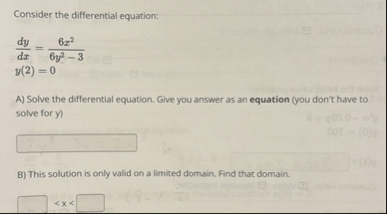 Consider th dferenil equator:
a 6
= ws
“=o
hn rail stor Greed re ss SE ET
scons ry oon md om re A
This is AI generated Response.
Asked by: July kumari
Created at: 2025-07-14 04:06:20
Asked by: July kumari
Created at: 2025-07-14 04:06:20
Final Answer:
Rendered
Raw Text
Did you like this answer?
Let's solve the given differential equation step by step as per Chegg guidelines:
Given:
\[
\frac{dy}{dx} = \frac{6x^2}{6y^2 - 3}, \quad y(2) = 0
\]
---
### **Step 1: Separate variables and integrate**
**Explanation:**
Rearrange the equation to get all \( y \) terms on one side and all \( x \) terms on the other, then integrate both sides.
\[
\frac{dy}{dx} = \frac{6x^2}{6y^2 - 3}
\]
Multiply both sides by \( (6y^2 - 3) \):
\[
(6y^2 - 3)\frac{dy}{dx} = 6x^2
\]
Now, rewrite as:
\[
(6y^2 - 3)dy = 6x^2 dx
\]
Integrate both sides:
\[
\int (6y^2 - 3)dy = \int 6x^2 dx
\]
\[
6\int y^2 dy - 3\int dy = 6\int x^2 dx
\]
\[
6 \cdot \frac{y^3}{3} - 3y = 6 \cdot \frac{x^3}{3} + C
\]
\[
2y^3 - 3y = 2x^3 + C
\]
---
### **Step 2: Apply the initial condition to find \( C \)**
**Explanation:**
Substitute \( x = 2 \) and \( y = 0 \) to solve for \( C \).
Given \( y(2) = 0 \):
\[
2(0)^3 - 3(0) = 2(2)^3 + C
\]
\[
0 = 2 \times 8 + C
\]
\[
0 = 16 + C \implies C = -16
\]
So the solution (as an equation) is:
\[
\boxed{2y^3 - 3y = 2x^3 - 16}
\]
---
### **Domain of Validity**
**Explanation:**
The original equation is only defined when the denominator is not zero: \( 6y^2 - 3 \neq 0 \implies y^2 \neq \frac{1}{2} \implies y \neq \pm \frac{1}{\sqrt{2}} \).
So, the solution is valid for values of \( x \) such that \( y(x) \neq \pm \frac{1}{\sqrt{2}} \).
Find the \( x \) values where \( y = \pm \frac{1}{\sqrt{2}} \):
Plug \( y = \frac{1}{\sqrt{2}} \) into the solution:
\[
2\left( \frac{1}{\sqrt{2}} \right)^3 - 3\left( \frac{1}{\sqrt{2}} \right) = 2x^3 - 16
\]
Calculate:
\[
\left( \frac{1}{\sqrt{2}} \right)^3 = \frac{1}{2\sqrt{2}}
\]
So,
\[
2 \cdot \frac{1}{2\sqrt{2}} - 3 \cdot \frac{1}{\sqrt{2}} = 2x^3 - 16
\]
\[
\frac{1}{\sqrt{2}} - \frac{3}{\sqrt{2}} = 2x^3 - 16
\]
\[
-\frac{2}{\sqrt{2}} = 2x^3 - 16
\]
\[
-\sqrt{2} = 2x^3 - 16
\]
\[
2x^3 = 16 - \sqrt{2}
\]
\[
x^3 = \frac{16 - \sqrt{2}}{2}
\]
\[
x_1 = \sqrt[3]{\frac{16 - \sqrt{2}}{2}}
\]
Similarly for \( y = -\frac{1}{\sqrt{2}} \):
\[
2\left( -\frac{1}{\sqrt{2}} \right)^3 - 3\left( -\frac{1}{\sqrt{2}} \right) = 2x^3 - 16
\]
\[
2 \cdot -\frac{1}{2\sqrt{2}} + \frac{3}{\sqrt{2}} = 2x^3 - 16
\]
\[
-\frac{1}{\sqrt{2}} + \frac{3}{\sqrt{2}} = 2x^3 - 16
\]
\[
\frac{2}{\sqrt{2}} = 2x^3 - 16
\]
\[
\sqrt{2} = 2x^3 - 16
\]
\[
2x^3 = 16 + \sqrt{2}
\]
\[
x^3 = \frac{16 + \sqrt{2}}{2}
\]
\[
x_2 = \sqrt[3]{\frac{16 + \sqrt{2}}{2}}
\]
**Domain:**
\[
x_1 < x < x_2
\]
\[
\boxed{
\sqrt[3]{\frac{16 - \sqrt{2}}{2}} < x < \sqrt[3]{\frac{16 + \sqrt{2}}{2}}
}
\]
---
## **Final Answers:**
### **A)**
\[
\boxed{2y^3 - 3y = 2x^3 - 16}
\]
### **B)**
\[
\boxed{
\sqrt[3]{\frac{16 - \sqrt{2}}{2}} < x < \sqrt[3]{\frac{16 + \sqrt{2}}{2}}
}
\]
Question:
write explanation in words for second step
This is AI generated Response.
Asked by: July kumari
Created at: 2025-07-14 04:12:28
Asked by: July kumari
Created at: 2025-07-14 04:12:28
Final Answer:
Rendered
Raw Text
Did you like this answer?
Certainly! Here's a detailed explanation in words for the second step:
---
**Step 2 Explanation: Applying the initial condition to find the constant \( C \)**
In the first step, we derived a general solution involving an arbitrary constant \( C \). To find this specific constant, we use the initial condition provided in the problem, which states that when \( x = 2 \), the value of \( y \) is 0.
This means we substitute \( x = 2 \) and \( y = 0 \) into our general solution equation:
\[
2y^3 - 3y = 2x^3 + C
\]
Plugging in the values:
\[
2 \times 0^3 - 3 \times 0 = 2 \times 2^3 + C
\]
Simplifies to:
\[
0 = 2 \times 8 + C
\]
\[
0 = 16 + C
\]
From this, we solve for \( C \):
\[
C = -16
\]
This step ensures the particular solution matches the initial condition, giving us a fully specified equation:
\[
2y^3 - 3y = 2x^3 - 16
\]
This is the explicit relation between \( x \) and \( y \) that satisfies both the differential equation and the initial condition.
📢 Instructions:
- Ask anything relatd to above question only.
- For new Question goto :