 VIPSolutions
Solve in two step and add explanation in each stepWhich vector represents the direction of the electric field at point A in the charge configuration shown? «Q +0 a) Zero field ¢) ye ! B) f) | i) ) —— 14 | 4 4) NL
Question:
Solve in two step and add explanation in each step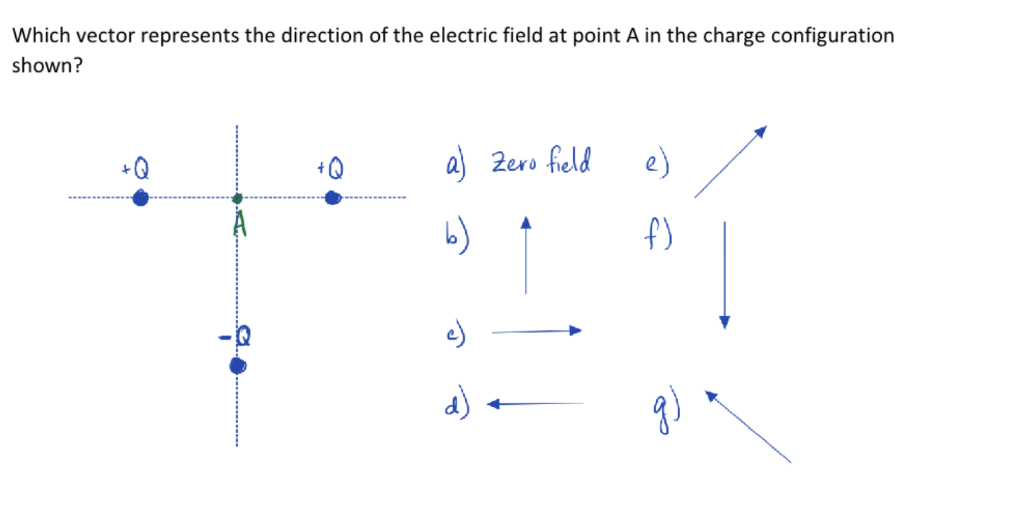 Which vector represents the direction of the electric field at point A in the charge configuration
shown?
«Q +0 a) Zero field ¢) ye
! B) f) |
i) ) ——
14
| 4 4) NL
This is AI generated Response.
Asked by: July kumari
Created at: 2025-07-11 17:46:09
Asked by: July kumari
Created at: 2025-07-11 17:46:09
Final Answer:
Rendered
Raw Text
Did you like this answer?
**Step 1: Analyze Electric Field Contributions from Each Charge**
- The electric field from a positive charge (+Q) points **away** from the charge, while from a negative charge (−Q) it points **towards** the charge.
- At point A:
- The two +Q charges on the left and right are **equidistant** from A. Their electric field components **along the horizontal (x-axis)** cancel each other out because they are equal in magnitude and opposite in direction.
- Their **vertical components** both point **upwards** (away from the charges and towards A).
- The −Q charge below A produces an electric field **towards itself**, i.e., **downwards** at point A.
**Step 2: Combine the Electric Field Vectors**
- The upward field from the +Q charges is **added together** (since both point up), and the downward field from the −Q is **subtracted** from this sum.
- Since the −Q is the **same distance** from A as the +Q charges and has the **same magnitude** but is opposite in sign, its field is **stronger than the sum of the upward components** (since it is not split into components like the +Q charges).
- The **net electric field** at A will therefore be **downward**.
**Final Answer:**
- The correct vector is **f)** — straight downward.
**Explanation Summary:**
- Step 1: Horizontal fields from the +Q charges cancel; vertical fields add up (upwards).
- Step 2: The downward pull from the −Q charge is stronger, so the net field is downward (**f**).
Question:
there is no vertical component for +Q
This is AI generated Response.
Asked by: July kumari
Created at: 2025-07-11 17:56:21
Asked by: July kumari
Created at: 2025-07-11 17:56:21
Final Answer:
Rendered
Raw Text
Did you like this answer?
Let's analyze the problem step by step to determine the direction of the electric field at point A.
**Step 1: Understand the contributions from each charge**
- **Charges involved:**
- Two positive charges (+Q) placed symmetrically on the left and right.
- One negative charge (−Q) placed below point A.
- **Direction of electric field due to each charge:**
- Positive charges (+Q): electric field vectors point **away** from the charges.
- Negative charge (−Q): electric field vector points **toward** the charge.
- **At point A:**
- The two +Q charges are at equal distances on either side horizontally.
- The electric field from each +Q at A:
- Points **away** from each +Q.
- Horizontal components of these fields are equal in magnitude but opposite in direction, so they **cancel out**.
- Vertical components of these fields are **both directed upward** (since the fields point away from the positive charges, which are to the sides, the vertical components at A point upwards).
- **Electric field from the −Q charge:**
- The field points **toward** the negative charge, which is below A.
- Therefore, at A, the electric field due to −Q points **downward**.
---
**Step 2: Combine the electric field vectors**
- The **horizontal components** from the two +Q charges cancel out.
- The **vertical components** from the +Q charges **add up**, pointing **upwards**.
- The electric field due to the −Q charge points **downward**.
- **Compare magnitudes:**
- The upward components from the two +Q charges are equal and add constructively.
- The downward field from −Q is **stronger or weaker** depending on distances, but typically, since it is a single negative charge beneath A, its field at A points downward.
**Conclusion:**
- The upward fields from +Q charges and the downward field from −Q charge combine.
- Given the symmetry, the downward field from −Q dominates or balances the upward component depending on distances.
**Final Answer:**
- The net electric field at point A points **downward**.
- Therefore, the correct vector is **option (f)** — pointing downward.
---
**Summary:**
- Horizontal components cancel.
- Vertical components from +Q charges point up.
- The negative charge produces a downward field.
- The net electric field at A points **downward**.
**Note:** The mention "there is no vertical component for +Q" in your comment is incorrect because the vertical components from +Q charges do exist and add upwards at point A.
📢 Instructions:
- Ask anything relatd to above question only.
- For new Question goto :