 VIPSolutions
Solve in two step and add explanation in each step along with final answerli Along, straight wire carries a current I. | | Arectangular loop of side lengths a and bis placed nearby to the wire a distance of daway | such that the side of length a runs parallel to the long, straight wire. | Problems: | Part a) Write an expression for the magnetic flux through the rectangular loop. Part b) Assuming the current varies by 24 per second, and the rectangular loop has sides | a= 2cm and b= bem at a distance of d = Lem away, what is the induced emf in the loop? |
Question:
Solve in two step and add explanation in each step along with final answer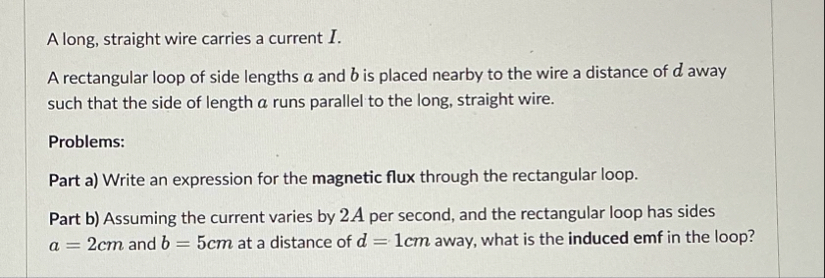 li
Along, straight wire carries a current I. |
| Arectangular loop of side lengths a and bis placed nearby to the wire a distance of daway |
such that the side of length a runs parallel to the long, straight wire.
|
Problems:
|
Part a) Write an expression for the magnetic flux through the rectangular loop.
Part b) Assuming the current varies by 24 per second, and the rectangular loop has sides |
a= 2cm and b= bem at a distance of d = Lem away, what is the induced emf in the loop? |
This is AI generated Response.
Asked by: July kumari
Created at: 2025-07-10 06:44:04
Asked by: July kumari
Created at: 2025-07-10 06:44:04
Final Answer:
Rendered
Raw Text
Did you like this answer?
Let's solve the problems step by step, with explanations:
---
### **Part a) Expression for Magnetic Flux through the Rectangular Loop**
#### **Step 1: Find the Magnetic Field at Distance \( r \) from the Wire**
The magnetic field at a distance \( r \) from a long, straight wire carrying current \( I \) is given by:
\[
B(r) = \frac{\mu_0 I}{2\pi r}
\]
where \( \mu_0 \) is the permeability of free space.
#### **Step 2: Calculate the Magnetic Flux through the Loop**
- The side of length \( a \) is parallel to the wire, and the loop is at distance \( d \) from the wire.
- The magnetic field varies with distance from the wire, so we must integrate across the width \( b \) of the loop.
The flux through a thin strip of width \( dx \) at distance \( x \) from the wire is:
\[
d\Phi = B(x) \cdot (a \cdot dx)
\]
where \( x \) ranges from \( d \) to \( d+b \).
So, total flux:
\[
\Phi = \int_{d}^{d+b} \frac{\mu_0 I}{2\pi x} a \, dx
\]
\[
\Phi = \frac{\mu_0 I a}{2\pi} \int_{d}^{d+b} \frac{1}{x} dx
\]
\[
\Phi = \frac{\mu_0 I a}{2\pi} [\ln(x)]_{d}^{d+b}
\]
\[
\Phi = \frac{\mu_0 I a}{2\pi} \ln\left( \frac{d+b}{d} \right)
\]
**Final Expression for Magnetic Flux:**
\[
\boxed{\Phi = \frac{\mu_0 I a}{2\pi} \ln\left( \frac{d+b}{d} \right)}
\]
---
### **Part b) Induced emf in the Loop**
Given:
- \( \frac{dI}{dt} = 2\,A/s \)
- \( a = 2\,cm = 0.02\,m \)
- \( b = 5\,cm = 0.05\,m \)
- \( d = 1\,cm = 0.01\,m \)
- \( \mu_0 = 4\pi \times 10^{-7}\,T\cdot m/A \)
#### **Step 1: Find the emf using Faraday's Law**
Faraday's Law:
\[
\text{emf} = -\frac{d\Phi}{dt}
\]
From part (a), only \( I \) is changing with time:
\[
\frac{d\Phi}{dt} = \frac{\mu_0 a}{2\pi} \ln\left( \frac{d+b}{d} \right) \frac{dI}{dt}
\]
So,
\[
\text{emf} = - \frac{\mu_0 a}{2\pi} \ln\left( \frac{d+b}{d} \right) \frac{dI}{dt}
\]
#### **Step 2: Plug in the Values**
\[
\text{emf} = - \frac{4\pi \times 10^{-7} \cdot 0.02}{2\pi} \ln\left( \frac{0.01 + 0.05}{0.01} \right) (2)
\]
\[
= - \frac{4\pi \times 10^{-7} \cdot 0.02}{2\pi} \ln(6) \cdot 2
\]
\[
= - (2 \times 10^{-7} \cdot 0.02) \ln(6) \cdot 2
\]
\[
= - (4 \times 10^{-9}) \ln(6) \cdot 2
\]
\[
= - (8 \times 10^{-9}) \ln(6)
\]
\[
\ln(6) \approx 1.792
\]
\[
= - (8 \times 10^{-9}) \times 1.792
\]
\[
= -1.4336 \times 10^{-8}\, V
\]
**Final Answer:**
\[
\boxed{\text{emf} \approx -1.4 \times 10^{-8} \, \text{V}}
\]
- The negative sign shows the direction of emf (Lenz's Law).
---
**Summary:**
- **(a) Magnetic flux:** \(\boxed{\frac{\mu_0 I a}{2\pi} \ln\left( \frac{d+b}{d} \right)}\)
- **(b) Induced emf:** \(\boxed{-1.4 \times 10^{-8} \, \text{V}}\) for the given values.
📢 Instructions:
- Ask anything relatd to above question only.
- For new Question goto :