 VIPSolutions
solve in two step and add explanation in each step along with final answer2(4pts). Given the following function: @=-— a) Find critical number(s) b) Find Local Maximum and Local Minimum values of f
Question:
solve in two step and add explanation in each step along with final answer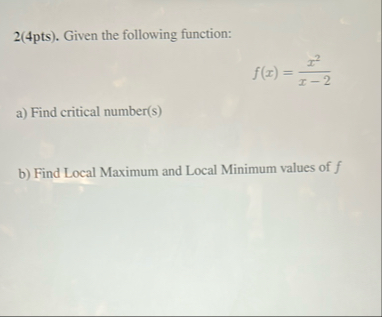 2(4pts). Given the following function:
@=-—
a) Find critical number(s)
b) Find Local Maximum and Local Minimum values of f
This is AI generated Response.
Asked by: July kumari
Created at: 2025-07-10 06:13:15
Asked by: July kumari
Created at: 2025-07-10 06:13:15
Final Answer:
Rendered
Raw Text
Did you like this answer?
Let's solve the problem step by step as requested.
Given function:
\[ f(x) = \frac{x^2}{x-2} \]
---
### **Step 1: Find critical number(s)**
**Explanation:**
Critical numbers occur where \( f'(x) = 0 \) or \( f'(x) \) is undefined (but \( f(x) \) is defined).
#### **Find the derivative using the quotient rule:**
\[
f'(x) = \frac{(x-2) \cdot 2x - x^2 \cdot 1}{(x-2)^2}
\]
\[
= \frac{2x(x-2) - x^2}{(x-2)^2}
\]
\[
= \frac{2x^2 - 4x - x^2}{(x-2)^2}
\]
\[
= \frac{x^2 - 4x}{(x-2)^2}
\]
\[
= \frac{x(x-4)}{(x-2)^2}
\]
Set \( f'(x) = 0 \):
\[
x(x-4) = 0
\]
\[
x = 0 \quad \text{or} \quad x = 4
\]
Also, check where \( f'(x) \) is undefined:
\[
(x-2)^2 = 0 \implies x = 2
\]
But at \( x=2 \), \( f(x) \) is also undefined (division by zero), so \( x=2 \) is not a critical number.
**Critical numbers:** \( \boxed{0 \text{ and } 4} \)
---
### **Step 2: Find Local Maximum and Local Minimum values of \( f \)**
**Explanation:**
Use the First Derivative Test:
- Plug values around critical points into \( f'(x) \) to determine increasing/decreasing behavior.
#### **Check intervals:**
- For \( x < 0 \): pick \( x = -1 \)
\[
f'(-1) = \frac{(-1)(-5)}{(-3)^2} = \frac{5}{9} > 0 \quad (\text{increasing})
\]
- Between \( 0 < x < 2 \): pick \( x = 1 \)
\[
f'(1) = \frac{1 \cdot (1-4)}{(1-2)^2} = \frac{1 \cdot (-3)}{1} = -3 < 0 \quad (\text{decreasing})
\]
- Between \( 2 < x < 4 \): pick \( x = 3 \)
\[
f'(3) = \frac{3 \cdot (3-4)}{(3-2)^2} = \frac{3 \cdot (-1)}{1} = -3 < 0 \quad (\text{decreasing})
\]
- For \( x > 4 \): pick \( x = 5 \)
\[
f'(5) = \frac{5 \cdot (5-4)}{(5-2)^2} = \frac{5 \cdot 1}{9} > 0 \quad (\text{increasing})
\]
#### **First Derivative Test Conclusion:**
- At \( x = 0 \): \( f'(x) \) changes from positive to negative \( \rightarrow \) **local maximum**
- At \( x = 4 \): \( f'(x) \) changes from negative to positive \( \rightarrow \) **local minimum**
#### **Find values:**
- \( f(0) = \frac{0^2}{0-2} = 0 \) (**local maximum**)
- \( f(4) = \frac{4^2}{4-2} = \frac{16}{2} = 8 \) (**local minimum**)
---
### **Final Answers**
**a) Critical numbers:** \(\boxed{0,\, 4}\)
**b)**
- **Local Maximum:** at \( x = 0,\, f(0) = 0 \)
- **Local Minimum:** at \( x = 4,\, f(4) = 8 \)
\[
\boxed{
\text{Local Maximum at } (0, 0) \\
\text{Local Minimum at } (4, 8)
}
\]
📢 Instructions:
- Ask anything relatd to above question only.
- For new Question goto :