 VIPSolutions
Solve in two step and add explanation in each stepIn a circuit shown in the below figure, the capacitance of each capacitor is equal to C and the resistance, to R. One of the capacitors was connected to a voltage Vo and then at the moment t = 0's, was shorted by means of the switch Sw. Find: (SHOW YOUR WORK) a. a current I(t) in the circuit as a function of time t; b. the amount of generated heat provided a dependence I(t) is known. R Earl Sw
Question:
Solve in two step and add explanation in each step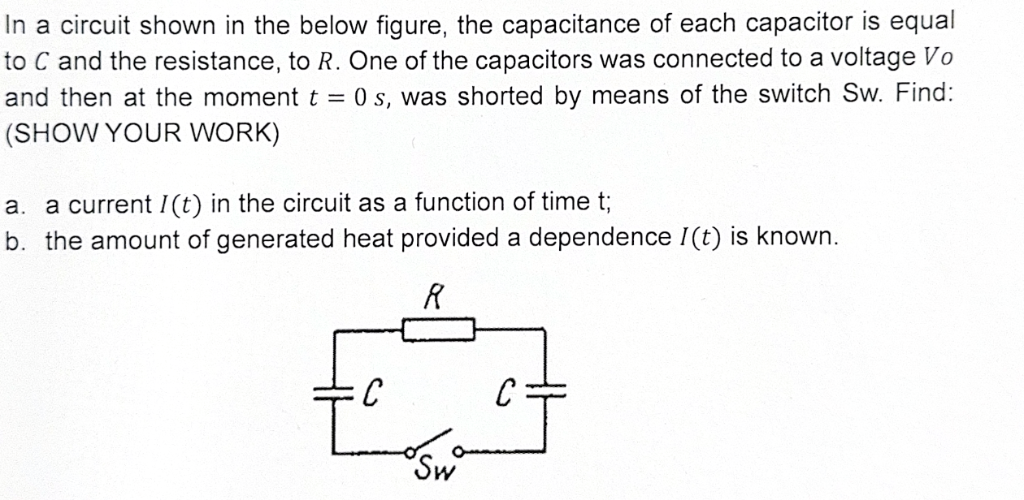 In a circuit shown in the below figure, the capacitance of each capacitor is equal
to C and the resistance, to R. One of the capacitors was connected to a voltage Vo
and then at the moment t = 0's, was shorted by means of the switch Sw. Find:
(SHOW YOUR WORK)
a. a current I(t) in the circuit as a function of time t;
b. the amount of generated heat provided a dependence I(t) is known.
R
Earl
Sw
This is AI generated Response.
Asked by: July kumari
Created at: 2025-07-09 21:07:04
Asked by: July kumari
Created at: 2025-07-09 21:07:04
Final Answer:
Rendered
Raw Text
Did you like this answer?
Let's solve the problem step by step.
---
### **Step 1: Find the current \( I(t) \) as a function of time \( t \)**
**Explanation:**
- Initially, **one capacitor is charged** to \( V_0 \), the other is uncharged.
- At \( t=0 \), the switch is closed, connecting both capacitors and the resistor in series.
#### **Step 1.1: Initial conditions and equivalent circuit**
- Capacitance of each capacitor: \( C \)
- Resistance: \( R \)
- Initial voltage across the charged capacitor: \( V_0 \)
- The two capacitors are now **in parallel** (after closing the switch).
- The total charge initially: \( Q_0 = CV_0 \)
#### **Step 1.2: Final voltage after equilibrium**
When switch is closed, the charge redistributes equally:
- Total charge remains the same: \( Q_0 \)
- Total capacitance (in parallel): \( C_{eq} = 2C \)
- Final voltage: \( V_f = \frac{Q_0}{2C} = \frac{CV_0}{2C} = \frac{V_0}{2} \)
#### **Step 1.3: Write the differential equation**
Let \( q(t) \) be the charge on the first capacitor at time \( t \).
The voltage across the resistor is the difference in voltages across the capacitors:
But since they are in parallel, let's use the **loop rule**:
\[
\text{Current } I(t) = \frac{dq}{dt}
\]
\[
\text{Voltage across resistor: } V_R = I(t)R
\]
\[
\text{Voltage difference across capacitors: } V_1 - V_2
\]
Let \( q_1 \) = charge on first capacitor, \( q_2 \) = charge on second.
- At \( t=0 \): \( q_1 = CV_0 \), \( q_2 = 0 \)
- At \( t \): \( q_1 \), \( q_2 \)
- Current flows from \( C_1 \) to \( C_2 \), so \( I = -\frac{dq_1}{dt} = \frac{dq_2}{dt} \)
The loop equation:
\[
V_{C1} - V_{C2} = IR
\]
\[
\frac{q_1}{C} - \frac{q_2}{C} = IR
\]
But \( q_1 + q_2 = CV_0 \implies q_2 = CV_0 - q_1 \)
\[
\frac{q_1}{C} - \frac{CV_0 - q_1}{C} = IR
\]
\[
\frac{q_1 - (CV_0 - q_1)}{C} = IR
\]
\[
\frac{2q_1 - CV_0}{C} = IR
\]
\[
2q_1 - CV_0 = I R C
\]
But \( I = -\frac{dq_1}{dt} \):
\[
2q_1 - CV_0 = -RC \frac{dq_1}{dt}
\]
\[
\frac{dq_1}{dt} + \frac{2}{RC}q_1 = \frac{V_0}{R}
\]
This is a first-order linear ODE.
#### **Step 1.4: Solve the ODE**
The general solution is:
\[
q_1(t) = A e^{-2t/(RC)} + \text{Particular solution}
\]
Particular solution: set \( dq_1/dt = 0 \) (steady state),
\[
\frac{2}{RC}q_1 = \frac{V_0}{R}
\implies q_1 = \frac{CV_0}{2}
\]
So,
\[
q_1(t) = \frac{CV_0}{2} + A e^{-2t/(RC)}
\]
At \( t = 0 \), \( q_1(0) = CV_0 \)
\[
CV_0 = \frac{CV_0}{2} + A \implies A = \frac{CV_0}{2}
\]
So,
\[
q_1(t) = \frac{CV_0}{2} + \frac{CV_0}{2} e^{-2t/(RC)}
\]
The current is:
\[
I(t) = -\frac{dq_1}{dt} = -\frac{CV_0}{2} \cdot \left(-\frac{2}{RC}\right) e^{-2t/(RC)}
= \frac{CV_0}{RC} e^{-2t/(RC)}
\]
---
### **Step 2: Find the generated heat as a function of \( I(t) \)**
**Explanation:**
The heat \( Q \) generated in the resistor is the energy dissipated:
\[
Q = \int_0^\infty I^2(t) R dt
\]
Substitute the result from part (a):
\[
I(t) = \frac{CV_0}{RC} e^{-2t/(RC)}
\]
\[
I^2(t) = \left(\frac{CV_0}{RC}\right)^2 e^{-4t/(RC)}
\]
\[
Q = \int_0^\infty \left(\frac{CV_0}{RC}\right)^2 e^{-4t/(RC)} R dt
\]
\[
= \frac{C^2 V_0^2}{R^2 C^2} R \int_0^\infty e^{-4t/(RC)} dt
\]
\[
= \frac{C V_0^2}{R} \int_0^\infty e^{-4t/(RC)} dt
\]
Let \( u = \frac{4t}{RC} \implies dt = \frac{RC}{4} du \):
\[
Q = \frac{C V_0^2}{R} \cdot \frac{RC}{4} \int_0^\infty e^{-u} du
\]
\[
= \frac{C^2 V_0^2}{4} [1]
\]
So,
\[
\boxed{Q = \frac{C V_0^2}{4}}
\]
---
## **Final Answers**
### **(a) Current as a function of time:**
\[
\boxed{I(t) = \frac{CV_0}{RC} e^{-2t/(RC)}}
\]
### **(b) Total heat generated:**
\[
\boxed{Q = \frac{C V_0^2}{4}}
\]
**Each step includes the necessary explanations and derivations.**
Question:
Draw the figure V_1 and V_2
This is AI generated Response.
Asked by: July kumari
Created at: 2025-07-09 21:13:55
Asked by: July kumari
Created at: 2025-07-09 21:13:55
Final Answer:
Rendered
Raw Text
Did you like this answer?
Certainly! Based on the problem description, after the switch is closed at \( t=0 \), the circuit involves two capacitors \( C \) connected in parallel with a resistor \( R \).
**Initial conditions:**
- Capacitor 1 (with voltage \( V_1 \)) initially charged to \( V_0 \).
- Capacitor 2 (with voltage \( V_2 \)) initially uncharged (0 V).
**At \( t=0 \), when the switch is closed:**
- The charged capacitor \( C_1 \) (initially at \( V_0 \)) shares charge with \( C_2 \), which was initially at 0 V.
- The voltages \( V_1(t) \) and \( V_2(t) \) evolve over time as the charges redistribute.
---
### **Sketch of the voltages \( V_1(t) \) and \( V_2(t) \):**
- **At \( t=0 \):**
- \( V_1(0) = V_0 \)
- \( V_2(0) = 0 \)
- **As \( t \to \infty \):**
- Both voltages equalize at half the initial voltage:
\[
V_1(\infty) = V_2(\infty) = \frac{V_0}{2}
\]
- This is because the total charge is conserved and the total capacitance is effectively doubled when in parallel.
---
### **Qualitative sketch:**
```
V_1(t) |-------------------\___________
| /
| /
V_0 |---------------/
| /
| /
V_2(t) |__________/
| /
| /
| /
| /
|/
+---------------------------
t=0 t → ∞
```
- **\( V_1(t) \)** starts at \( V_0 \) and decreases exponentially toward \( V_0/2 \).
- **\( V_2(t) \)** starts at 0 V and increases exponentially toward \( V_0/2 \).
### **Mathematical expressions:**
From the derivation:
\[
V_1(t) = \frac{V_0}{2} + \frac{V_0}{2} e^{-2t/(RC)}
\]
\[
V_2(t) = \frac{V_0}{2} - \frac{V_0}{2} e^{-2t/(RC)}
\]
- \( V_1(t) \) decreases from \( V_0 \) to \( V_0/2 \).
- \( V_2(t) \) increases from 0 to \( V_0/2 \).
---
**Summary:**
- **Initial voltages:**
\[
V_1(0) = V_0,\quad V_2(0) = 0
\]
- **Voltages at time \( t \):**
\[
V_1(t) = \frac{V_0}{2} + \frac{V_0}{2} e^{-2t/(RC)}
\]
\[
V_2(t) = \frac{V_0}{2} - \frac{V_0}{2} e^{-2t/(RC)}
\]
This describes how the voltages evolve as the charge redistributes after switching.
📢 Instructions:
- Ask anything relatd to above question only.
- For new Question goto :