 VIPSolutions
Solve in two step and add explanation in each step along with final answerAU - shaped tube open at both ends has one side with a diameter of, d, = 3.90cm, and the other sidewith a dlameter of, d, =180cm, is partislly filled with water with a density of 1.000 x 10°. A small sample of oil with a density of 709k is then poured into the m m smaller side until it forms a column 19.0 cm tall. Determine how far above its original height: the water rises in the other side of the tube.
Question:
Solve in two step and add explanation in each step along with final answer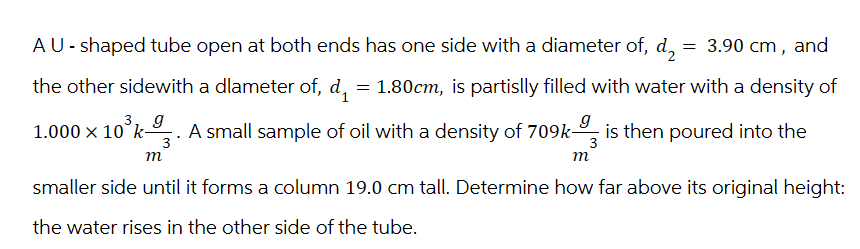 AU - shaped tube open at both ends has one side with a diameter of, d, = 3.90cm, and
the other sidewith a dlameter of, d, =180cm, is partislly filled with water with a density of
1.000 x 10°. A small sample of oil with a density of 709k is then poured into the
m m
smaller side until it forms a column 19.0 cm tall. Determine how far above its original height:
the water rises in the other side of the tube.
This is AI generated Response.
Asked by: Sunil kumar
Created at: 2025-07-09 06:57:27
Asked by: Sunil kumar
Created at: 2025-07-09 06:57:27
Final Answer:
Rendered
Raw Text
Did you like this answer?
Let's break the problem into **two steps** as requested, with explanations at each stage.
---
### **Step 1: Calculate the Pressure Exerted by the Oil Column**
**Given:**
- Height of oil column, \( h_{\text{oil}} = 19.0 \) cm \( = 0.190 \) m
- Density of oil, \( \rho_{\text{oil}} = 709 \) kg/m³
- Density of water, \( \rho_{w} = 1.000 \times 10^3 \) kg/m³
- Gravity, \( g = 9.81 \) m/s²
**Explanation:**
Since the U-tube is open at both ends and initially water levels are the same, pouring oil in one side will push water up on the other. The pressure at the bottom of both columns (at the same level) must be equal.
The pressure at the bottom due to the oil column is:
\[
P_{\text{oil}} = \rho_{\text{oil}} \cdot g \cdot h_{\text{oil}}
\]
If the water rises by \( h \) in the other arm, the difference in water levels between the two sides will be \( h \). The pressure at the bottom of the water column is:
\[
P_{\text{water}} = \rho_{w} \cdot g \cdot h
\]
Equating:
\[
P_{\text{oil}} = P_{\text{water}}
\]
\[
\rho_{\text{oil}} \cdot g \cdot h_{\text{oil}} = \rho_{w} \cdot g \cdot h
\]
\[
h = \frac{\rho_{\text{oil}} \cdot h_{\text{oil}}}{\rho_{w}}
\]
---
### **Step 2: Plug in Values and Calculate the Rise in Water Level**
\[
h = \frac{709 \, \text{kg/m}^3 \times 0.190 \, \text{m}}{1000 \, \text{kg/m}^3}
\]
\[
h = \frac{134.71}{1000}
\]
\[
h = 0.135 \, \text{m} = 13.5 \, \text{cm}
\]
---
## **Final Answer:**
\[
\boxed{13.5 \, \text{cm}}
\]
**The water rises 13.5 cm above its original height on the other side of the tube.**
---
**Summary of Steps:**
1. **Equated the pressure exerted by the oil column to the pressure exerted by the risen water column.**
2. **Solved for the height the water rises using the densities and given height of the oil.**
📢 Instructions:
- Ask anything relatd to above question only.
- For new Question goto :