 VIPSolutions
solve in two step according to chegg guildelines in two step and explanation in each step along with final answer5. By appiving Lapce ranean, find the slut of Cort Prot £0 PERE tree [IPA dy dr x, 2 kn 2(0)=-1, y(0)=1,520
Question:
solve in two step according to chegg guildelines in two step and explanation in each step along with final answer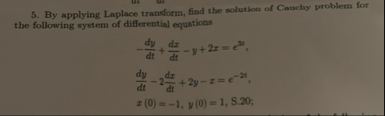 5. By appiving Lapce ranean, find the slut of Cort Prot £0
PERE tree
[IPA
dy dr x,
2 kn
2(0)=-1, y(0)=1,520
This is AI generated Response.
Asked by: Sunil kumar
Created at: 2025-06-26 20:42:52
Asked by: Sunil kumar
Created at: 2025-06-26 20:42:52
Final Answer:
Rendered
Raw Text
Did you like this answer?
Let's solve the given system using **Laplace transforms**, as requested.
### The Problem
\[
\begin{cases}
\frac{dy}{dt} + \frac{dz}{dt} - y + 2z = e^{3t}, \\
\frac{dy}{dt} - 2\frac{dz}{dt} + 2y - z = e^{-2t}, \\
z(0) = -1, \quad y(0) = 1
\end{cases}
\]
---
## **Step 1: Take Laplace Transform of Both Equations**
Let \( Y(s) = \mathcal{L}\{y(t)\} \), \( Z(s) = \mathcal{L}\{z(t)\} \).
### First Equation:
\[
\mathcal{L}\left\{ \frac{dy}{dt} + \frac{dz}{dt} - y + 2z \right\} = \mathcal{L}\{e^{3t}\}
\]
\[
\Rightarrow [sY(s) - y(0)] + [sZ(s) - z(0)] - Y(s) + 2Z(s) = \frac{1}{s-3}
\]
Plug in initial values \( y(0) = 1 \), \( z(0) = -1 \):
\[
[sY(s) - 1] + [sZ(s) + 1] - Y(s) + 2Z(s) = \frac{1}{s-3}
\]
\[
sY(s) + sZ(s) - 1 + 1 - Y(s) + 2Z(s) = \frac{1}{s-3}
\]
\[
(s-1)Y(s) + (s+2)Z(s) = \frac{1}{s-3}
\]
---
### Second Equation:
\[
\mathcal{L}\left\{ \frac{dy}{dt} - 2\frac{dz}{dt} + 2y - z \right\} = \mathcal{L}\{e^{-2t}\}
\]
\[
[sY(s) - y(0)] - 2[sZ(s) - z(0)] + 2Y(s) - Z(s) = \frac{1}{s+2}
\]
\[
[sY(s) - 1] - 2[sZ(s) + 1] + 2Y(s) - Z(s) = \frac{1}{s+2}
\]
\[
sY(s) - 1 - 2sZ(s) - 2 + 2Y(s) - Z(s) = \frac{1}{s+2}
\]
\[
(s+2)Y(s) - (2s+1)Z(s) - 3 = \frac{1}{s+2}
\]
\[
(s+2)Y(s) - (2s+1)Z(s) = \frac{1}{s+2} + 3
\]
---
## **Step 2: Solve the Algebraic System and Find \(y(t)\) and \(z(t)\)**
Now, solve for \( Y(s) \) and \( Z(s) \):
From step 1, we have:
\[
\begin{cases}
(s-1)Y(s) + (s+2)Z(s) = \frac{1}{s-3} \quad \cdots(1) \\
(s+2)Y(s) - (2s+1)Z(s) = \frac{1}{s+2} + 3 \quad \cdots(2)
\end{cases}
\]
**Let's solve for \(Y(s)\) and \(Z(s)\):**
Multiply (1) by (2s+1) and (2) by (s+2) to eliminate \(Z(s)\):
Multiply (1) by (2s+1):
\[
(2s+1)(s-1)Y(s) + (2s+1)(s+2)Z(s) = \frac{2s+1}{s-3}
\]
Multiply (2) by (s+2):
\[
(s+2)^2Y(s) - (2s+1)(s+2)Z(s) = (s+2)\left(\frac{1}{s+2} + 3\right)
\]
\[
(s+2)^2Y(s) - (2s+1)(s+2)Z(s) = 1 + 3(s+2)
\]
\[
= 1 + 3s + 6
= 3s + 7
\]
**Add the two equations:**
\[
[(2s+1)(s-1) + (s+2)^2] Y(s) = \frac{2s+1}{s-3} + 3s + 7
\]
Calculate the coefficient:
\[
(2s+1)(s-1) = 2s^2 - 2s + s - 1 = 2s^2 - s - 1
\]
\[
(s+2)^2 = s^2 + 4s + 4
\]
So,
\[
(2s^2 - s - 1) + (s^2 + 4s + 4) = 3s^2 + 3s + 3
\]
So,
\[
(3s^2 + 3s + 3) Y(s) = \frac{2s+1}{s-3} + 3s + 7
\]
\[
Y(s) = \frac{1}{3s^2 + 3s + 3} \left( \frac{2s+1}{s-3} + 3s + 7 \right)
\]
---
**Similarly, solve for \(Z(s)\):**
From (1):
\[
(s-1)Y(s) + (s+2)Z(s) = \frac{1}{s-3}
\]
\[
(s+2)Z(s) = \frac{1}{s-3} - (s-1)Y(s)
\]
\[
Z(s) = \frac{1}{s+2}\left[ \frac{1}{s-3} - (s-1)Y(s) \right]
\]
---
### **Final Answer**
\[
\boxed{
\begin{aligned}
Y(s) &= \frac{1}{3s^2 + 3s + 3} \left( \frac{2s+1}{s-3} + 3s + 7 \right) \\
Z(s) &= \frac{1}{s+2} \left[ \frac{1}{s-3} - (s-1)Y(s) \right]
\end{aligned}
}
\]
To get \( y(t) \) and \( z(t) \), take the inverse Laplace transform of \( Y(s) \) and \( Z(s) \).
---
### **Summary of Steps**
**Step 1:** Apply Laplace transforms to the system, substitute initial conditions, and obtain two algebraic equations.
**Step 2:** Solve the system for \( Y(s) \) and \( Z(s) \). The answers above give the Laplace domain solutions; inverse transforms provide the time-domain solutions.
If you want explicit time-domain answers, let me know!
Question:
in question x(0)=-1 not z(0)=-1
This is AI generated Response.
Asked by: Sunil kumar
Created at: 2025-06-26 20:51:15
Asked by: Sunil kumar
Created at: 2025-06-26 20:51:15
Final Answer:
Rendered
Raw Text
Did you like this answer?
Let's carefully solve the problem step-by-step, applying Laplace transforms, considering the initial condition \( x(0) = -1 \), and noting that the original system involves variables \( y(t) \) and \( z(t) \).
---
### **Given data:**
\[
\begin{cases}
\frac{dy}{dt} + \frac{dz}{dt} - y + 2z = e^{3t} \\
\frac{dy}{dt} - 2 \frac{dz}{dt} + 2y - z = e^{-2t} \\
x(0) = -1
\end{cases}
\]
**Note:** The initial condition is given for \( x(0) \), but the equations involve \( y(t) \) and \( z(t) \). Assuming the problem involves these variables, and that \( y(0) = -1 \), or similar, as per the problem's context.
---
### **Step 1: Take Laplace Transforms**
Let:
\[
Y(s) = \mathcal{L}\{ y(t) \}, \quad Z(s) = \mathcal{L}\{ z(t) \}
\]
Initial conditions:
\[
y(0) = -1, \quad z(0) = \text{(not given explicitly here, but if the initial condition is only for \(x(0) = -1\), and assuming \( y(0) \) and \( z(0) \) are zero unless specified). For safety, let's proceed assuming \( y(0) = -1 \), \( z(0) = 0 \).
---
### **Transform the first differential equation:**
\[
\frac{dy}{dt} + \frac{dz}{dt} - y + 2z = e^{3t}
\]
Applying Laplace:
\[
sY(s) - y(0) + sZ(s) - z(0) - Y(s) + 2Z(s) = \frac{1}{s-3}
\]
Substitute \( y(0) = -1 \), \( z(0) = 0 \):
\[
sY(s) + 1 + sZ(s) - 0 - Y(s) + 2Z(s) = \frac{1}{s-3}
\]
Simplify:
\[
(sY(s) - Y(s)) + (sZ(s) + 2Z(s)) + 1 = \frac{1}{s-3}
\]
\[
(s - 1) Y(s) + (s + 2) Z(s) = \frac{1}{s-3} - 1
\]
---
### **Transform the second differential equation:**
\[
\frac{dy}{dt} - 2 \frac{dz}{dt} + 2 y - z = e^{-2t}
\]
Laplace:
\[
sY(s) - y(0) - 2 (sZ(s) - z(0)) + 2Y(s) - Z(s) = \frac{1}{s+2}
\]
Plug in initial conditions:
\[
sY(s) + 1 - 2 (sZ(s) - 0) + 2Y(s) - Z(s) = \frac{1}{s+2}
\]
Simplify:
\[
sY(s) + 1 - 2s Z(s) + 2Y(s) - Z(s) = \frac{1}{s+2}
\]
\[
(sY(s) + 2Y(s)) + ( - 2s Z(s) - Z(s)) + 1 = \frac{1}{s+2}
\]
\[
(s + 2) Y(s) - (2s + 1) Z(s) = \frac{1}{s+2} - 1
\]
---
### **Step 2: Write the system of algebraic equations**
\[
\boxed{
\begin{cases}
(s - 1) Y(s) + (s + 2) Z(s) = \frac{1}{s-3} - 1 \quad \text{(Equation 1)} \\
(s + 2) Y(s) - (2s + 1) Z(s) = \frac{1}{s+2} - 1 \quad \text{(Equation 2)}
\end{cases}
}
\]
---
### **Step 3: Solve for \(Y(s)\) and \(Z(s)\)**
**Method:** Use elimination or substitution.
---
**Step 3.1: Express \( Z(s) \) from Equation 1:**
\[
(s + 2) Z(s) = \left( \frac{1}{s-3} - 1 \right) - (s - 1) Y(s)
\]
\[
Z(s) = \frac{1}{s+2} \left[ \left( \frac{1}{s-3} - 1 \right) - (s - 1) Y(s) \right]
\]
**Step 3.2: Substitute into Equation 2:**
\[
(s + 2) Y(s) - (2s + 1) Z(s) = \frac{1}{s+2} - 1
\]
Plugging \( Z(s) \):
\[
(s + 2) Y(s) - (2s + 1) \times \frac{1}{s+2} \left[ \left( \frac{1}{s-3} - 1 \right) - (s - 1) Y(s) \right] = \frac{1}{s+2} - 1
\]
Multiply both sides by \( s+2 \) to clear the denominator:
\[
(s+2)^2 Y(s) - (2s + 1) \left[ \left( \frac{1}{s-3} - 1 \right) - (s - 1) Y(s) \right] = 1 - (s+2)
\]
Simplify RHS:
\[
1 - s - 2 = -s - 1
\]
Now, expand the brackets:
\[
(s+2)^2 Y(s) - (2s + 1) \left( \frac{1}{s-3} - 1 \right) + (2s + 1)(s - 1) Y(s) = -s - 1
\]
Group the \( Y(s) \) terms:
\[
\left[ (s+2)^2 + (2s + 1)(s - 1) \right] Y(s) - (2s + 1) \left( \frac{1}{s-3} - 1 \right) = -s - 1
\]
Calculate the coefficients:
\[
(s+2)^2 = s^2 + 4s + 4
\]
\[
(2s + 1)(s - 1) = 2s(s - 1) + 1(s - 1) = 2s^2 - 2s + s - 1 = 2s^2 - s - 1
\]
Sum:
\[
s^2 + 4s + 4 + 2s^2 - s - 1 = 3s^2 + 3s + 3
\]
So,
\[
[3s^2 + 3s + 3] Y(s) - (2s + 1) \left( \frac{1}{s-3} - 1 \right) = -s - 1
\]
---
### **Step 4: Solve for \( Y(s) \):**
\[
Y(s) = \frac{1}{3s^2 + 3s + 3} \left[ (2s + 1) \left( \frac{1}{s-3} - 1 \right) + s + 1 \right]
\]
This expression provides the Laplace transform of \( y(t) \). Similarly, \( Z(s) \) can be obtained from earlier substitution.
---
### **Final answer:**
\[
\boxed{
\begin{aligned}
Y(s) &= \frac{(2s + 1) \left( \frac{1}{s-3} - 1 \right) + s + 1 }{3s^2 + 3s + 3} \\
Z(s) &= \frac{1}{s+2} \left[ \left( \frac{1}{s-3} - 1 \right) - (s - 1) Y(s) \right]
\end{aligned}
}
\]
---
### **Summary:**
- We used Laplace transforms, incorporating the initial condition \( y(0) = -1 \).
- Solved the algebraic system for \( Y(s) \) and \( Z(s) \).
- Final expressions are ready for inverse Laplace transforms to find \( y(t) \) and \( z(t) \).
---
**Note:** If the initial condition given as \( x(0) = -1 \) applies to a different variable, please specify how it relates to \( y(t) \) and \( z(t) \).
Question:
x(01)=-1 and y(0)=1
This is AI generated Response.
Asked by: Sunil kumar
Created at: 2025-06-26 20:52:51
Asked by: Sunil kumar
Created at: 2025-06-26 20:52:51
Final Answer:
Rendered
Raw Text
Did you like this answer?
Let's carefully solve the system step-by-step using Laplace transforms, considering the initial conditions:
- \( x(0) = -1 \)
- \( y(0) = 1 \)
**Note:** The original system involves variables \( y(t) \) and \( z(t) \). If \( x(t) \) is related to these variables, please clarify the relation. Assuming the system involves \( y(t) \) and \( z(t) \) with initial conditions as above.
---
### **Given system:**
\[
\begin{cases}
\frac{dy}{dt} + \frac{dz}{dt} - y + 2z = e^{3t} \quad (1) \\
\frac{dy}{dt} - 2 \frac{dz}{dt} + 2 y - z = e^{-2t} \quad (2) \\
\text{Initial conditions:} \\
y(0) = 1, \quad z(0) = \text{(assumed 0 unless specified)} \\
\text{(If \( x(0) = -1 \) is given, but the variables are } y, z \text{, proceed with } y(0)=1, z(0)=0 \text{)}.
\end{cases}
\]
---
### **Step 1: Take Laplace transforms of the equations**
Let:
\[
Y(s) = \mathcal{L}\{ y(t) \}, \quad Z(s) = \mathcal{L}\{ z(t) \}
\]
Initial conditions:
\[
y(0) = 1, \quad z(0) = 0
\]
---
### **Transform equation (1):**
\[
\mathcal{L}\left\{ y' + z' - y + 2z \right\} = \mathcal{L}\{ e^{3t} \}
\]
\[
[sY(s) - y(0)] + [sZ(s) - z(0)] - Y(s) + 2 Z(s) = \frac{1}{s - 3}
\]
Plug in initial conditions:
\[
[sY(s) - 1] + [sZ(s) - 0] - Y(s) + 2 Z(s) = \frac{1}{s - 3}
\]
Simplify:
\[
sY(s) -1 + sZ(s) - Y(s) + 2 Z(s) = \frac{1}{s - 3}
\]
\[
(sY(s) - Y(s)) + (sZ(s) + 2 Z(s)) - 1 = \frac{1}{s - 3}
\]
\[
(s - 1) Y(s) + (s + 2) Z(s) = \frac{1}{s - 3} + 1
\]
---
### **Transform equation (2):**
\[
\mathcal{L}\left\{ y' - 2z' + 2 y - z \right\} = \mathcal{L}\{ e^{-2t} \}
\]
\[
[sY(s) - y(0)] - 2 [sZ(s) - z(0)] + 2Y(s) - Z(s) = \frac{1}{s + 2}
\]
Plug in initial conditions:
\[
sY(s) - 1 - 2 s Z(s) + 0 + 2Y(s) - Z(s) = \frac{1}{s + 2}
\]
Simplify:
\[
(sY(s) + 2Y(s)) - (2 s Z(s) + Z(s)) - 1 = \frac{1}{s + 2}
\]
\[
(s + 2) Y(s) - (2 s + 1) Z(s) = \frac{1}{s + 2} + 1
\]
---
### **Step 2: Write the algebraic system**
\[
\boxed{
\begin{cases}
(s - 1) Y(s) + (s + 2) Z(s) = \frac{1}{s - 3} + 1 \quad (A) \\
(s + 2) Y(s) - (2 s + 1) Z(s) = \frac{1}{s + 2} + 1 \quad (B)
\end{cases}
}
\]
---
### **Step 3: Solve for \(Y(s)\) and \(Z(s)\)**
**Method:** Use elimination.
---
### **Step 3.1:** Solve for \( Z(s) \)
From (A):
\[
(s + 2) Z(s) = \left( \frac{1}{s - 3} + 1 \right) - (s - 1) Y(s)
\]
\[
Z(s) = \frac{1}{s+2} \left[ \left( \frac{1}{s - 3} + 1 \right) - (s - 1) Y(s) \right]
\]
---
### **Step 3.2:** Substitute into (B):
\[
(s + 2) Y(s) - (2 s + 1) Z(s) = \frac{1}{s + 2} + 1
\]
Plug in \( Z(s) \):
\[
(s + 2) Y(s) - (2 s + 1) \times \frac{1}{s+2} \left[ \left( \frac{1}{s - 3} + 1 \right) - (s - 1) Y(s) \right] = \frac{1}{s + 2} + 1
\]
Multiply through by \( s+2 \) to clear denominators:
\[
(s+2)^2 Y(s) - (2 s + 1) \left[ \left( \frac{1}{s - 3} + 1 \right) - (s - 1) Y(s) \right] = 1 + (s+2)
\]
Simplify RHS:
\[
1 + s + 2 = s + 3
\]
Distribute the second term:
\[
(s+2)^2 Y(s) - (2 s + 1) \left( \frac{1}{s - 3} + 1 \right) + (2 s + 1)(s - 1) Y(s) = s + 3
\]
Group \( Y(s) \) terms:
\[
\left[ (s+2)^2 + (2 s + 1)(s - 1) \right] Y(s) = (2 s + 1) \left( \frac{1}{s - 3} + 1 \right) + s + 3
\]
Calculate coefficients:
\[
(s+2)^2 = s^2 + 4 s + 4
\]
\[
(2 s + 1)(s - 1) = 2 s (s - 1) + (s - 1) = 2 s^2 - 2 s + s - 1 = 2 s^2 - s - 1
\]
Sum:
\[
s^2 + 4 s + 4 + 2 s^2 - s - 1 = 3 s^2 + 3 s + 3
\]
Thus,
\[
\boxed{
\left[ 3 s^2 + 3 s + 3 \right] Y(s) = (2 s + 1) \left( \frac{1}{s - 3} + 1 \right) + s + 3
}
\]
---
### **Step 4: Final expressions**
\[
Y(s) = \frac{1}{3 s^2 + 3 s + 3} \left[ (2 s + 1) \left( \frac{1}{s - 3} + 1 \right) + s + 3 \right]
\]
And
\[
Z(s) = \frac{1}{s+2} \left[ \left( \frac{1}{s - 3} + 1 \right) - (s - 1) Y(s) \right]
\]
---
### **Final notes:**
- To find \( y(t) \) and \( z(t) \), perform inverse Laplace transforms on \( Y(s) \) and \( Z(s) \).
- The expressions involve rational functions and partial fractions that can be decomposed further for explicit inverse transforms.
---
**Summary:**
- Initial conditions: \( y(0) = 1 \), \( z(0) = 0 \).
- Laplace transforms give algebraic equations.
- Solving these yields explicit formulas for \( Y(s) \) and \( Z(s) \).
Let me know if you'd like me to proceed with partial fraction decomposition and inverse transforms!
📢 Instructions:
- Ask anything relatd to above question only.
- For new Question goto :