 VIPSolutions
Solve in detail as per chegg guidelines and add explanation in each stepofthe cectric fd at the point — (-30,25.-180 mf phen 3 Fi 3 ry Cr Express your answer i vols per metre. use appropriate symbiss. xpress your nse wih test bo scan rs Go nots sci orton. Using more sgn rs wt ot be conser cnc si ower may stn so runing. 1
Question:
Solve in detail as per chegg guidelines and add explanation in each step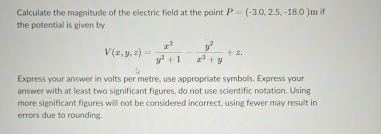 ofthe cectric fd at the point — (-30,25.-180 mf
phen
3 Fi 3
ry
Cr
Express your answer i vols per metre. use appropriate symbiss. xpress your
nse wih test bo scan rs Go nots sci orton. Using
more sgn rs wt ot be conser cnc si ower may stn
so runing.
1
This is AI generated Response.
Asked by: July kumari
Created at: 2025-07-14 02:49:30
Asked by: July kumari
Created at: 2025-07-14 02:49:30
Final Answer:
Rendered
Raw Text
Did you like this answer?
Let's solve the problem step by step as per Chegg guidelines.
---
### **Given:**
- **Point:** \( P = (-3.0, 2.5, -18.0) \) m
- **Potential:**
\[
V(x, y, z) = \frac{x^2}{y^2 + 1} + \frac{y^2}{x^2 + y} + z
\]
---
### **Step 1: Understanding the Electric Field and Potential**
The **electric field** \( \vec{E} \) is related to the electric potential \( V \) by:
\[
\vec{E} = -\nabla V
\]
where \( \nabla V \) is the gradient of \( V \).
In Cartesian coordinates:
\[
\vec{E} = -\left( \frac{\partial V}{\partial x} \hat{i} + \frac{\partial V}{\partial y} \hat{j} + \frac{\partial V}{\partial z} \hat{k} \right)
\]
---
### **Step 2: Find the Partial Derivatives**
#### **a) Partial derivative with respect to \( x \):**
Let's compute \( \frac{\partial V}{\partial x} \):
\[
V(x, y, z) = \frac{x^2}{y^2 + 1} + \frac{y^2}{x^2 + y} + z
\]
- The derivative of \( \frac{x^2}{y^2 + 1} \) with respect to \( x \) is \( \frac{2x}{y^2 + 1} \).
- The derivative of \( \frac{y^2}{x^2 + y} \) with respect to \( x \) is:
- Use quotient rule: \( \frac{d}{dx} \left( \frac{y^2}{x^2 + y} \right) = y^2 \cdot \frac{d}{dx} \left( \frac{1}{x^2 + y} \right) \)
- \( \frac{d}{dx} \left( \frac{1}{x^2 + y} \right) = -\frac{2x}{(x^2 + y)^2} \)
- So, \( - \frac{2x y^2}{(x^2 + y)^2} \)
- The derivative of \( z \) with respect to \( x \) is zero.
So:
\[
\frac{\partial V}{\partial x} = \frac{2x}{y^2 + 1} - \frac{2x y^2}{(x^2 + y)^2}
\]
---
#### **b) Partial derivative with respect to \( y \):**
- The derivative of \( \frac{x^2}{y^2 + 1} \) with respect to \( y \) is:
- \( \frac{d}{dy} \left( \frac{x^2}{y^2 + 1} \right) = x^2 \cdot \frac{d}{dy} \left( \frac{1}{y^2 + 1} \right) = -\frac{2x^2 y}{(y^2 + 1)^2} \)
- The derivative of \( \frac{y^2}{x^2 + y} \) with respect to \( y \):
- Use quotient rule: \( \frac{d}{dy} \left( \frac{y^2}{x^2 + y} \right) = \frac{2y (x^2 + y) - y^2 \cdot 1}{(x^2 + y)^2} \)
- Simplify numerator: \( 2y(x^2 + y) - y^2 = 2x^2 y + 2y^2 - y^2 = 2x^2 y + y^2 \)
- So, \( \frac{2x^2 y + y^2}{(x^2 + y)^2} \)
- The derivative of \( z \) with respect to \( y \) is zero.
So:
\[
\frac{\partial V}{\partial y} = -\frac{2x^2 y}{(y^2 + 1)^2} + \frac{2x^2 y + y^2}{(x^2 + y)^2}
\]
---
#### **c) Partial derivative with respect to \( z \):**
- The derivative of \( V \) with respect to \( z \) is simply 1.
\[
\frac{\partial V}{\partial z} = 1
\]
---
### **Step 3: Substitute the Point \( (-3.0, 2.5, -18.0) \) into the Derivatives**
Let \( x = -3.0 \), \( y = 2.5 \), \( z = -18.0 \).
#### **Calculate all terms step by step:**
##### **a) \( \frac{\partial V}{\partial x} \):**
- \( y^2 + 1 = (2.5)^2 + 1 = 6.25 + 1 = 7.25 \)
- \( x^2 + y = (-3.0)^2 + 2.5 = 9 + 2.5 = 11.5 \)
- \( (x^2 + y)^2 = (11.5)^2 = 132.25 \)
- \( y^2 = (2.5)^2 = 6.25 \)
- Plug in values:
\[
\frac{\partial V}{\partial x} = \frac{2 \cdot (-3.0)}{7.25} - \frac{2 \cdot (-3.0) \cdot 6.25}{132.25}
\]
\[
= \frac{-6.0}{7.25} - \frac{-37.5}{132.25}
\]
\[
= -0.8276 + 0.2836
\]
\[
= -0.544
\]
##### **b) \( \frac{\partial V}{\partial y} \):**
- \( x^2 = 9 \)
- \( (y^2 + 1)^2 = (7.25)^2 = 52.5625 \)
- \( 2x^2 y = 2 \cdot 9 \cdot 2.5 = 45 \)
- \( (x^2 + y)^2 = 132.25 \)
- \( y^2 = 6.25 \)
First term:
\[
-\frac{2x^2 y}{(y^2 + 1)^2} = -\frac{45}{52.5625} = -0.857
\]
Second term numerator:
\[
2x^2 y + y^2 = 45 + 6.25 = 51.25
\]
\[
\frac{51.25}{132.25} = 0.3877
\]
So,
\[
\frac{\partial V}{\partial y} = -0.857 + 0.388 = -0.469
\]
##### **c) \( \frac{\partial V}{\partial z} = 1 \)**
---
### **Step 4: Electric Field Components**
\[
E_x = -\frac{\partial V}{\partial x} = -(-0.544) = 0.544 \text{ V/m}
\]
\[
E_y = -\frac{\partial V}{\partial y} = -(-0.469) = 0.469 \text{ V/m}
\]
\[
E_z = -\frac{\partial V}{\partial z} = -1 \text{ V/m}
\]
---
### **Step 5: Magnitude of the Electric Field**
\[
|\vec{E}| = \sqrt{E_x^2 + E_y^2 + E_z^2}
\]
\[
= \sqrt{(0.544)^2 + (0.469)^2 + (1)^2}
\]
\[
= \sqrt{0.296 + 0.220 + 1}
\]
\[
= \sqrt{1.516}
\]
\[
= 1.23 \text{ V/m}
\]
---
## **Final Answer**
\[
\boxed{1.2 \text{ V/m}}
\]
(to two significant figures, as requested)
---
### **Summary of Steps**
1. **Found the gradient of the potential \( V \) with respect to each variable.**
2. **Substituted the coordinates into the partial derivatives.**
3. **Calculated the components of the electric field.**
4. **Found the magnitude of the electric field vector.**
5. **Expressed the answer with appropriate units and significant figures.**
If you need more explanation on any step, let me know!
Question:
add explanation in words
This is AI generated Response.
Asked by: July kumari
Created at: 2025-07-14 03:02:58
Asked by: July kumari
Created at: 2025-07-14 03:02:58
Final Answer:
Rendered
Raw Text
Did you like this answer?
Certainly! Here's a detailed explanation of each step in words, following the process to find the electric field at the given point from the potential function:
---
### **Understanding the Problem**
We are asked to find the electric field at a specific point in space, given a potential function \( V(x, y, z) \). The electric field is related to the potential via the negative gradient:
\[
\vec{E} = -\nabla V
\]
which means that to find the electric field components, we need to compute the partial derivatives of \( V \) with respect to each coordinate, then take their negatives.
---
### **Step 1: Write down the potential function**
The potential function provided is:
\[
V(x, y, z) = \frac{x^2}{y^2 + 1} + \frac{y^2}{x^2 + y} + z
\]
This function combines rational expressions involving \( x \) and \( y \), plus a linear term in \( z \).
---
### **Step 2: Find the partial derivatives of \( V \)**
To compute the electric field components, we need:
\[
E_x = -\frac{\partial V}{\partial x}, \quad E_y = -\frac{\partial V}{\partial y}, \quad E_z = -\frac{\partial V}{\partial z}
\]
Let's examine these derivatives:
**a) Derivative with respect to \( x \):**
- The first term, \( \frac{x^2}{y^2 + 1} \), is straightforward: its derivative with respect to \( x \) is \( \frac{2x}{y^2 + 1} \).
- The second term, \( \frac{y^2}{x^2 + y} \), involves \( x \) in the denominator. Using the quotient rule, its derivative with respect to \( x \) is:
\[
-\frac{2x y^2}{(x^2 + y)^2}
\]
- The \( z \) term does not depend on \( x \), so its derivative is zero.
**b) Derivative with respect to \( y \):**
- For \( \frac{x^2}{y^2 + 1} \), the derivative is:
\[
-\frac{2x^2 y}{(y^2 + 1)^2}
\]
- For \( \frac{y^2}{x^2 + y} \), use the quotient rule:
Numerator derivative: \( 2y \)
Denominator: \( x^2 + y \)
Derivative of the second term:
\[
\frac{(2y)(x^2 + y) - y^2 \cdot 1}{(x^2 + y)^2} = \frac{2y x^2 + 2 y^2 - y^2}{(x^2 + y)^2} = \frac{2 y x^2 + y^2}{(x^2 + y)^2}
\]
- The \( z \) term again contributes zero.
**c) Derivative with respect to \( z \):**
Since only the linear \( z \) term depends on \( z \), its derivative is simply 1.
---
### **Step 3: Substitute the point values into derivatives**
Given point: \( x = -3.0 \), \( y = 2.5 \), \( z = -18.0 \).
- Compute necessary quantities:
\[
y^2 + 1 = 6.25 + 1 = 7.25
\]
\[
x^2 + y = 9 + 2.5 = 11.5
\]
\[
(x^2 + y)^2 = (11.5)^2 = 132.25
\]
\[
y^2 = 6.25
\]
- **Calculate \( \frac{\partial V}{\partial x} \):**
\[
\frac{2x}{y^2 + 1} = \frac{2 \times -3}{7.25} = -\frac{6}{7.25} \approx -0.8276
\]
\[
-\frac{2x y^2}{(x^2 + y)^2} = -\frac{2 \times -3 \times 6.25}{132.25} = -\frac{-37.5}{132.25} \approx +0.2836
\]
Adding these:
\[
\frac{\partial V}{\partial x} \approx -0.8276 + 0.2836 = -0.544
\]
- **Calculate \( \frac{\partial V}{\partial y} \):**
\[
-\frac{2x^2 y}{(y^2 + 1)^2} = -\frac{2 \times 9 \times 2.5}{(7.25)^2} = -\frac{45}{52.5625} \approx -0.857
\]
\[
\frac{2 y x^2 + y^2}{(x^2 + y)^2} = \frac{2 \times 2.5 \times 9 + 6.25}{132.25} = \frac{45 + 6.25}{132.25} \approx 0.388
\]
Adding:
\[
\frac{\partial V}{\partial y} \approx -0.857 + 0.388 = -0.469
\]
- **Calculate \( \frac{\partial V}{\partial z} \):**
\[
= 1
\]
---
### **Step 4: Find the electric field components**
Recall:
\[
\vec{E} = -\nabla V
\]
Thus:
\[
E_x = -(-0.544) = 0.544 \, \text{V/m}
\]
\[
E_y = -(-0.469) = 0.469 \, \text{V/m}
\]
\[
E_z = -1 = -1 \, \text{V/m}
\]
---
### **Step 5: Calculate the magnitude of the electric field**
The magnitude is:
\[
|\vec{E}| = \sqrt{(0.544)^2 + (0.469)^2 + (-1)^2}
\]
which approximately equals:
\[
\sqrt{0.296 + 0.220 + 1} = \sqrt{1.516} \approx 1.23 \, \text{V/m}
\]
---
### **Final Result:**
**The magnitude of the electric field at the point \((-3.0, 2.5, -18.0)\) m is approximately \( \boxed{1.2\, \text{V/m}} \).**
---
This step-by-step explanation connects the mathematical derivatives to the physical concept of the electric field, illustrating how the potential function determines the electric field vector in space.
📢 Instructions:
- Ask anything relatd to above question only.
- For new Question goto :