This is AI generated Response.
Asked by: July kumari
Created at: 2025-07-14 07:00:18
Final Answer:
RenderedRaw Text
Did you like this answer?
Let's solve the problem step by step, **explaining each step** and each **option** for the error identification:
---
## **Step 1: Find the Derivative**
Given \( f(x) = x^{1/4} \):
- The derivative using the power rule is:
\[
f'(x) = \frac{1}{4} x^{-3/4}
\]
- This matches the derivative used in the work shown.
---
## **Step 2: Find \( f'(a) \) where \( a = 81 \)**
- Substitute \( a = 81 \):
\[
f'(81) = \frac{1}{4} \times (81)^{-3/4}
\]
- Let's compute \( (81)^{-3/4} \):
- \( 81^{1/4} = 3 \) because \( 3^4 = 81 \).
- \( 81^{-3/4} = (81^{1/4})^{-3} = 3^{-3} = \frac{1}{27} \).
So,
\[
f'(81) = \frac{1}{4} \times \frac{1}{27} = \frac{1}{108}
\]
- The derivative calculation is correct in the work shown.
---
## **Step 3: Find \( \Delta x \)**
- \( a = 81, \quad b = 81.4 \)
- Change in \( x \) is:
\[
\Delta x = b - a = 81.4 - 81 = 0.4
\]
**NOTE:** In the work shown, they used \(-0.4\) instead of \(+0.4\). This is a sign error.
---
## **Step 4: Linear Approximation Formula**
\[
\Delta f \approx f'(a) \Delta x
\]
Plug values in:
\[
\Delta f \approx \frac{1}{108} \times 0.4
\]
\[
\Delta f \approx 0.00370
\]
- **But in the work shown, they used \(-0.4\)**, so their value is negative (which is not correct).
---
### **Identifying the First Error**
Let's analyze each option:
1. **The value of \( f'(a) \) should be \( f'(a) = 6.75 \).**
- \( f'(a) = \frac{1}{108} \), not 6.75. So this is incorrect.
2. **The change in \( x \) should be \( \Delta x = 0.4 \).**
- **This is correct.** They incorrectly used \(-0.4\).
3. **The value of \( f'(a) \) should be \( f'(a) = -6.75 \).**
- This is not true.
4. **The derivative of \( f \) should be \( x^{-3/4} \).**
- The derivative is \( \frac{1}{4} x^{-3/4} \), not just \( x^{-3/4} \).
5. **The derivative of \( f \) should be \( \frac{1}{4}x^{3/4} \).**
- This is incorrect. The derivative is \( \frac{1}{4} x^{-3/4} \).
### **Correct Option:**
- **The change in \( x \) should be \( \Delta x = 0.4 \).**
---
## **Step 5: Compute the Linear Approximation**
\[
\Delta f \approx \frac{1}{108} \times 0.4
\]
\[
\Delta f \approx 0.00370
\]
(to five decimal places: \( 0.00370 \))
---
## **Step 6: Compute Actual Change and Error**
### **Actual change:**
\[
\Delta f_\text{actual} = f(81.4) - f(81)
\]
Calculate:
- \( f(81.4) = (81.4)^{1/4} \)
- \( f(81) = (81)^{1/4} = 3 \)
Calculate \( (81.4)^{1/4} \):
- Using a calculator: \( 81.4^{0.25} \approx 3.00123 \)
So,
\[
\Delta f_\text{actual} \approx 3.00123 - 3 = 0.00123
\]
### **Compute the Error:**
\[
\text{error} = |\Delta f_\text{actual} - \Delta f_\text{approx}|
\]
\[
\text{error} \approx |0.00123 - 0.00370| = 0.00247
\]
---
## **SUMMARY OF ANSWERS**
### **First box:**
\[
\Delta f \approx 0.00370
\]
### **Second box (error):**
\[
\text{error} \approx 0.00247
\]
---
## **EXTRA: Explanation of Each Option**
1. **\( f'(a) = 6.75 \):** Incorrect, derivative is \( \frac{1}{108} \).
2. **\( \Delta x = 0.4 \):** **Correct.** Error was using \(-0.4\) instead.
3. **\( f'(a) = -6.75 \):** Incorrect.
4. **Derivative is \( x^{-3/4} \):** Not correct, missing \( \frac{1}{4} \) factor.
5. **Derivative is \( \frac{1}{4} x^{3/4} \):** Incorrect exponent sign.
---
## **Final Answers to Fill In**
**Linear Approximation:**
\[
\Delta f \approx 0.00370
\]
**Error:**
\[
\text{error} \approx 0.00247
\]
**Correct Error Option:**
**The change in \( x \) should be \( \Delta x = 0.4 \).**
Question:
add explanation in words
This is AI generated Response.
Asked by: July kumari
Created at: 2025-07-14 07:06:16
Final Answer:
RenderedRaw Text
Did you like this answer?
Let's carefully analyze and solve the problem step by step, providing clear explanations at each stage:
---
### **Understanding the problem**
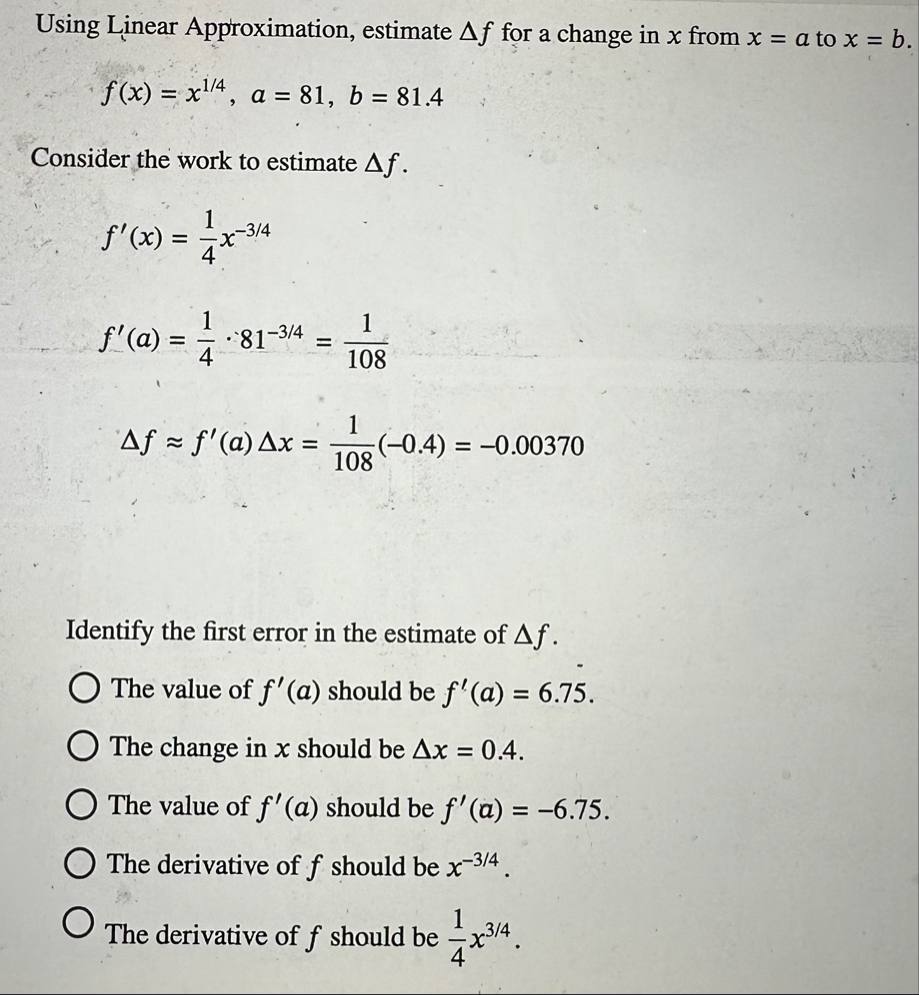
Given the function \( f(x) = x^{1/4} \), we want to estimate the change in \( f \) (denoted as \( \Delta f \)) when \( x \) changes from \( a = 81 \) to \( b = 81.4 \).
The method used is **Linear Approximation**, which approximates the change in the function as:
\[
\Delta f \approx f'(a) \times \Delta x
\]
where \( \Delta x = b - a \).
---
### **Step 1: Find the derivative \( f'(x) \)**
Using the power rule:
\[
f(x) = x^{1/4} \implies f'(x) = \frac{1}{4} x^{(1/4) - 1} = \frac{1}{4} x^{-3/4}
\]
This derivative tells us how the function changes with respect to \( x \).
---
### **Step 2: Calculate \( f'(a) \) at \( a = 81 \)**
Substitute \( a = 81 \):
\[
f'(81) = \frac{1}{4} \times 81^{-3/4}
\]
Now, compute \( 81^{-3/4} \):
- First, find \( 81^{1/4} \): Since \( 3^4 = 81 \), then \( 81^{1/4} = 3 \).
- Then, \( 81^{-3/4} = (81^{1/4})^{-3} = 3^{-3} = \frac{1}{3^3} = \frac{1}{27} \).
So,
\[
f'(81) = \frac{1}{4} \times \frac{1}{27} = \frac{1}{108}
\]
which is approximately \( 0.009259 \).
---
### **Step 3: Determine \( \Delta x \)**
Given \( a = 81 \) and \( b = 81.4 \):
\[
\Delta x = 81.4 - 81 = 0.4
\]
---
### **Step 4: Estimate \( \Delta f \) using Linear Approximation**
Calculate:
\[
\Delta f \approx f'(81) \times \Delta x = \frac{1}{108} \times 0.4
\]
Perform the multiplication:
\[
\frac{1}{108} \times 0.4 = \frac{0.4}{108} \approx 0.0037037
\]
Rounded to five decimal places:
\[
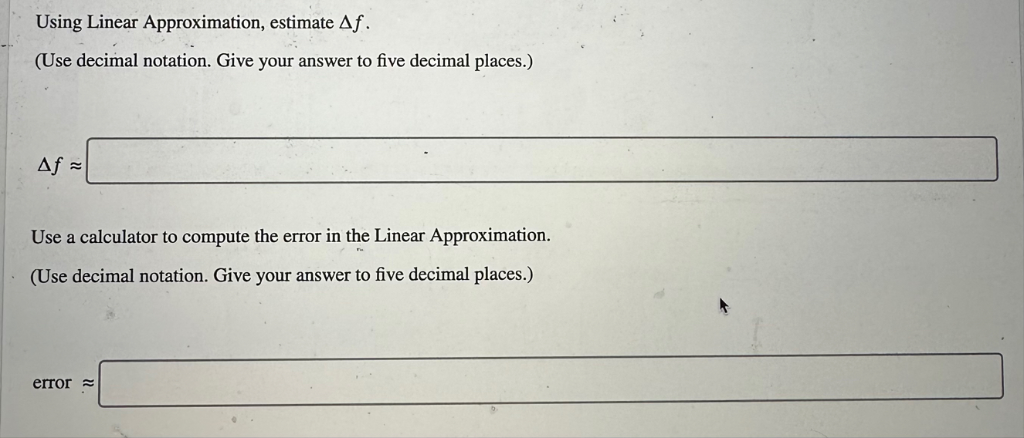
\boxed{\Delta f \approx 0.00370}
\]
---
### **Step 5: Find the actual change \( f(81.4) - f(81) \) and compute the error**
Calculate \( f(81.4) \):
\[
f(81.4) = (81.4)^{1/4}
\]
Using a calculator:
\[
81.4^{1/4} \approx 3.00123
\]
Since \( f(81) = 3 \), the actual change is:
\[
\Delta f_\text{actual} \approx 3.00123 - 3 = 0.00123
\]
**Error in approximation:**
\[
\text{Error} = |\text{Actual} - \text{Approximate}| = |0.00123 - 0.00370| \approx 0.00247
\]
---
### **Summary of the key points:**
- The **estimated change** in \( f \):
\[
\boxed{\Delta f \approx 0.00370}
\]
- The **error** in the linear approximation:
\[
\boxed{\approx 0.00247}
\]
---
### **Identifying the first error in the original estimate:**
From the options:
- **Option 1:** *The value of \( f'(a) \) should be \( 6.75 \).* — **Incorrect**, because \( f'(81) = 1/108 \approx 0.009259 \).
- **Option 2:** *The change in \( x \) should be \( 0.4 \).* — **Correct**, because \( 81.4 - 81 = 0.4 \).
- **Option 3:** *The value of \( f'(a) \) should be \( -6.75 \).* — Incorrect.
- **Option 4:** *The derivative of \( f \) should be \( x^{-3/4} \).* — The derivative is \( \frac{1}{4} x^{-3/4} \), so this is incomplete.
- **Option 5:** *The derivative of \( f \) should be \( \frac{1}{4} x^{3/4} \).* — Incorrect, since the derivative involves a negative exponent.
**Therefore, the first error is that the change in \( x \) was incorrectly taken as \(-0.4\) instead of \( +0.4 \).**
---
### **Final notes:**
- **Estimated change \( \Delta f \):** approximately **0.00370**.
- **Error in the approximation:** approximately **0.00247**.
- **First mistake in the original estimate:** using the wrong sign for \( \Delta x \), i.e., using \(-0.4\) instead of \( +0.4 \).
---
**In words:**
The linear approximation estimates the change in \( f \) as roughly 0.00370 when \( x \) increases from 81 to 81.4. The actual change is about 0.00123, so the approximation slightly overestimates the true change. The main mistake in the original estimate was using a negative change in \( x \) (−0.4) instead of the correct positive change (0.4), which affects the sign and accuracy of the estimate.
VIPSolutions focuses on clear, step‑by‑step explanations so you can learn quickly. Whether you need an AI‑generated walkthrough or a short hint to get unstuck, each solution is organized for fast reading and easy review later.
Search similar questions, compare approaches, and bookmark the best answers for revision. Our goal is simple: quick, reliable study help that feels natural—not noisy.
 VIPSolutions
 Using Linear Approximation, estimate Af for a change in x from x = a to x = b.
fe) =x", a=81, b=814
Consider the work to estimate A, fo : : |
,
: fe) a 1 on
' 4
1 1
re —2/a )
=f) = 8 108
Af = f'(@) Ax = T0509) = —0.00370
Identify the first error in the estimate of Af.
O The value of f’(a) should be f(a) = 6.75.
O The change in x should be Ax = 0.4. |
|
O The value of f(a) should be f'(@) = -6.75.
© The derivative of f should be x4.
1
Ole derivative of f should be 75
£4 Using Linear Approximation, estimate Af. f : $s 4
(Use decimal notation. Give your answer to five decimal places.) % a 3 p
& =
fal BE
Use a calculator to compute the error in the Linear Approximation. Al he
(Use decimal notation. Give your answer to five decimal places.) pti’ oe
Bs - be
- 3 LR
z —