 VIPSolutions
SOLVE IN 2 STEP AND ADD EXPLANATION IN BOTH STEP AND FINAL CONCLUSIONPharoah Company acquired 19000 shares of its common stock at $22 per share on February 5, 2025, and sold 9500 of these shares at: $29 per share on August 9, 2026. The fair value of Pharoah's common stock was $26 per share at December 31, 2025, and $27 per share at December 31, 2026. The cost method is used to record treasury stock transactions. What account{s) should Pharoah credit in 2026 to record the sale of 9500 shares? © Treasury Stock for $209000 and Retained Earnings for $66500. © Treasury Stock for $275500. ; © Treasury Stock for $247000 and Retained Earnings for $28500. © Treasury Stock for $209000 and Paid-in Capital from Treasury Stock for $66500.
Question:
SOLVE IN 2 STEP AND ADD EXPLANATION IN BOTH STEP AND FINAL CONCLUSION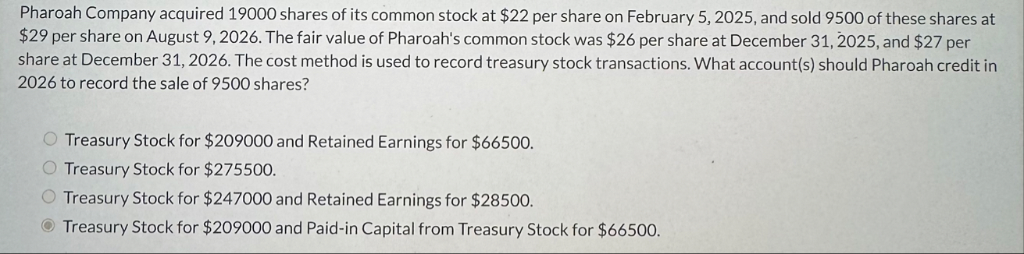 Pharoah Company acquired 19000 shares of its common stock at $22 per share on February 5, 2025, and sold 9500 of these shares at:
$29 per share on August 9, 2026. The fair value of Pharoah's common stock was $26 per share at December 31, 2025, and $27 per
share at December 31, 2026. The cost method is used to record treasury stock transactions. What account{s) should Pharoah credit in
2026 to record the sale of 9500 shares?
© Treasury Stock for $209000 and Retained Earnings for $66500.
© Treasury Stock for $275500. ;
© Treasury Stock for $247000 and Retained Earnings for $28500.
© Treasury Stock for $209000 and Paid-in Capital from Treasury Stock for $66500.
This is AI generated Response.
Asked by: Priyanshu Yadav
Created at: 2025-10-09 12:48:45
Asked by: Priyanshu Yadav
Created at: 2025-10-09 12:48:45
Final Answer:
Rendered
Raw Text
Did you like this answer?
## Step 1: **Calculate the Cost of Treasury Stock Sold**
Pharoah acquired **19,000 shares at $22 per share**.
The company sold **9,500 shares**.
- **Cost per share:** $22
- **Total cost of shares sold:**
\( 9,500 \text{ shares} \times \$22 = \$209,000 \)
**Explanation:**
Under the cost method, the Treasury Stock account is credited for the cost of the shares sold, **not the selling price**.
---
## Step 2: **Calculate Excess Received Over Cost**
- **Selling price per share:** $29
- **Total amount received:**
\( 9,500 \text{ shares} \times \$29 = \$275,500 \)
- **Excess over cost:**
\( \$275,500 - \$209,000 = \$66,500 \)
**Explanation:**
The excess of the selling price over the cost is credited to **Paid-in Capital from Treasury Stock** (not Retained Earnings).
---
## **Final Conclusion**
**Pharoah should credit:**
- Treasury Stock for **$209,000**
- Paid-in Capital from Treasury Stock for **$66,500**
**Correct Answer:**
> Treasury Stock for $209,000 and Paid-in Capital from Treasury Stock for $66,500.
---
### **Summary Table**
| Account | Amount |
|--------------------------------------------|-----------|
| Treasury Stock (cost of shares sold) | $209,000 |
| Paid-in Capital from Treasury Stock (excess)| $66,500 |
📢 Instructions:
- Ask anything relatd to above question only.
- For new Question goto :