 VIPSolutions
give answer in 2 step with explanation at the end of each step and final answer at the end:2 Tilting plane A mass M is fixed at the right-angled vertex where a massless rod of length [ is connected to a very long massless rod . A mass m is free to move frictionlessly along the long rod. The rod of length I is hinged at a support, and the whole system is free to rotate, in the plane of the rods, about the support. Let 0 be the angle of rotation of the system, and let x be the distance between m and M. 1 1 1 1 10 / 1 1 xX m a) Find the equations of motion. b) Find the normal modes when 6 and z are both very small.
Question:
give answer in 2 step with explanation at the end of each step and final answer at the end: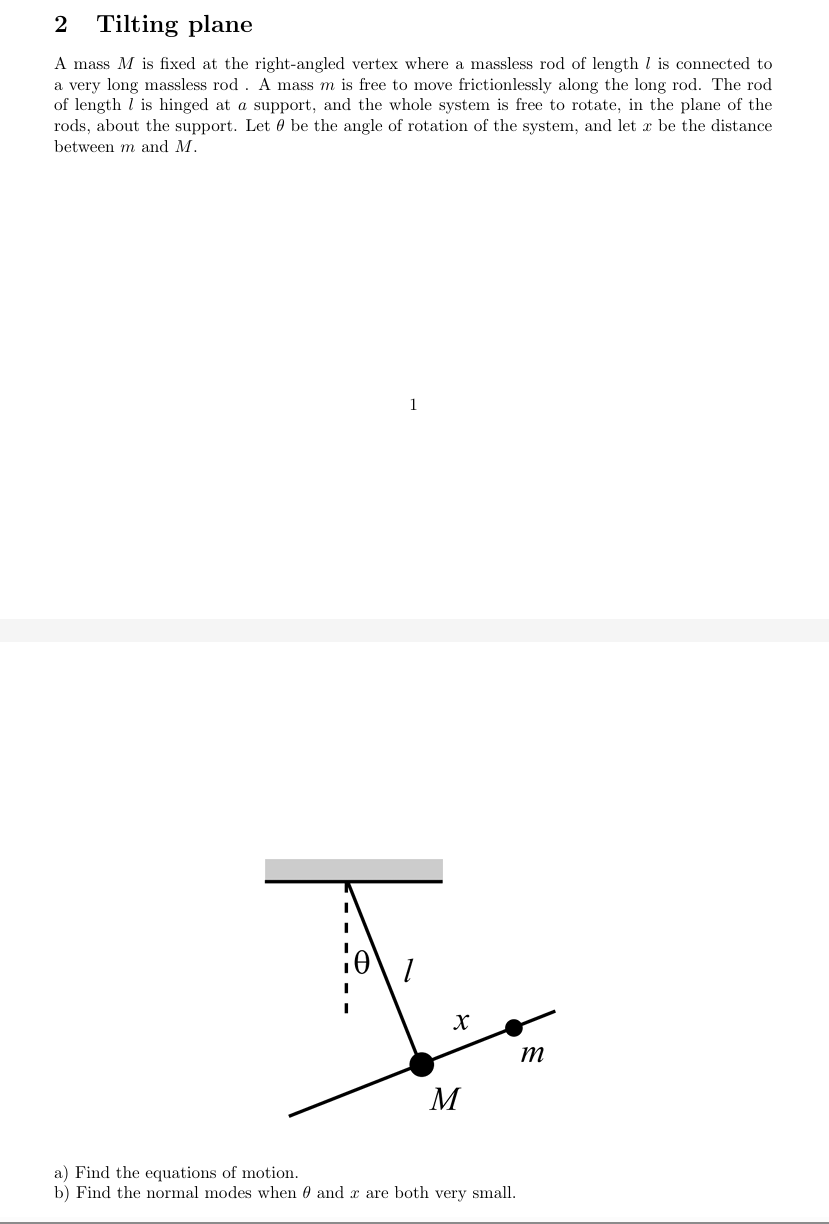 2 Tilting plane
A mass M is fixed at the right-angled vertex where a massless rod of length [ is connected to
a very long massless rod . A mass m is free to move frictionlessly along the long rod. The rod
of length I is hinged at a support, and the whole system is free to rotate, in the plane of the
rods, about the support. Let 0 be the angle of rotation of the system, and let x be the distance
between m and M.
1
1
1
1
10 /
1
1
xX
m
a) Find the equations of motion.
b) Find the normal modes when 6 and z are both very small.
This is AI generated Response.
Asked by: Rahul
Created at: 2025-11-06 03:00:00
Asked by: Rahul
Created at: 2025-11-06 03:00:00
Final Answer:
Rendered
Raw Text
Did you like this answer?
## Step 1: Write the Lagrangian
Let's choose coordinates:
- θ: angle of the rod (with the vertical)
- x: distance between masses \(M\) and \(m\) along thehorizontal) long rod
### Kinetic Energy
- **Mass \(M\)**: Moves in a circle of radius \(l\), so its velocity is \(l\dot{\theta}\).
\[
T_M = \frac{1}{2} M (l\dot{\theta})^2
\]
- **Mass \(m\)**: Its velocity has two components:
- Along the rod: \(\dot{x}\)
- Due to rotation: \((l + x)\dot{\theta}\) (perpendicular to the rod)
\[
T_m = \frac{1}{2} m \left[ \dot{x}^2 + ((l+x)\dot{\theta})^2 \right]
\]
Thus,
\[
T = \frac{1}{2} M l^2 \dot{\theta}^2 + \frac{1}{2} m \left[ \dot{x}^2 + (l + x)^2 \dot{\theta}^2 \right]
\]
### Potential Energy
- **Mass \(M\)**: Height is \(-l\cos\theta\)
\[
V_M = -M g l \cos\theta
\]
- **Mass \(m\)**: Height is \(-(l+x)\cos\theta\)
\[
V_m = -m g (l + x) \cos\theta
\]
So,
\[
V = -M g l \cos\theta - m g (l + x) \cos\theta
\]
### **Lagrangian**
\[
\mathcal{L} = T - V = \frac{1}{2} (M l^2 + m (l + x)^2) \dot{\theta}^2 + \frac{1}{2} m \dot{x}^2 + (M l + m(l + x))g\cos\theta
\]
---
**Explanation:**
We have written the full Lagrangian in terms of the coordinates \(\theta\) and \(x\), accounting for both kinetic and potential energies of the masses.
---
## Step 2: Equations of Motion
Use the Euler-Lagrange equations for both \(x\) and \(\theta\):
### For \(x\):
\[
\frac{d}{dt} \left( \frac{\partial \mathcal{L}}{\partial \dot{x}}\right) - \frac{\partial \mathcal{L}}{\partial x} =
\]
Compute:
- \(\frac{\partial \mathcal{L}}{\partial \dot{x}} = m \dot{x}\)
- \(\frac{d}{dt} (m \dot{x}) = m \ddot{x}\)
- \(\frac{\partial \mathcal{L}}{\partial x} = m (l + x) \dot{\theta}^2 - m g \cos\theta\)
So,
\[
m \ddot{x} - m (l + x) \dot{\theta}^2 + m g \cos\theta =
\]
\[
\boxed{\ddot{x} = (l + x)\dot{\theta}^2 - g\cos\theta}
\]
---
**Explanation:**
We applied the Euler-Lagrange equation to \(x\) to get its equation of motion, which includes coupling to the angular variable \(\theta\).
---
### For \(\theta\):
\[
\frac{d}{dt} \left( \frac{\partial \mathcal{L}}{\partial \dot{\theta}}\right) - \frac{\partial \mathcal{L}}{\partial \theta} =
\]
Compute:
- \(\frac{\partial \mathcal{L}}{\partial \dot{\theta}} = (M l^2 + m (l + x)^2)\dot{\theta}\)
- \(\frac{d}{dt} = (M l^2 + m (l + x)^2)\ddot{\theta} + 2m(l + x)\dot{x}\dot{\theta}\)
- \(\frac{\partial \mathcal{L}}{\partial \theta} = -(M l + m(l + x))g \sin\theta\)
So,
\[
(M l^2 + m (l + x)^2)\ddot{\theta} + 2m(l + x)\dot{x}\dot{\theta} + (M l + m(l + x))g\sin\theta =
\]
---
**Explanation:**
We applied the Euler-Lagrange equation to \(\theta\) to get its equation of motion, which is coupled to both \(x\) and their derivatives.
---
## **Final Answers**
### a) **Equations of Motion:**
\[
\boxed{
\begin{aligned}
&\ddot{x} = (l + x)\dot{\theta}^2 - g\cos\theta \\
&(M l^2 + m (l + x)^2)\ddot{\theta} + 2m(l + x)\dot{x}\dot{\theta} + (M l + m(l + x))g\sin\theta =
\end{aligned}
}
\]
---
### b) **Normal Modes (when \(x\) and \(\theta\) are small)**
When \(x \ll l\), \(\theta \ll 1\):
- \(\sin\theta \approx \theta\), \(\cos\theta \approx 1\)
- \(l + x \approx l\)
Linearize the equations:
1. \(\ddot{x} = l\dot{\theta}^2 - g\)
- But for small \(\dot{\theta}\), \(\dot{\theta}^2 \approx \), so:
\[
\ddot{x} \approx -g\theta
\]
2. \((M l^2 + m l^2)\ddot{\theta} + (M l + m l) g \theta = \)
- Or:
\[
(M + m)l^2\ddot{\theta} + (M + m)l g \theta =
\]
\[
\ddot{\theta} + \frac{g}{l} \theta =
\]
---
**Final Linearized Equations (Normal Modes):**
\[
\boxed{
\begin{aligned}
&\ddot{x} = -g\theta \\
&\ddot{\theta} + \frac{g}{l}\theta =
\end{aligned}
}
\]
---
**Summary:**
- The normal mode for \(\theta\) is a simple pendulum with frequency \(\omega^2 = \frac{g}{l}\).
- The \(x\) coordinate is driven by the tilt \(\theta\). The two are weakly coupled in the small angle/small \(x\) approximation.
Question:
Solve good solution
This is AI generated Response.
Asked by: Rahul
Created at: 2025-11-06 03:01:15
Asked by: Rahul
Created at: 2025-11-06 03:01:15
Final Answer:
Rendered
Raw Text
Did you like this answer?
## Step 1: Write the Lagrangian
Let's define the coordinates for the system:
- **\(\theta\)**: angle of the rod with the vertical
- **\(x\)**: distance along the horizontal rod between masses \(M\) and \(m\)
### Kinetic Energy
1. **For Mass \(M\)**:
- Moves in a circle of radius \(l\); its velocity: \(l\dot{\theta}\).
\[
T_M = \frac{1}{2} M (l\dot{\theta})^2
\]
2. **For Mass \(m\)**:
- Velocity components:
- Along the rod: \(\dot{x}\)
- Due to rotation: \((l + x)\dot{\theta}\) (perpendicular to the rod)
\[
T_m = \frac{1}{2} m \left[ \dot{x}^2 + ((l+x)\dot{\theta})^2 \right]
\]
Combining these:
\[
T = \frac{1}{2} M l^2 \dot{\theta}^2 + \frac{1}{2} m \left[ \dot{x}^2 + (l + x)^2 \dot{\theta}^2 \right]
\]
### Potential Energy
1. **For Mass \(M\)**:
- Height: \(-l\cos\theta\)
\[
V_M = -M g l \cos\theta
\]
2. **For Mass \(m\)**:
- Height: \(-(l+x)\cos\theta\)
\[
V_m = -m g (l + x) \cos\theta
\]
Total potential energy:
\[
V = -M g l \cos\theta - m g (l + x) \cos\theta
\]
### Lagrangian
Combining kinetic and potential energies:
\[
\mathcal{L} = T - V = \frac{1}{2} (M l^2 + m (l + x)^2) \dot{\theta}^2 + \frac{1}{2} m \dot{x}^2 + (M l + m(l + x))g\cos\theta
\]
---
**Explanation:**
The Lagrangian \(\mathcal{L}\) is expressed in terms of the coordinates \(\theta\) and \(x\), capturing the dynamics of both masses through their kinetic and potential energies.
---
## Step 2: Equations of Motion
We will apply the Euler-Lagrange equations for both coordinates \(x\) and \(\theta\).
### For \(x\):
The Euler-Lagrange equation is:
\[
\frac{d}{dt} \left( \frac{\partial \mathcal{L}}{\partial \dot{x}}\right) - \frac{\partial \mathcal{L}}{\partial x} = 0
\]
Calculating the components:
- \(\frac{\partial \mathcal{L}}{\partial \dot{x}} = m \dot{x}\)
- Taking the time derivative:
\(\frac{d}{dt} (m \dot{x}) = m \ddot{x}\)
- \(\frac{\partial \mathcal{L}}{\partial x} = m (l + x) \dot{\theta}^2 - m g \cos\theta\)
Putting it all together:
\[
m \ddot{x} - m (l + x) \dot{\theta}^2 + m g \cos\theta = 0
\]
This simplifies to:
\[
\ddot{x} = (l + x)\dot{\theta}^2 - g\cos\theta
\]
\[
\boxed{\ddot{x} = (l + x)\dot{\theta}^2 - g\cos\theta}
\]
---
**Explanation:**
The equation for \(x\) shows how the motion is influenced by both the angular motion of the rod and gravitational effects.
---
### For \(\theta\):
Using the Euler-Lagrange equation:
\[
\frac{d}{dt} \left( \frac{\partial \mathcal{L}}{\partial \dot{\theta}}\right) - \frac{\partial \mathcal{L}}{\partial \theta} = 0
\]
Calculating:
- \(\frac{\partial \mathcal{L}}{\partial \dot{\theta}} = (M l^2 + m (l + x)^2)\dot{\theta}\)
- Taking the derivative:
\[
\frac{d}{dt} \left((M l^2 + m (l + x)^2)\dot{\theta}\right) = (M l^2 + m (l + x)^2)\ddot{\theta} + 2m(l + x)\dot{x}\dot{\theta}
\]
- \(\frac{\partial \mathcal{L}}{\partial \theta} = -(M l + m(l + x))g \sin\theta\)
Thus, we have:
\[
(M l^2 + m (l + x)^2)\ddot{\theta} + 2m(l + x)\dot{x}\dot{\theta} + (M l + m(l + x))g\sin\theta = 0
\]
---
**Explanation:**
This equation for \(\theta\) indicates that the angular motion is coupled to the linear motion of \(x\) and is influenced by gravity.
---
## **Final Answers**
### a) **Equations of Motion:**
\[
\boxed{
\begin{aligned}
&\ddot{x} = (l + x)\dot{\theta}^2 - g\cos\theta \\
&(M l^2 + m (l + x)^2)\ddot{\theta} + 2m(l + x)\dot{x}\dot{\theta} + (M l + m(l + x))g\sin\theta = 0
\end{aligned}
}
\]
---
### b) **Normal Modes (when \(x\) and \(\theta\) are small)**
For small angles \(x \ll l\) and \(\theta \ll 1\):
1. Approximating \(\sin\theta \approx \theta\) and \(\cos\theta \approx 1\):
- The equations simplify to:
- For \(x\):
\[
\ddot{x} = -g\theta
\]
2. For \(\theta\):
\[
(M + m)l^2\ddot{\theta} + (M + m)g \theta = 0
\]
---
**Final Linearized Equations (Normal Modes):**
\[
\boxed{
\begin{aligned}
&\ddot{x} = -g\theta \\
&\ddot{\theta} + \frac{g}{l}\theta = 0
\end{aligned}
}
\]
---
**Summary:**
- The normal mode for \(\theta\) behaves like a simple pendulum with a frequency \(\omega^2 = \frac{g}{l}\).
- The motion of \(x\) is driven by the angle \(\theta\), revealing a coupled system in small-angle approximation.
📢 Instructions:
- Ask anything relatd to above question only.
- For new Question goto :