 VIPSolutions
Solve correct optionpens | = a 7 BIE oc woo suv rv ing Speed ise : By - a. : cc < : a... E © @ ©
Question:
Solve correct option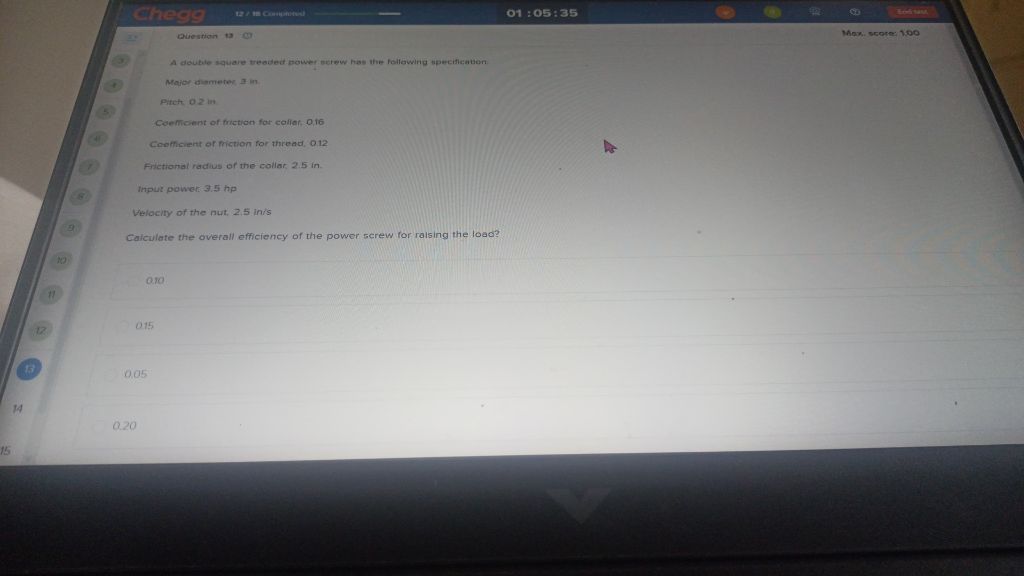 pens |
= a
7 BIE oc woo suv rv ing Speed ise
: By -
a. :
cc < :
a... E
©
@
©
This is AI generated Response.
Asked by: Raju
Created at: 2025-10-28 12:11:32
Asked by: Raju
Created at: 2025-10-28 12:11:32
Final Answer:
Rendered
Raw Text
Did you like this answer?
Let's break down the information given and solve for the overall efficiency of the power screw.
## **Given Data**
- Major diameter, \( d = 3 \) in
- Pitch, \( p = .2 \) in
- Coefficient of friction for collar, \( f_c = .16 \)
- Coefficient of friction for thread, \( f_t = .12 \)
- Frictional radius of collar, \( r_c = 2.5 \) in
- Input power, \( P_{in} = 3.5 \) hp
- Velocity of nut, \( v = 2.5 \) in/s
Let's convert input power to watts:
\[ 1 \text{ hp} = 746 \text{ W} \]
\[ P_{in} = 3.5 \times 746 = 2611 \text{ W} \]
## **Step 1: Output Power**
Output power is the work done in raising the load:
\[
P_{out} = \text{Load} \times \text{velocity}
\]
But the load is not given directly. Let's express efficiency in terms of available data.
## **Step 2: Efficiency Formula**
Efficiency (\(\eta\)) is:
\[
\eta = \frac{\text{Output Power}}{\text{Input Power}}
\]
### **Output Power**
\[
P_{out} = F \times v
\]
Where \( F \) is the axial load.
### **Input Power**
Input power is calculated using torque and angular velocity:
\[
P_{in} = T \cdot \omega
\]
Where \( T \) is the total torque required to raise the load and \( \omega \) is the angular speed.
### **Torque Required for Power Screw (with Collar Friction):**
For a double square threaded screw:
\[
T = F \left[ \frac{d_m}{2} \cdot \frac{\tan \lambda + f_t}{1 - f_t \tan \lambda} + f_c r_c \right]
\]
Where:
- \( d_m \) = mean diameter = major diameter - (pitch/2) (since it's square threaded)
- \( \tan \lambda = \frac{\text{lead}}{\pi d_m} \)
- For double thread, **lead = 2 × pitch**
#### Calculate terms:
- Pitch = .2 in, so lead = .4 in
- \( d_m = 3 - .2/2 = 2.9 \) in
\[
\tan \lambda = \frac{.4}{\pi \times 2.9} = \frac{.4}{9.11} \approx .044
\]
Now, plug values into torque equation:
\[
T = F \left[ \frac{2.9}{2} \cdot \frac{.044 + .12}{1 - .12 \times .044} + .16 \times 2.5 \right]
\]
Calculate denominator:
\[
1 - .12 \times .044 = 1 - .00528 = .99472
\]
Numerator:
\[
.044 + .12 = .164
\]
So,
\[
\frac{.164}{.99472} = .16498
\]
\[
\frac{2.9}{2} = 1.45
\]
\[
1.45 \times .16498 = .239
\]
\[
.16 \times 2.5 = .4
\]
\[
T = F (.239 + .4) = F \times .639
\]
### **Angular Speed (\(\omega\)):**
\[
\text{Lead} = .4 \text{ in/rev}
\]
\[
\text{Velocity} = 2.5 \text{ in/s}
\]
So,
\[
\text{Revolutions per second} = \frac{2.5}{.4} = 6.25 \text{ rev/s}
\]
\[
\omega = 2\pi \times 6.25 = 39.27 \text{ rad/s}
\]
### **Input Power:**
\[
P_{in} = T \cdot \omega = .639F \times 39.27 = 25.09F
\]
### **Output Power:**
\[
P_{out} = F \times 2.5
\]
### **Efficiency:**
\[
\eta = \frac{P_{out}}{P_{in}} = \frac{F \times 2.5}{25.09F} = \frac{2.5}{25.09} = .0996 \approx .10
\]
---
## **Final Answer**
### **The correct option is:**
\[
\boxed{.10}
\]
📢 Instructions:
- Ask anything relatd to above question only.
- For new Question goto :