 VIPSolutions
Solve correct optionad 3 [ a=§inds 6 7 a=107rd§* 8 9 a=%0nds’ 0 0 PERT pe == = = - --— = = =F - == Lc = = = = == = £ S0kN s 0 FO 3; Oi N .
Question:
Solve correct option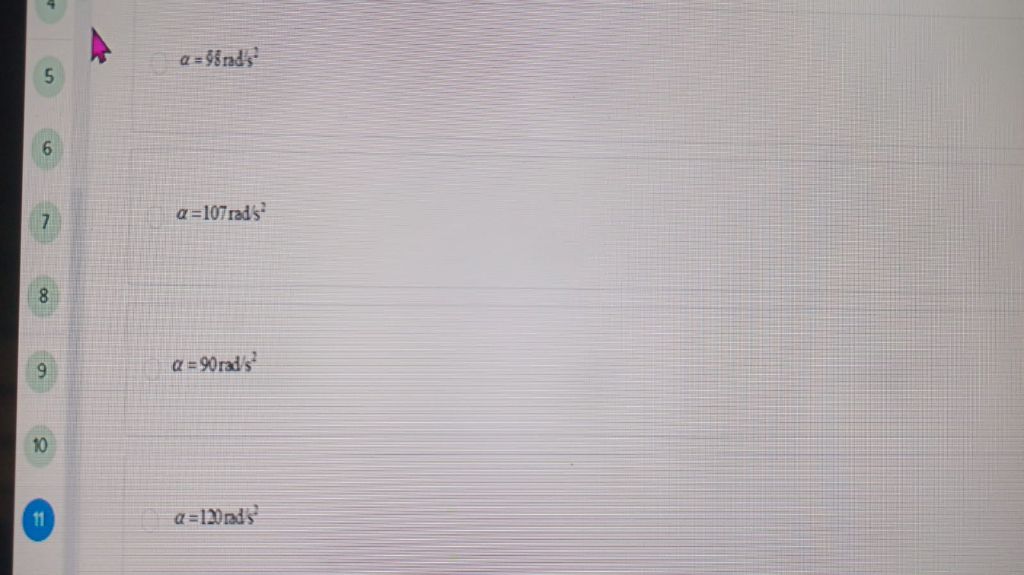
 ad
3 [ a=§inds
6
7 a=107rd§*
8
9 a=%0nds’
0
0 PERT
pe ==
= = - --— =
= =F -
== Lc =
= = =
== =
£ S0kN
s 0 FO 3; Oi
N
.
This is AI generated Response.
Asked by: Sanjay hipparakar
Created at: 2025-09-18 13:28:18
Asked by: Sanjay hipparakar
Created at: 2025-09-18 13:28:18
Final Answer:
Rendered
Raw Text
Did you like this answer?
Let's **solve Question 11** from the second image:
### Problem Recap
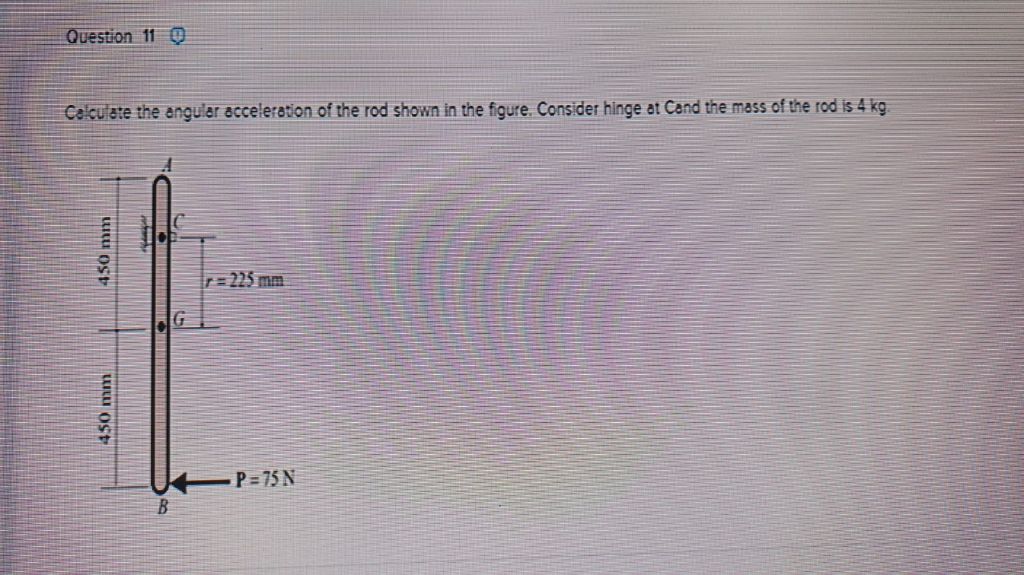
> **Calculate the angular acceleration of the rod shown in the figure. Consider hinge at C and the mass of the rod is 4 kg.**
- **Rod length:** \( 450\,\text{mm} + 450\,\text{mm} = 900\,\text{mm} = 0.9\,\text{m} \)
- **Force at B:** \( P = 75\,\text{N} \)
- **Distance from C to B:** \( r = 225\,\text{mm} = 0.225\,\text{m} \)
- **Hinge at C**
- **Mass:** \( m = 4\,\text{kg} \)
### Step 1: Calculate Moment of Inertia about C
Rod of length \( L \), mass \( m \), and axis at distance \( r \) from center:
\[
I_C = I_G + m r^2
\]
where
- \( I_G = \frac{1}{12} m L^2 \) (about the center)
- \( r = 0.225\,\text{m} \) (distance from C to G, which is at center: \( 0.45\,\text{m} \) from C; but diagram shows \( r = 0.225\,\text{m} \))
- Actually, C is 0.225 m from G (since total length is 0.9 m, so center is at 0.45 m; C is at 0.225 m from top, so from G: \(0.45 - 0.225 = 0.225 \) m)
So,
\[
I_C = \frac{1}{12} m L^2 + m r^2
\]
\[
= \frac{1}{12} \times 4 \times (0.9)^2 + 4 \times (0.225)^2
\]
\[
= \frac{1}{12} \times 4 \times 0.81 + 4 \times 0.050625
\]
\[
= \frac{4 \times 0.81}{12} + 0.2025
\]
\[
= \frac{3.24}{12} + 0.2025
\]
\[
= 0.27 + 0.2025 = 0.4725\,\text{kg}\cdot\text{m}^2
\]
---
### Step 2: Compute Torque about C
Torque, \( \tau = F \cdot d \), where \( d \) is perpendicular distance from C to B.
From C to B is:
- From C to A: 0.225 m up
- From C to G: 0.225 m down
- From G to B: 0.45 m down
- So total from C to B = 0.225 + 0.45 = 0.675 m
But diagram shows C is 0.225 m from one end, so from C to B: \( 0.9 - 0.225 = 0.675 \) m
\[
\tau = 75\,\text{N} \times 0.675\,\text{m} = 50.625\,\text{N}\cdot\text{m}
\]
---
### Step 3: Angular Acceleration
\[
\tau = I_C \alpha \implies \alpha = \frac{\tau}{I_C}
\]
\[
\alpha = \frac{50.625}{0.4725} \approx 107.2\,\text{rad/s}^2
\]
---
### Step 4: Compare with Options
From the options in the first image:
- \( \alpha = 98\,\text{rad/s}^2 \)
- \( \alpha = 107\,\text{rad/s}^2 \) **← CLOSEST**
- \( \alpha = 90\,\text{rad/s}^2 \)
- \( \alpha = 120\,\text{rad/s}^2 \)
**Correct Option:**
\[
\boxed{\alpha = 107\,\text{rad/s}^2}
\]
📢 Instructions:
- Ask anything relatd to above question only.
- For new Question goto :